.png)

Network engineers are increasingly adopting Python libraries to automate device management, configuration, and monitoring.
Tools like Nornir, Netmiko, and NAPALM are helping professionals streamline multi-vendor network operations efficiently.
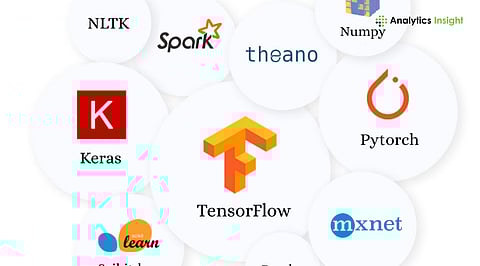
Libraries supporting data processing and AI, such as Pandas, NumPy, and TensorFlow, are enhancing analytics and predictive maintenance capabilities.
Python is one of the most versatile programming languages with a wide range of applications such as data analysis and network automation. Python libraries help developers and engineers accomplish the most complicated tasks smoothly, reducing manual effort and increasing productivity. Professionals working with modern technology need to learn these libraries.
Within Python's massive library, there are certain crucial tools for specific areas such as network automation, data science, and machine learning. Understanding these tools is the groundwork for achieving the full potential of Python in real-world applications.
Nornir is an automation framework built using Python for network engineers. It is a basic tool for performing parallel executions, managing inventory, and integrating with utilities such as Netmiko and Napalm. Nornir runs natively in Python, thus enabling simple yet powerful scripting without depending on heavy external engines.
Its modular structure is the reason why it can be used in large network automation workloads in big enterprises.
NumPy is the core Python library for numerically computing, providing powerful support for multidimensional arrays and matrices. It is able to offer extremely fast mathematical processing through its C implementations.
NumPy allows data manipulation, which is one of the most important aspects of scientific computing, machine learning, and data analysis. The library's wide Ecosystem integration makes it a foundation for libraries like Pandas, SciPy, and TensorFlow.
NAPALM is a Python-based library that allows automating and controlling unified network device management across multiple vendors. It gives a uniform API that allows for safely pushing configurations, managing interfaces, etc. The library has compatibility for vendors such as Cisco, Juniper, and Arista, which altogether make it easier to operate with multiple vendors.
Moreover, its built-in validation and comparison features help reliable and predictable network automation workflows.
Pandas is a Python library that provides fast and versatile data analysis, offering strong data structures such as Series and DataFrame. It simplifies data cleaning, transforming, and aggregating.
The library uses its efficient indexing and alignment features to process large datasets. Its collaboration with NumPy and other data tools is a must for the analytics and machine learning workflows.
Netmiko is a Python library that simplifies SSH-based network automation by providing easy-to-use interfaces for connecting to a wide range of network devices. It supports dozens of vendors and abstracts low-level SSH complexities to speed up scripting. The library allows to perform reliable session management along with configuration changes, command execution and device validation.
Stability and vendor coverage are key factors that make it a preferred choice among network engineers to automate their daily operations.
TensorFlow is an open-source Python library developed by Google for machine learning and deep learning applications. The library is packed with features for constructing and training neural networks, supporting both CPU and GPU acceleration. TensorFlow is known for its high-level APIs like Keras, which provide user-friendly model setup and low-level operations for advanced personalizations.
In the field of research and production, TensorFlow has been the tool of choice for various applications such as image recognition, natural language processing, and predictive analytics.
TextFSM is a Python library for parsing and structuring text data, commonly from command‑line outputs of network devices. It utilizes template files and regular expressions to extract significant data in the form of structured formats, like lists or dictionaries.
As a result, the automation of network inventory, configuration audits, and reporting becomes a lot easier. TextFSM is not heavy, does not depend on vendors, and is frequently integrated with libraries such as Netmiko for network automation workflow.
Keras is a high-level Python library that helps create and train neural networks for simplified and easy experimentation. It has an easy-to-use API that is built on TensorFlow, making the process of creating, evaluating and deploying models easier.
In addition to deep learning, Keras also accepts standard machine learning practices such as CNNs, RNNs and transfer learning. Its ease of use has made Keras a favorite among both researchers and developers for quick AI model prototyping.
PyTorch, the open-source Python library for deep learning, is the most common tool for the construction and training of neural networks. It allows users to create dynamic computation graphs, which makes the model development and debugging process more intuitive and flexible.
On top of that, the library offers GPU support, which significantly speeds up the training process for large datasets and complex models. PyTorch is the most common framework in the research and production areas like image recognition, NLP, and RL.
Pydantic is a Python library for data validation and settings management using Python type annotations. The system guarantees that data meets the defined types and formats, raising clear errors when validation fails. The library is widely used in web development and API design, especially in combination with frameworks such as FastAPI.
Furthermore, its combination of type safety, performance, and user-friendliness makes it suitable for creating dependable, data-driven applications.
Also Read: Top 10 Hidden Python Libraries to Boost Your Data Skills
Python libraries are essential tools to simplify complex tasks in areas such as network automation, data analysis, and AI. Learning these libraries will not only increase efficiency but will also allow experts to create robust and scalable solutions with confidence.
These libraries, when compared with previous workflows, have reduced the need for human input, thereby increasing the accuracy level and extending their use to more complex and diverse vendor networks. Adopting them is now crucial for engineers who want to optimize performance, ensure reliability, and stay ahead in an evolving digital sector.
1. Which Python library is commonly used for network automation tasks?
Some popular libraries include Netmiko, NAPALM, and Ansible. Time-Saving: Automating network tasks with Python can save you significant time.
2. What is the difference between Plotly and NetworkX?
NetworkX is a powerful Python library for creating, manipulating, and analyzing complex networks, while Plotly is a versatile library for building interactive and visually appealing visualizations.
3. Is Python needed for CCNA?
It plays an essential role in the CCNA course. Python is the most widely used language during software development. It is a significant and critical language for a network engineer. People often wonder about the role of Python in the CCNA course.
4. What is the best Python network graph library?
PyG is a library built upon PyTorch to easily write and train Graph Neural Networks for a wide range of applications related to structured data. PyG is both friendly to machine learning researchers and first-time users of machine learning toolkits.
5. Which Python library is best for deep learning?
Developed by Google, TensorFlow is one of the most powerful AI/ML libraries. It's designed for deep learning, large-scale AI models, and real-time applications.
