.png)

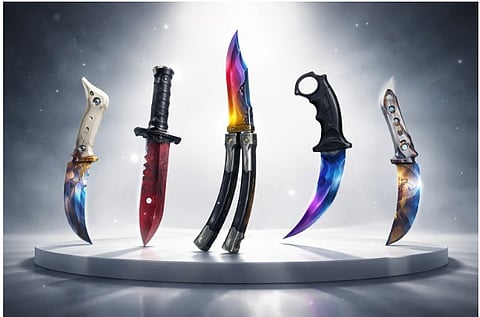
The air in a competitive lobby is always a bit different when there’s a high-tier blade involved. You know the feeling. You’re sitting in freeze time, the countdown is ticking, and the teammate next to you starts that rhythmic, clicking dance—the frantic, metallic butterfly-knife-flip or the subtle, deadly rotation of a Karambit. It’s not just about the money, though let’s be honest, the money is a huge part of the flex. It’s about the soul of the game. Counter-Strike has always been more than just a tactical shooter; it’s a theater of pixels and prestige. When we talk about the transition from CS:GO to CS2, we aren't just talking about smoke physics or sub-tick rates. We are talking about how our digital steel looks under the new sun. Whether you are hunting for a specific Butterfly Knife Fade or just keeping a pulse on the general cs2 knife market, the goal remains the same: finding that one animation that makes every frag feel like a movie.
There is a specific kind of weight that comes with an iconic finish. It’s the difference between a simple elimination and a statement. Over the last decade, certain animations have become synonymous with legendary clutches and heartbreaking whiffs. We’ve watched pros like s1mple or NiKo tilt the world by simply hitting the inspect key at the wrong time—or the perfectly right time. This is the history of the steel that defined an era.
If you were around in 2013 when the Arms Deal update first dropped, you remember the collective gasp the community took. Before then, a knife was just a tool of last resort, a way to run faster. Then came the Karambit. It changed the geometry of the player model's hand. That curved, predatory blade held in a reverse grip felt less like a tool and more like a weapon from a high-budget action flick. It wasn't just a new skin; it was a total shift in how we viewed our loadouts.
The Karambit is arguably the most successful cs2 knife in terms of pure longevity. Why? Because of the spin. There is something hypnotic about the way the character model loops the blade around their index finger. It’s a nervous habit for millions of players. You’ll see a pro player holding an angle on A-site Mirage, and the moment the utility clears, they swap to the Karambit for a split second just to see that rotation. It’s a reset for the brain, a way to keep the fingers twitching and ready for the next peak.
In the competitive circuit, the Karambit Doppler—specifically the Ruby and Sapphire phases—became the ultimate status symbols. In CS2, these finishes have been elevated to a point that’s almost blinding. The new lighting engine treats the metallic surfaces of Market CSGO items with a level of realism we never had in the old engine. When you see a Karambit Fade or a Doppler under the bright lights of Overpass, it doesn't just look like a skin; it looks like jewelry. It’s the "OG" king of the competitive scene, and it isn’t giving up the throne anytime soon. The way the light catches the edge during a draw animation is enough to make any spectator pause.
If the Karambit is the king, the Butterfly Knife is the jester that actually runs the kingdom. It wasn't part of the original lineup, arriving later in the Operation Breakout update, but it quickly became the most sought-after item in the entire game. The animation is why. It’s chaotic, loud, and incredibly complex. Most other knives have one or two inspect animations; the Butterfly Knife has a whole repertoire of flips, catches, and clicks. It’s the ultimate fidget toy for someone with too much adrenaline.
In a high-stakes pro match, the Butterfly Knife serves a psychological purpose. It’s distracting, yes, but it also keeps the hands warm. Watching a player like m0NESY flick between his AWP and his Butterfly Knife is like watching a world-class pianist. It’s a rhythm. The "Butterfly Knife flip" is the most recognizable sound in a competitive match besides the AK-47’s bark. It’s a taunt without words.
People who browse the cs2 knife market often find themselves torn between the Karambit’s elegance and the Butterfly’s kinetic energy. But when you see a Marble Fade or a Tiger Tooth on a Butterfly, the way the light dances off the moving parts during the animation is incomparable. It’s the ultimate "look at me" weapon. It’s the skin you buy when you know you have the mechanical skill to back up the flashiness. It tells the lobby you aren't just here to win—you're here to put on a show.
While the flashier blades get the headlines, the M9 Bayonet has always been the "player’s knife." It’s large, it’s rugged, and it has an animation that feels heavy. When you pull out an M9, there’s a satisfying "thud" to the sound, and the way the character model thrusts it forward feels purposeful. It doesn't need to spin to get your attention; its sheer size and the way it dominates the screen do that for it.
For many legendary pros, the M9 Bayonet is the only choice. It offers the largest surface area for cs2 knife skins, meaning patterns like the Crimson Web or the Lore look significantly more detailed here than on a smaller blade. There’s no spinning, no fancy finger-work—just a solid, professional draw. It’s the knife for the guy who carries the bomb, anchors the site, and doesn't miss.
In the transition to CS2, the M9 Bayonet took on a new life. The serrated edge along the spine of the blade catches the light in a way that feels incredibly tactile. When you’re looking at Market CSGO skins for the M9, you’re looking for something that commands respect. It’s the knife of a rifler who doesn't need to show off because their headshot percentage does it for them. It’s the blade of a veteran. It’s the kind of steel that feels like it has weight when you swing it.
For a long time, the Karambit had no rivals in the curved-blade department. Then the Talon Knife showed up. At first, people called it the "budget Karambit," but that label didn't last long. The Talon has its own personality. The handle is ivory-white by default, and the blade features those distinct circular cutouts. It feels a bit more "street" and a bit more aggressive.
But the real reason it carved out a spot in competitive history is the infinite inspect animation. If you hold the inspect key, your character will spin the Talon indefinitely. It became an instant favorite for streamers and pro players who wanted to add a bit of flair to their movement during long rotates. The sound is different, too—sharper, more mechanical. It lacks the smooth "whoosh" of the Karambit, replacing it with a rhythmic clicking that is strangely addictive.
When you look at the Talon Knife in CS2, the difference in the "Case Hardened" finishes is staggering. The way the blue gems reflect the environment makes it one of the most visually stunning Market CSGO items you can own. It’s a knife that rewards those who like to stay in motion, providing a constant visual loop that keeps the momentum going. It’s for the player who never wants to stop moving, even when there’s no one in sight.
The Skeleton Knife is a relatively recent addition compared to the classics, but it skipped the line to become an icon almost immediately. It’s minimalist—a single piece of steel with a hole in the center. Its popularity in the pro scene exploded because of its rare draw animation where the character model spins the knife around their finger by the central hole. It’s a "blink and you’ll miss it" moment of cool.
It’s less "look at this expensive thing I have" and more "I am an expert with this tool." The Skeleton Knife doesn't have the bulk of the M9 or the clatter of the Butterfly, but it has a sleekness that fits the modern CS2 aesthetic perfectly. Seeing a Skeleton Knife Fade in a high-definition CS2 match is a reminder of how far the game’s visual fidelity has come. It’s a clean, sharp, and lethal-looking bit of kit that appeals to the "minimalist" elite. It’s the weapon of a silent assassin.
We can't talk about animations without talking about the finishes themselves. The move to the Source 2 engine was a massive gamble for the skin economy. People were worried their beloved pixels would look worse. Instead, the opposite happened. The "Doppler" effect became truly translucent. "Fade" patterns started to glow with an internal light. The shaders handled the metallic surfaces with such grace that even lower-tier cs2 knife skins started looking like they belonged on a pro stage.
The cs2 knife market reacted predictably—prices shifted as people realized that certain skins, like the Doppler Phase 2 or the Gamma Doppler, looked like they were pulsing with energy. The "finish" is the coat of paint on the car, but the "animation" is the engine. You need both to have a classic. A Sapphire finish is great, but a Sapphire Karambit with that signature spin? That’s legendary status. It’s the pinnacle of digital collecting.
Think about the most iconic kills in CS history. Often, they are followed by a quick-switch to a knife. That quick-switch isn't just a habit; it’s a celebration. It’s the "taunt" of the Counter-Strike world. When a pro pulls out a high-tier blade after a 1v4 clutch, they aren't just resetting their movement speed. They are taking a victory lap in front of hundreds of thousands of viewers. It’s a way of saying "I'm still here, and I'm better than you."
It’s easy for outsiders to look at the prices of these items and scoff. But for those of us who have spent thousands of hours in the server, these aren't just "items." They are milestones. You remember the first "good" knife you traded for. You remember the time you saw a rare pattern in a random matchmaking game. These things have history. They have weight.
Market CSGO skins have created a subculture within the gaming world that is part stock market, part art gallery, and part trophy room. The animations are the heartbeat of that culture. If the knives just sat there static in the hand, they wouldn't have half the value they do now. The fact that they move, that they have "personality," is what makes them iconic. It’s why we care so much about the frame data of an inspect animation.
Whether it's the classic flip of a Flip Knife or the heavy pull of a Bowie, these animations are baked into the muscle memory of the community. We know the sounds. We know the timings. We know exactly how many frames it takes for the blade to be "ready" after a swap. It’s a secret language that every veteran player speaks fluently.
As CS2 continues to evolve, we will likely see new knives and new animations. But the "Big Three"—the Karambit, the Butterfly, and the M9 Bayonet—have already secured their place in the hall of fame. They are the weapons that defined the careers of legends. They are the pixels we dream of when we load into a match.
The next time you’re watching a Major and you see a player clutching with nothing but a P250 and a dream, watch what happens after the smoke clears. Watch the hand movement. The frantic spin of a cs2 knife isn't just a nervous tic—it’s the signature of a player who knows they’ve just made history. And in the world of Counter-Strike, history is always written in steel and shadow, reflected off a perfectly polished blade.
Whether you’re a collector, a pro, or just someone who likes to look good while losing a rank-up game, the importance of these animations cannot be overstated. They are the soul of the game, the flair in the fire, and the reason we keep coming back to the server, one inspect-click at a time. It’s not just a game; it’s an art form.
