.png)

In the past, screen repair simply required replacing the entire screen. However, today, more and more devices are experiencing issues such as OLED indentations, LCD delamination and bubbling, or the need for secondary lamination after screen refurbishment. Simply replacing the screen is no longer sufficient to meet repair needs.
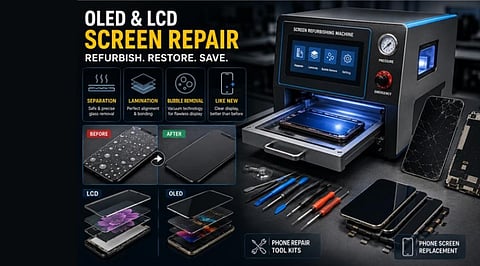
These types of repairs rely more on specialized screen refurbishing machines. Through processes such as separation, lamination, and bubble removal, they achieve stable and repeatable screen repairs.
This article will introduce the actual working principles of new screen refurbishing technologies, the differences between LCD and OLED refurbishment, and analyze the improvements in cost, efficiency, and business capabilities that repair shops experience after equipping themselves with refurbishment equipment.
The profitability of a screen job in most repair shops is calculated as compared to the replacement panel cost and labor. That calculation is not based on a large revenue stream: screens that do not require a full replacement but cannot be returned to a customer in such a condition.
A panel with a small defect in lamination, the distant residue of adhesive to be seen under the glass, or an agglomerate of bubbles somewhere at the corner does not constitute a dead screen. It is a television that should be refurbished by him/her. In a shop that does not have a machine that can do that job, the shop will risk paying the cost of full replacement to the machine that is not needed, or give a low-quality repair that could hurt its reputation.
A Screen Refurbishing Machine is one with inbuilt laminating, separating, and pop removal features that transform calculations. Write-offs (panels) are now reclaimable. Jobs that were in need of a complete replacement are changed to refurbishment jobs at a fraction of the cost.
Before refurbishing a screen, it's crucial to understand the differences between LCD and OLED screens, as their responses to temperature, pressure, and adhesives are completely different.
LCD screens have a relatively stable structure. The OCA adhesive is softened by heating, and then bonding and debubbling are completed using vacuum and pressure. Therefore, refurbishment is less difficult and has a higher tolerance for errors.
OLED screens, however, are more sensitive. Their organic light-emitting layer cannot withstand high temperatures. Directly applying LCD refurbishment processes can easily lead to screen burn-in or panel damage. Therefore, OLED refurbishment requires lower temperatures, shorter processing times, and more precise pressure control.
This is also the key value of professional LCD/OLED refurbishing machines: they can adjust temperature and pressure parameters according to different screen types, allowing the same machine to safely refurbish and repair both types of screens.
Screen refurbishing machines are not just single devices, but a complete screen repair process, including key steps such as separation, adhesive removal, lamination, and bubble removal.
Separation: By precisely heating and softening the adhesive layer between the glass and the screen, broken glass is safely separated, preventing damage to the panel or touch layer.
Cleaning and adhesive removal: After screen separation, residual OCA adhesive must be thoroughly removed. Incomplete cleaning can easily lead to smudges, bubbles, or uneven display after refurbishment.
Vacuum lamination: The new glass and screen are placed in a vacuum environment, and bonding is achieved through pressure and heat, while preventing air from entering and creating bubbles.
Bubble removal (autoclave operation): Even after lamination, tiny bubbles may remain. Therefore, high-pressure bubble removal is required to achieve a transparent, bubble-free screen.
The entire refurbishment process requires extremely high precision in temperature, pressure, and time control. Professional refurbishing machines, through programmable and automated control, reduce human error and ensure consistent repair results every time.
Stores that have a screen refurbishing machine also increase their service provision in three distinct directions.
Lower-cost tele repair services: Not all customers will be willing to spend on an OEM screen panel. Giving customers an option to choose a lower cost that does not compromise on the quality of the product is the provision of a refurbished original screen that is professionally separated, cleaned, and re-laminated. It is of particular applicability to older flagship devices with OEM panels of a premium price.
Wholesale and resale screen preparation: Shops that buy screens in bulk to resell or re-repair often receive panels requiring lamination work to be made to retail standards. Those panels are refurbished in-house using a refurbishing machine, without outsourcing.
Premium repair positioning: A shop that offers full-screen refurbishment, such as removing bubbles and re-lamination, positions itself in a different light than a shop that has an option, but does not offer full-screen refurbishment. Careful customers, who not only care about the display of their gadgets but also demand that their display is of high quality, will use the shop that will restore the displays of their gadgets, not only restore, but also upgrade the displays as well.
All these three directions are linked with profitability. A greater range of service choices at various prices, reduced wastage of unused panels and improved positioning to value more highly, which underpins higher pricing.
A refurbishing machine handles the lamination and separation work, but two other components complete a professional screen repair operation.
Phone Screen Replacement panels that meet quality standards give you reliable inputs for the refurbishment process. The quality of the panel going into the lamination machine directly affects the quality of the output. Starting with a consistent panel eliminates variables that make troubleshooting difficult.
Phone Repair Tool Kits for disassembly and reassembly work around the screen repair complete the workflow. Proper spudgers, suction tools, and adhesive strips designed for specific phone models prevent damage during the open and close process that a laminating machine cannot compensate for.
Together, a quality refurbishing machine, reliable replacement panels, and proper disassembly tools create a screen repair workflow that produces consistent, professional results from start to finish.
Screen refurbishment technology is no longer just a high-end repair service. For repair shops dealing with OLED devices, handling large volumes of screens, or looking to reduce costs through screen recycling, it has become a core repair capability. Screen refurbishment machines can reliably complete processes that are difficult to control precisely by hand. Combined with high-quality screens and professional phone repair tool kits, repair shops can establish a more complete screen repair system, not only improving repair quality but also increasing customer trust and business value.
