.png)

Real-time insights and self-service analytics have become critical for survival in a rapidly evolving data landscape. Organizations are grappling with growing complexity; wrapped in a maze of siloed systems, inconsistent metrics, and unclear data ownership. The struggle to balance centralized governance with the need for agility is only intensifying. In response to these mounting challenges, a new model is gaining traction: federated data ownership. This approach is quietly but fundamentally reshaping how enterprises manage their data and empower teams across domains.
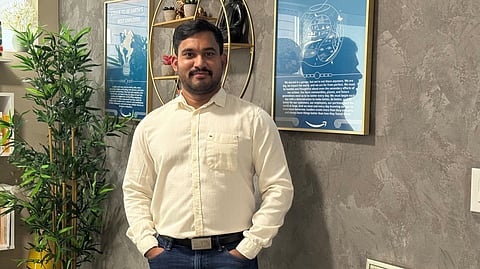
One of the key voices advancing this shift is data thought leader Dinesh Thangaraju. A researcher and practitioner in the data governance and architecture space, he has been championing a paradigm where ownership, automation, and trust converge to fuel scalable innovation. His work is not just theoretical; it’s deeply rooted in real-world implementation, influencing large organizations seeking to harmonize fragmented data landscapes. Through a series of widely cited papers, he has defined what it means to enable truly federated data ecosystems.
At the core of his work is the belief that data should be owned where it’s best understood. In mainstream models, data teams tended to play a gatekeeper role, slowing innovation and confusing business interpretation. He notes that decentralized organizations, with their flatter and more distributed decision-making architectures, present special challenges in establishing distinct data governance roles. Instead of reenacting central controls, he emphasizes the importance of federated governance, wherein domain-level ownership is coupled with coordinated oversight.
This transition, he says, changes the way data moves and is relied upon within and between organizations. “Developing a federated governance model with a central oversight committee and delegated local governance teams helps establish clear escalation pathways and decision-making frameworks,” he states. It’s a call to balance autonomy with accountability; a message that’s finding resonance across industries, from retail to logistics.
One of his most referenced ideas is the principle of “automate once, use everywhere.” Dinesh explains that automation not only reduces manual workload but also becomes a key enabler of trust. “It improves efficiency and enhances the reliability and trustworthiness of the data-driven insights,” he says.
This philosophy has seen real-world impact. For example, consider the critical business driver of revenue. Through the data federation model, organizations can resolve conflicting definitions of revenue and cost related metrics. By automating metric calculations and aligning data ownership between finance and sales, they can achieve clarity that had long been elusive. “The organization can generate a standardized revenue metric that is consistently applied across all business units,” he explains.
This led to the establishment of a unified source of truth that enabled all teams to operate with greater alignment and confidence.
Another critical insight he offers is a reimagining of the data catalog, not as a passive inventory but as a dynamic, collaborative knowledge hub. Dinesh observes that modern catalogs are evolving to automate the collection of both technical and business metadata across distributed data ecosystems. This evolution, he explains, enables more effective data discovery, governance, and collaboration.
He emphasizes that technology alone is not enough. “Catalogs are becoming repositories for business-oriented metadata,” he considers, “allowing both technical experts and business users to interact with and co-create definitions.”
This shift in metadata management enables organizations to harness both structured systems and community knowledge. It builds a vital bridge between technical rigor and the informal human understanding behind metrics, something too often overlooked in enterprise data environments.
His work further reveals that standardized, federated data pipelines aren't just cleaner, they’re catalytic. In one example, a company that implemented federated pipelines reduced its time-o-insight for key business metrics from weeks to just hours. “Rather than waiting for IT or analytics teams to manually generate reports,” he explains, “users can self-serve the required metrics and data through intuitive, user-friendly interfaces.”
This kind of accessibility accelerates decision-making and transforms team collaboration. A data steward at a global logistics firm reflected, “Suddenly, every stakeholder knew who to call, what a metric meant, and how it was built; there was no more fighting over whose number mattered.”
Throughout his work, he consistently returns to a central theme: trust. For him, federated data ownership is not just a technical framework; it is a cultural foundation. “By establishing clear ownership and accountability, the framework ensures that the underlying data sources are well-maintained, accurate, and up-to-date,” he says.
He insists that trust is not incidental; it must be intentionally designed. Transparency, lineage tracking, and clearly defined roles are the building blocks. Without these, even the most advanced tools risk falling apart under the weight of organizational ambiguity.
His research and thought leadership are compiled in several key publications: Standardized Enterprise Metrics: A Framework for Consistency and Efficiency through Federated Data Management (2022), Data Governance in Decentralized Organizations (2021), and Data Catalog—Federated Approach to Metadata Management (2020). These papers, now widely cited, have served as blueprints for organizations across sectors seeking to modernize their data strategies.
Now, federated data ownership is no longer a theoretical concept; it’s becoming a practical necessity in modern enterprise architecture. Dinesh considers it a pillar strategy for organizations that wish to grow self-service analytics with consistency and credibility. “Ongoing research and development in this area will be crucial for organizations to stay competitive in the rapidly changing business landscape,” he says.
As the industry is too often dominated by tools and trends, Dinesh Thangaraju offers a refreshing perspective, one grounded in clarity, pragmatism, and long-term thinking. As more companies struggle to find meaning in the data turbulence surrounding us, his study is not only a roadmap, but a mirror held before us so that we might see where we are, and where we need to be.
Disclaimer: The views expressed in this article are those of the author and do not represent the views of any current or former employer.
