.png)

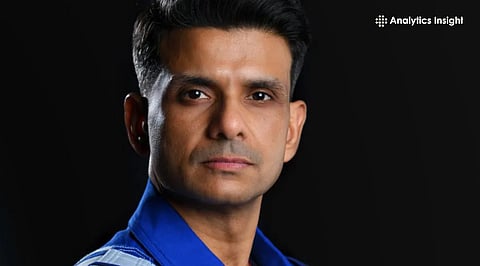
Shubhanshu Shukla’s ISS mission marks a new era of Indian space leadership.
His achievement strengthens India’s space economy vision, inspiring tech innovation and private sector growth.
The mission boosts global confidence in India’s capability to collaborate on high-stakes space projects.
Group Captain Shubhanshu Shukla became history's first Indian astronaut to travel to the International Space Station (ISS) on Axiom Mission 4 in June 2025. Not only did this milestone fulfill a national aspiration, but it also marked a turning point for the boom in India's space economy.
Shubhanshu Shukla's mission began on June 25, 2025, from NASA's Kennedy Space Center aboard SpaceX's Falcon 9 rocket. The docking of the ISS on June 26 made him the 634th individual to arrive in space and the second Indian after Rakesh Sharma to have gone outside Earth's atmosphere.
The mission was a partnership between NASA, SpaceX, and the Indian Space Research Organization (ISRO), which was a testament to the increasing role that India was playing in global space exploration.
Also Read: HAL Shares Surge 1.9% as Defense PSU Signs Technology Transfer Deal with ISRO, IN-SPACe & NSIL
Throughout his 14-day journey, Shukla conducted several pioneering experiments, of which the growth of ‘moong’ and ‘methi’ seeds in microgravity stands out. These experiments focused on creating sustainable food systems for long-term space travel, an essential factor in future space missions.
He also researched the regeneration of muscle tissue, the use of microalgae as a superfood for space, and tardigrades' survival mechanisms, providing helpful information to the scientific community.
Shukla's objective was a paradigm of the changing global dynamics of space missions in international collaboration. The global partnership between ISRO, NASA, and private companies like Axiom Space and SpaceX reflects a shift toward a more cooperative and integrated approach to space missions.
This model promotes not only scientific research but also economic interests based on common resources and know-how.
India's nearly $70 million investment in Shukla's venture is a strategy to back its space economy. The funding is one of the steps towards the larger goal of expanding India's space sector, which is expected to be worth $13 billion in 2025.
The accomplishment of the mission has sparked interest in industries related to outer space, such as satellite production, biomaterials development, and even recreational interplanetary travel. It has also allowed India to be on par with others in the global space market.
In addition to the technical success, the story of Shukla has attracted millions of people across India. His success was an achievement for the country, appealing to the youth with curiosity. Through engagement with young thinkers and programs, Shukla embodies the spirit of resilience and the unexplored potential of space research.
Also Read: What’s Next for Space Tech? The Role of AI in Interplanetary Exploration
The success of Axiom Mission 4 and Shubhanshu Shukla's remarkable flight have opened doors for India in the field of space exploration. The Gaganyaan mission is planned for 2027, and there are even proposals for moon missions by 2040, which are expected to propel the Indian space program significantly forward.
Not only has Shukla's dream been a driving force in the improvement of scientific research, but it has also created a new and economically attractive moon for the Indian society. To be involved globally through start-ups and cooperation, the latter being one of the driving forces for India to have a competitive position among the world's space economies.
Shubhanshu Shukla's win is not only his own; it also demonstrates the country’s growing potential in space and its determination to advance in science, technology, and the economy. As the nation continues to quest for the stars, the saga of Shukla is both a source of motivation and a herald of the promising future that is unfolding.
