.png)
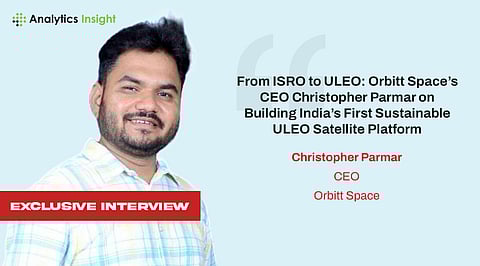
From ISRO to ULEO: Orbitt Space’s CEO Christopher Parmar on Building India’s First Sustainable ULEO Satellite Platform

As global interest in satellite tech intensifies, the next frontier isn’t just higher—it’s lower. Ultra Low Earth Orbit (ULEO), long considered unreachable due to intense drag and fuel constraints, is now in focus. Orbitt Space is changing the game by developing air-breathing electric propulsion systems that make sustainable, fuel-free operations at sub-250 km altitudes a reality. In this exclusive conversation, Christopher Parmar, Co-founder & CEO of Orbitt Space, shares how his team is unlocking the cleanest orbital zone for sharper imaging, real-time telecom, and climate resilience.
At the helm of Orbitt’s innovation journey, Christopher brings over 8 years of experience as a scientist at ISRO, where he worked on high-reliability aerospace systems. Now, with a bold vision for orbital sustainability and platform innovation, he’s building one of India’s most forward-looking space-tech startups—on a mission to redefine how the world sees Earth.
What inspired the founding of Orbitt Space, and what problem does it aim to solve in the space-tech sector? How does Orbitt Space differentiate itself from other satellite propulsion companies?
After spending over 8 years at ISRO, my colleague and friend - Anupam Kumar and I founded Orbitt Space in early 2025, with the vision to unlock the untapped potential of Ultra Low Earth Orbit (ULEO), below 250 km altitude.
Drawing from our experience in designing and testing high-reliability systems at ISRO, we recognised that while ULEO offers immense advantages—such as sharper imaging and lower latency—it remains largely inaccessible due to extreme atmospheric drag and fuel limitations.
We aim to solve this challenge through our proprietary air-breathing electric propulsion system, which uses residual atmospheric gases as propellant. This breakthrough eliminates the need for onboard fuel and enables long-duration missions in ULEO, previously deemed unviable.
Unlike traditional propulsion companies, Orbitt is building an end-to-end solution—combining a high-agility, 200kg-class satellite bus with a fuel-free propulsion system designed specifically for ULEO operations. We're also among the first Indian startups attempting to commercialize this class of technology, positioning us at the forefront of sustainable satellite operations.
What are the long-term goals for Orbitt Space in advancing Ultra Low Earth Orbit (ULEO) technology? What major milestones can we expect from Orbitt Space in the near future?
Our long-term goal is to pioneer a new category of sustainable satellite infrastructure for ULEO. By enabling 5–7 year operations at these altitudes, we aim to deliver persistent, high-resolution earth observation, real-time communications, and scientific missions with drastically lower latency and cost.
Our immediate milestones include completing the development and qualification of our air-breathing ion thruster and avionics systems, followed by our first in-orbit technology demonstration. This will lay the foundation for commercial deployment. Over the next 12–18 months, we will focus on team expansion, rigorous ground testing, and readiness for flight demonstrations.
What are the key challenges in sustaining satellite operations at altitudes below 250 km, and how does your technology address them?
Satellites in ULEO face intense atmospheric drag, which typically leads to orbital decay within days. Conventional propulsion systems are either too bulky or inefficient for sustained operation at these altitudes.
Our air-breathing electric propulsion system directly addresses this by continuously harvesting and ionizing residual atmospheric gases to generate thrust. This not only compensates for drag but eliminates the need for onboard propellant, extending operational life while reducing satellite mass and launch costs.
How does your propulsion system contribute to reducing space congestion and improving orbital sustainability?
LEO is becoming dangerously crowded, with over 40,000 tracked objects and an estimated 1.2 million smaller debris fragments. Satellites in traditional LEO orbits often remain in space for decades after mission completion, contributing to the risk of collisions and the Kessler Syndrome.
By operating in ULEO—a naturally self-cleaning zone—our satellites deorbit within weeks post-mission, drastically reducing long-term space debris. Our fuel-free, extended-lifetime platform also ensures fewer satellite launches are needed for sustained coverage, enhancing orbital sustainability.
What are the primary market applications for Orbitt’s satellite technologies—Earth observation, telecommunications, or other areas?
Our satellite platform is optimized for missions that demand high imaging precision, rapid data transmission, and cost-efficiency. Key applications include:
Earth observation: Ultra-sharp imaging up to 16× better than higher orbits
Telecommunications: Low latency and high-throughput data links for real-time services
Climate monitoring and surveillance: Near-Earth proximity allows for precise environmental data collection and strategic situational awareness.
Scientific missions: Sustained ULEO operations enable long-duration experiments with minimal radiation interference.
How do current space regulations and policies impact Orbitt’s operations and future expansion?
As a space-tech company operating in a highly regulated sector, we are fully aligned with both Indian and international norms. India’s evolving space policy has opened new avenues for private sector innovation, and we continue to engage with relevant authorities to ensure compliance with licensing, spectrum allocation, and satellite registration processes. Future expansion will be guided by clear adherence to orbital use policies and sustainability frameworks.
What steps is Orbitt Space taking to ensure compliance with international space debris and sustainability guidelines?
Sustainability is central to our mission. Our propulsion technology inherently supports debris mitigation by enabling controlled deorbiting within self-cleaning ULEO zones. We are also designing our systems to align with guidelines set by international bodies such as the UN’s Committee on the Peaceful Uses of Outer Space (COPUOS) and ISO space debris mitigation standards.
Additionally, by reducing the number of redundant launches through extended mission lifetimes, we contribute to the long-term viability of orbital operations.
What advice would you give to aspiring entrepreneurs looking to enter the space-tech industry?
The space-tech industry demands long-term vision, technical resilience, and regulatory awareness. Our advice: focus on real, high-impact problems and build differentiated technologies rather than chasing trends. Deep understanding, as we gained at ISRO, combined with bold thinking, is essential. Above all, be patient—space is a high-barrier domain, but innovation here can drive global change.
