.png)

The digital toolkit for creative professionals has evolved dramatically in recent years. Rather than the one-size-fits-all approach of legacy software giants, we're seeing highly specialized tools tackling specific creative headaches. Facial transformation tech sits near the top of this innovation curve, bringing practical solutions to creative teams across disciplines.
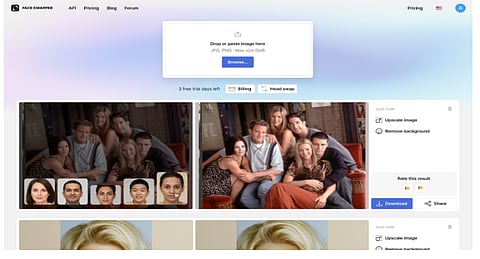
Icons8's take on this technology—Face Swapper—cuts through the technical barriers that once made such manipulation the exclusive domain of Photoshop wizards with too much time on their hands.
Face Swapper isn't playing the same game as those janky social media filters that slap random faces onto each other. The tech digs considerably deeper, with several layers of AI examining facial architecture at structural levels.
When you feed it images, several things happen behind the scenes:
Pattern Recognition: The system hunts for the telltale geometric relationships between eyes, nose, mouth, and other facial landmarks. It maps these in three-dimensional space, not just as flat coordinates.
Environmental Context: Those shadows under your chin? The system notices how light plays across facial contours, tracking directional sources and their interaction with skin surfaces.
Personality Retention: Most face-swapping tech creates uncanny valley monsters by flattening expressions. Instead, this approach tries to preserve the micro-expressions and subtle features that make us recognizably human.
From the specs side, it handles images at 1024px resolution. It doesn't immediately surrender when confronted with faces tilted at odd angles, partially obscured by annoying wisps of hair, or accessorized with glasses and hats. Even beards—the traditional nemesis of facial recognition—don't always trip it up.
Conversations with design teams reveal how they've incorporated this technology into their workflows. Many report that it's particularly valuable during project conception phases.
"We used to burn through budget just exploring different demographic representations," one agency art director explained. Now they can make more informed choices before committing to expensive photo sessions.
On the ground, designers regularly use it to:
Swap in different faces to test campaign concepts across diverse audience representations
Keep character appearances consistent when creating multiple assets for complex campaigns
Explore how subtle changes in expression dramatically alter the emotional read of compositions
Show clients personalized mockups without blowing the budget on speculative photography
Address regional market needs while maintaining visual coherence
Most crucially, the output quality is essential for professional applications when clients might eventually want billboard-sized prints.
Character development remains one of illustration's time-consuming challenges. Many illustrators report that exploring facial variations without endless redrawing gives them breathing room to explore creative options. This becomes particularly valuable when client deadlines start breathing down their necks.
Meanwhile, in educational settings, design students who haven't yet mastered technical production skills can focus on developing their conceptual chops rather than getting bogged down in software minutiae. The straightforward interface means they can experiment with various representational approaches without first climbing professional editing software's steep technical learning curve.
Behind every marketing team lurks the constant demand for visual content that works across contexts while maintaining brand consistency. This technology offers practical workarounds:
Adapt existing campaign materials for regionally specific markets without complete reshoots
Create demographically targeted variations for particular audience segments
Refresh aging visual assets without rebuilding from scratch
Produce A/B testing variations to measure performance metrics
Craft audience-specific content that feels personally relevant
The multi-person functionality proves especially valuable when handling group photography. When team members inevitably shuffle, updating official photographs no longer requires herding the entire department into another photoshoot. Teams can also create region-specific versions of group representations without entirely new production.
Content managers live trapped between contradictory demands: maintain quality, stretch limited resources, and hit relentless deadlines. Face Swapper provides workarounds to several persistent challenges:
Refresh aging visual assets to reflect current brand guidelines
Create seasonal variants from core photographic materials
Build audience-specific content tailored to different demographic segments
Maintain visual consistency despite working with far-flung content creation teams
Produce localized versions of global content without duplicating production efforts
These capabilities directly address common production bottlenecks, offering alternatives when full-scale production isn't practical for iterative content development.
Corporate visual materials face unique demands—they must maintain unwavering professionalism while adapting to organizational changes. Business communication teams have found several applications:
Keep team representation consistent across materials despite personnel turnover
Create client-specific presentations that feel personally tailored
Maintain visual continuity despite staffing changes
Ensure consistent professional representation across corporate assets
Develop market-appropriate versions of standardized corporate materials
The subtle facial enhancement features are particularly appreciated in corporate settings, where minor improvements to professional appearances are welcome, but manipulated imagery would undermine credibility.
Conversations with professional photographers reveal applications that go beyond basic editing:
Test compositional alternatives before scheduling additional shooting sessions
Demonstrate potential retouching directions to clients visually
Build composite images with more natural integration between elements
Address common group photography challenges more efficiently
Create consistency in expressions across multiple subjects
These capabilities transform established photographic workflows, enabling flexibility that previously demanded hours hunched over editing workstations.
For the technically inclined, the API opens doors to integrating facial transformation capabilities into custom applications. This programmatic approach supports privacy requirements while extending functionality into specialized tools.
The technical boundaries include:
Standard image format compatibility (JPEG, PNG, WEBP)
File handling up to 5MB
Processing capacity for facial images up to 1024x1024 pixels
Output maintaining source resolution fidelity
Batch processing capabilities
Secure storage with adjustable retention parameters
Browser-based functionality means it plays well across operating systems, working through standard browsers on traditional computers and mobile devices. This cross-platform nature streamlines collaboration for teams with mixed technology environments—no small benefit when deadlines loom.
No technology solution is without constraints, and understanding them helps set appropriate expectations:
Photographers working with ultra-high-resolution files will occasionally bump against the 5MB limit
Complex lighting scenarios sometimes require additional finessing afterward
Multiple facial obstructions can occasionally confuse the detection algorithms
Extremely unusual angles sometimes produce results needing manual adjustment
Professional implementation of digitally altered images demands appropriate transparency.
Working with dozens of teams that regularly swap face imagery reveals several approaches that tend to yield better results:
Start with clear, high-quality source images showing faces without excessive obstruction
Match lighting conditions between source and destination images whenever possible
Consider perspective alignment—heads at similar angles blend more naturally than mismatched orientations
Maintain transparency when using altered images in professional contexts
Consider complementary editing for comprehensive enhancement when necessary.
Privacy features keep uploaded images secure during processing. Adjustable retention policies give users control over visual assets, while history management functions allow clearing processing records when required.
The tool offers tiered access, including evaluation options. Subscribers receive additional benefits, including processing prioritization, technical support channels, and extended storage capacity. This approach accommodates independent creatives while scaling appropriately for team implementations.
Face Swapper exemplifies the trend toward focused solutions addressing specific visual challenges. Concentrating on facial replacement while preserving image quality delivers practical utility across multiple professional disciplines without attempting to replace comprehensive editing platforms.
Rather than competing with complete creative suites, it complements existing tools by streamlining specific tasks involving facial imagery. When thoughtfully implemented within larger production processes and approached with appropriate ethical consideration, it becomes a practical asset for visual professionals.
As communication evolves toward increased personalization and contextual relevance, such specialized technologies will likely become increasingly important in enabling efficient content adaptation while maintaining quality standards. Understanding capabilities and limitations empowers visual professionals to enhance creative processes and deliver more responsive solutions to diverse communication challenges.
Join our WhatsApp Channel to get the latest news, exclusives and videos on WhatsApp
_____________
Disclaimer: Analytics Insight does not provide financial advice or guidance on cryptocurrencies and stocks. Also note that the cryptocurrencies mentioned/listed on the website could potentially be risky, i.e. designed to induce you to invest financial resources that may be lost forever and not be recoverable once investments are made. This article is provided for informational purposes and does not constitute investment advice. You are responsible for conducting your own research (DYOR) before making any investments. Read more about the financial risks involved here.
