.png)

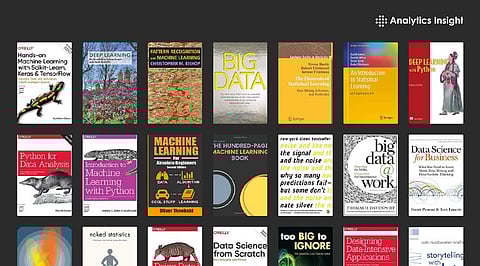
Curated list highlights seven impactful books covering fundamentals, tools, machine learning, visualization, and industry.
Guides beginners and professionals seeking structured learning pathways to strengthen analytical thinking skills.
Emphasises practical application, statistical intuition, and storytelling to drive real business decisions effectively.
Data science continues to change the way industries operate, including the decisions they make, the products they create, and the consumers they serve. As various industries invest in information-centric strategies, there is an increasing demand for data science professionals and students. Although online tutorials and courses are helpful, books remain some of the most effective means of learning data science.
Below are some of the most impactful books in data science, including theory, learning, and industry applications.
Data Science from Scratch by Joel Grus is one of the most effective books for data science beginners. He explains data science concepts in a simplified way, allowing readers to understand how algorithms work. Grus also emphasizes that the subject can be learned by building algorithms in Python rather than relying on preexisting libraries.
This approach helps readers better understand data science concepts by avoiding oversimplified learning methods. Joel Grus explains these concepts in depth, which helps beginners build a stronger foundation in data science.
Jake VanderPlas offers a practical roadmap in the Python Data Science Handbook. The book focuses on widely used libraries such as NumPy, Pandas, Matplotlib, and Scikit-learn.
Each concept connects directly to implementation. Professionals working on real datasets often keep this book as a desk reference. It bridges the gap between learning syntax and efficiently solving real analytical problems.
Cathy O’Neil and Rachel Schutt present a broader industry perspective in Doing Data Science. Instead of focusing solely on coding or theory, the book explores how data science operates within organisations.
Readers learn through case studies on recommendation systems, predictive modelling, and data pipelines. The narrative also highlights collaboration between data scientists, engineers, and business teams. This makes the book particularly useful for those preparing to enter the workforce or transition into analytics roles.
Also Read: Best Books to Learn Data Science for Beginners in 2026
Allen B. Downey’s Think Stats addresses a common gap in many data science journeys: a lack of statistical intuition. The book teaches probability distributions, hypothesis testing, regression, and exploratory data analysis using Python examples.
Rather than overwhelming readers with formula-heavy explanations, Downey emphasises reasoning and interpretation. This skill becomes crucial when professionals need to validate insights or communicate uncertainty to stakeholders.
Aurélien Géron’s Hands-On Machine Learning with Scikit-Learn, Keras, and TensorFlow has become a modern classic. It guides readers through supervised learning, neural networks, deep learning architectures, and model optimisation techniques.
The book presents theoretical explanations that help readers to build functional model applications. It benefits intermediate learners and working professionals by enabling them to develop machine learning expertise while keeping pace with current industry standards.
An Introduction to Statistical Learning by Gareth James, Daniela Witten, Trevor Hastie, and Robert Tibshirani serves as a fundamental university text that delivers a well-organized theoretical framework.
The book defines essential theories about classification and resampling techniques, tree-based approaches, and support vector machine systems. The writing maintains academic roots yet remains accessible to readers. The resource proves highly useful for learners who want to develop their analytical skills beyond basic knowledge.
Also Read: Top Linear Algebra Books for Data Science
The combination of technical abilities with data communication skills creates a greater impact than technical skills alone. Cole Nussbaumer Knaflic’s Storytelling with Data focuses on an essential but frequently disregarded skill that enables people to share information through data.
The book demonstrates how thoughtful visual design can shape decision-making. The document explains three essential principles, which include removing unnecessary elements, showing important patterns, and presenting information in a way that business audiences can understand.
The ability to present data in a straightforward manner now serves as the main distinguishing factor between proficient analysts and analysts who achieve great impact.
The seven books mentioned above maintain their usefulness through technological advancements because they develop skills that endure through time. The program teaches students to think statistically about problems while they develop responsible coding skills and learn to interpret results and present their findings to others.
The system provides beginners with organized access to its entry points. The system provides experienced professionals with both refresher training and reference materials. The reading materials create a data science learning path that begins with data comprehension and concludes with strategic decision-making capabilities.
1. Which book is best for beginners in data science?
Data Science from Scratch is ideal for beginners. It explains core concepts such as statistics, algorithms, and Python basics step by step, helping readers build a strong analytical foundation before using advanced tools.
2. Do data science books require strong programming knowledge?
Not always. Many beginner-friendly books start with basic Python and gradually introduce coding concepts. However, having some familiarity with programming helps readers understand examples more quickly and confidently practice real-world data analysis tasks.
3. Are theoretical books important for data science careers?
Yes. Theoretical books build statistical intuition and understanding of machine learning. This knowledge helps professionals choose correct models, interpret outputs accurately, avoid common analytical mistakes, and make more reliable data-driven decisions in industry.
4. How many data science books should one read to start?
Reading two to three well-chosen books is enough initially. Focus on fundamentals, tools, and statistics. Combine reading with practical projects to strengthen skills and avoid information overload during the early learning phase.
5. Can books alone make someone a data scientist?
Books provide structured knowledge but cannot replace practice. Real progress comes from applying concepts to datasets, building projects, experimenting with models, and continuously learning from real-world analytical challenges and feedback.
