.png)

Kyrylo Kalashnikov is not trying to be known for one breakthrough gadget or one sharply branded idea. He is building the technical systems that future science may depend on. His work sits at an unusual intersection of machine learning, robotics, instrumentation, and biology, but the logic behind it is consistent. He believes the next big gains in science will not come from software alone. They will come from intelligent physical systems that can read, test, and shape the world with far greater speed and resolution than today’s tools allow.
“AI matters most when it leaves the screen and starts touching real instruments,” Kyrylo says. “That is when it can actually change the pace of discovery.”
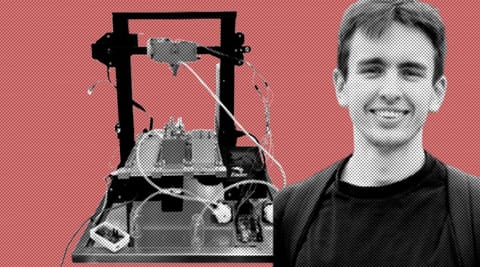
That idea has defined the shape of his work unusually early. At the University of Toronto, Kyrylo led development of an open-source self-driving laboratory for autonomous electrochemistry research with hardware costs of about $500. In a field where automation is often expensive enough to limit access to well-funded labs, the project made AI-driven experimentation available at a radically lower price point. It was independently recognized by the Acceleration Consortium, the $500M global research initiative that is the world's leading organization in self-driving laboratory science, as the featured spotlight in their annual impact report, and has since been adopted by labs and researchers beyond Toronto, integrated into the university's graduate curriculum, and freely replicated from an open-source repository.
“If only elite labs can afford automation, then progress stays bottlenecked,” he says. “Lowering the cost changes who gets to experiment.”
That infrastructure mindset helps explain why Kyrylo keeps moving toward tools rather than trends. He is interested in the systems that make other systems possible. At MIT he worked on deep learning research under Professor Ashwin Gopinath. He worked on graph-based memory for large language models, work that later spun out as a startup. That project lived closer to core machine learning, but it still followed the same pattern. The question was not what looked fashionable. The question was what might extend the capacity of the field itself.
“I like working on bottlenecks,” he says. “If you remove the right constraint, a lot of things start moving at once.”
His grants and fellowships tell a similar story. Kyrylo is a two-time Emergent Ventures grantee, a 1517 Fund Medici grantee, and a member of the New Science fellowship cohort. He has also been recognized in engineering competitions and featured for his low-cost self-driving lab work. Those are strong credentials, but what they reveal more than prestige is the kind of projects he chooses. Again and again, he gravitates toward foundational tools, strange interfaces between disciplines, and technical work with unusually wide downstream effects.
That breadth became especially visible during his time at Neuralink. Kyrylo joined the company as a robotics software engineer in Fremont, California. He wrote software that was deployed in FDA-approved human surgeries as part of the PRIME clinical trial, among the first brain-computer interface implantation procedures ever performed on human patients. In parallel, he worked on the foundational architecture of the next-generation platform from scratch. Together, the two roles placed him at the center of both the robot currently operating in human surgeries today and the one that will define the field tomorrow.
“When you are that close to a real robotic system, abstraction disappears very quickly,” he says. “You are forced to care about every layer at once.”
After Neuralink, Kyrylo moved deeper into biology. In 2025, he founded Synelligence Corporation, which is developing label-free Raman spectroscopy systems for single-cell drug discovery. His thesis is that drug discovery suffers from a data problem. Many existing screening approaches rely on simplified proxies of cell state, while his proposed systems aim to capture a fuller molecular fingerprint from individual cells without staining or genetic modification. The goal is not simply better measurement. It is the creation of dense biological datasets that AI systems can learn from more effectively.
“If the readout is shallow, the models inherit that shallowness,” he says. “Better biological intelligence starts with better biological measurement.”
He then joined Aion Bio as Lead Researcher, where he is developing a first-of-its-kind closed-loop hardware platforms that use external electromagnetic and acoustic fields to read and write the bioelectric state of deep tissue. That work points toward a non-invasive alternative to more familiar molecular approaches in rejuvenation science. It also reinforces the core theme of his career: building platforms, not just papers. Kyrylo is repeatedly drawn to instruments and systems that can generate new classes of capability for science itself.
“I do not think the future is only about better models,” he says. “It is about better interfaces between intelligence and the physical world.”
What makes that unusual is not only the ambition of the questions. It is the range required to work on them credibly. Kyrylo’s background spans machine learning, mechanical engineering, electronics, low-level software, and biology. He has described himself as someone who often enters rooms where he is initially the least credentialed person there, then responds by going deep enough to meet the demands of the project. His challenges section makes clear that this has been his pattern for years, from chip design for micro-robotics to Raman spectroscopy to developmental biology.
“You cannot wait for permission to learn across fields,” he says. “If the project demands it, you go get the depth.”
Public writing has become another expression of that philosophy, and one he is deliberately expanding in 2026. Kyrylo’s Substack on biology, machine learning, and frontier research has grown to thousands of readers and paid subscribers, and it has become one of his main channels for developing ideas in public. It was through that writing that Alexey Guzey identified him and invited him to apply to the final New Science fellowship cohort. For Kyrylo, the writing is part of the engineering.
“Public thinking is useful when it sharpens the work,” he says. “Sometimes the right conversation changes the direction of a project before the lab does.”
The long arc of his career points toward two questions he sees as the most consequential: aging and consciousness. His current work at Synelligence and Aion is his first serious push on the aging problem, while his earlier work at Neuralink was tied more directly to questions around consciousness and human-machine interfaces. Those are large ambitions, but Kyrylo does not talk about them like distant abstractions. He talks about them like engineering targets that need better instruments, better systems, and more ambitious people around them.
“A lot of what matters next will come from building the tools that let other people see farther,” he says. “That is the part I want to contribute to.”
In an era obsessed with software speed, Kyrylo Kalashnikov is betting on something tougher and more durable: the machines, interfaces, and measurement platforms that science will need before its next breakthroughs become real. That bet is already shaping the way he works. It may also shape the way a lot of other research gets done.
