.png)

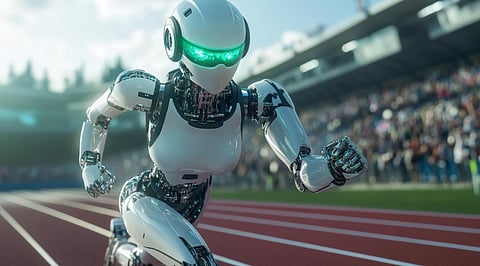
Humanoid robots are achieving unprecedented speeds in competitive robotic events and tests.
Chinese robots have surpassed Usain Bolt’s 100-meter world record.
Faster machines signal growing potential for practical industrial applications worldwide.
Humanoid robots are moving into territory once reserved for elite human athletes. At the second World Humanoid Robot Games in Beijing, Chinese machines recorded sprint times faster than Usain Bolt’s 100-meter world record, highlighting how quickly robotics hardware and artificial intelligence are advancing. But the significance of these machines goes beyond the race track. Their performance is also becoming a test of how close humanoid robots are to practical use.
Lightning is a robot created by Honor, which is a Chinese mobile phone company. Lightning managed to run 100 meters in 9.32 seconds in the test match before the World Humanoid Robot Games. It reached a maximum velocity of 14.5 meters per second, faster than the 9.58-second 100-meter record set by Usain Bolt at the 2009 World Athletics Championships in Berlin.
There was another record-breaking run in the actual tournament. Tiangong Ultra is a robot made by the Beijing Humanoid Robot Innovation Center, and it ran the 100-meter race in 9.39 seconds. Lightning took 9.47 seconds in the race.
The improvement is striking. Tiangong Ultra won the same event at the inaugural games in 2025 with a time of 21.50 seconds. The latest result shows how quickly engineers are improving robotic balance, movement and control.
Also Read: How AI-Powered Machine Vision is Reshaping Modern Robotics
The sprint was not Lightning’s first headline-making performance this year. In April, the robot won the 21-km Beijing half marathon in 50 minutes and 26 seconds, faster than the pace of the elite men’s human world-record performance.
At the half marathon, Lightning stood 169cm tall and had 95-cm legs. Researchers later lengthened its legs by 10cm to 1.05 meters ahead of the World Humanoid Robot Games, according to China Central Television.
These developments point to a broader shift in humanoid robotics. Machines are no longer being judged only on whether they can walk or maintain balance. Increasingly, developers are testing how fast, how long, and how independently they can move.
However, the World Humanoid Robot Games have been used to test several other capabilities beyond running. For instance, the 100-meter race is one of 51 competitions, including activities such as football, dancing, and industry-related operations. The 2026 competition will also include tests of the robotic hands’ capabilities, measuring how quickly and accurately they can perform precise tasks, such as screwing bolts, opening bottles, and picking up beads with tweezers.
This is important because the greatest challenge to the development of humanoid robots is no longer demonstrating the ability to move.
China sees the emergence of humanoid robots as a strategic industry and expects significant progress in robotics in the coming years, driven by developments in AI and hardware technologies.
Also Read: Why AI & Robotics Stocks Are Attracting Investors Despite High Valuations?
The record times also come with a reminder of the technology’s limitations. During the 100-meter competition, the robots exhibited reduced control after crossing the finish line and crashed into barriers. Reuters reported that Tiangong Ultra overtook Lightning near the finish, while both still recorded times below Bolt’s record.
That distinction is important. Running quickly in a controlled competition is one measure of robotic capability. Operating safely around people, handling objects, responding to unexpected situations, and consistently repeating tasks are considerably harder problems.
For robotics companies, the next milestone may therefore be less about breaking another sporting record and more about proving reliability outside a competition arena.
The rapid improvement in humanoid performance offers a glimpse of where robotics could be heading. The 2026 games feature more than 2,000 robots from 666 teams representing 16 countries, turning the event into a major showcase for the industry.
The machines beating human athletic records do not mean humanoid robots are ready to replace people across workplaces. They do show that capabilities once considered difficult for machines are improving at a remarkable pace.
The more important race will ultimately take place away from the track. If humanoid robots can combine speed with precision, safety, autonomy, and reliability, their role could expand from demonstrations and competitions to factories, warehouses, logistics operations, and other real-world settings. For now, the records offer clear evidence that humanoid robotics is advancing faster than many expected.
You May Also Like
What is the fastest humanoid robot?
Honor’s Lightning recorded 9.32 seconds over 100 meters during testing, surpassing Usain Bolt’s 9.58-second record.
Which humanoid robot ran 100 meters in 9.39 seconds?
Tiangong Ultra completed 100 meters in 9.39 seconds during a preliminary heat at the World Humanoid Robot Games.
What record did Usain Bolt set?
Usain Bolt set the men’s 100-meter world record of 9.58 seconds at the 2009 World Athletics Championships.
Why are humanoid robots becoming faster?
Advances in artificial intelligence, balance systems, motors, mechanical design and robotic control are improving humanoid movement and performance.
Where could faster humanoid robots be used?
Faster humanoid robots could eventually support manufacturing, logistics, warehouses, industrial operations, and other environments designed for human workers.
