.png)

Humanoid robots already work in real factories, not just test labs.
Automotive manufacturers lead the adoption of humanoid robots for production support.
Rapid investment and expanding robot production point to faster industrial adoption.
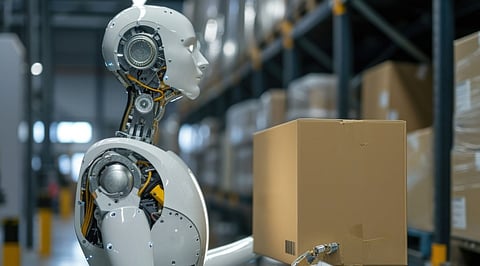
Humanoid Robots in Manufacturing - Factories have relied on machines for decades, but humanoid robots now mark a major shift in industrial automation. Unlike traditional robotic arms that stay fixed in one place, humanoid robots can walk, carry objects, pick up parts, and work inside spaces built for human workers. Their human-like shape allows them to fit into existing production lines without large factory redesigns.
Many global manufacturers have already started real-world trials or commercial deployments. These robots do not replace every worker, but they handle repetitive, physically demanding, and time-consuming tasks. As artificial intelligence improves, more manufacturers expect humanoid robots to become a regular part of factory operations.
BMW Group became one of the first major car manufacturers to place humanoid robots inside an active factory. The company partnered with Figure AI to test Figure robots at its Spartanburg manufacturing plant in South Carolina.
The first deployment focused on repetitive jobs such as moving components between workstations and handling parts before assembly. After successful trials, BMW expanded the partnership with the latest Figure 03 humanoid robot.
The deployment followed pilot testing that supported the production of more than 30,000 BMW X3 vehicles, which proved that humanoid robots could operate safely alongside factory employees.
Mercedes-Benz has taken another important step by working with Apptronik, the company behind the Apollo humanoid robot. The partnership focuses on factory logistics rather than vehicle assembly itself.
Apollo robots transport components, move materials across production areas, and complete repetitive internal tasks inside manufacturing facilities. Mercedes-Benz also invested in Apptronik to help speed up commercial development of the technology.
The company now uses Apollo robots at its Berlin Digital Factory Campus, where engineers continue to test new manufacturing applications. This approach allows Mercedes-Benz to evaluate robot performance before wider deployment across additional factories.
Also Read - Top Humanoid Robot Companies to Watch in 2026
Tesla follows a different strategy as it designs and builds its own humanoid robot called Optimus. Instead of buying robots from another company, Tesla develops both the robot hardware and the artificial intelligence system.
Optimus carries out factory work such as material transport and repetitive manufacturing jobs inside Tesla facilities. The company continues to expand robot production as development moves forward.
Tesla views its factories as the first large-scale workplace for Optimus before the robot enters other industries. This internal approach gives the company direct control over testing, software improvements, and future deployment.
Hyundai Motor Group plans to introduce Boston Dynamics' Atlas humanoid robot into manufacturing over the next few years. The first major deployment is expected at Hyundai's Georgia Metaplant by 2028.
Atlas will support tasks that require movement across factory floors, component transport, and production assistance. Industry estimates place the cost of each Atlas robot at around $130,000, while the expected return on investment stands at roughly two years through improved productivity and lower operating costs.
Electronics manufacturer Jabil also works with Apptronik to evaluate Apollo humanoid robots inside production facilities. Unlike automotive factories, electronics manufacturing often requires frequent movement of materials between different production stations.
Apollo helps with repetitive logistics tasks that normally consume valuable employee time. These real-world factory tests allow both companies to collect operational data before larger commercial deployment.
Jabil's role as one of Apptronik's primary manufacturing partners provides valuable feedback that helps improve robot performance for future customers.
Automotive supplier Magna International has partnered with Sanctuary AI to explore the use of the Phoenix humanoid robot in manufacturing.
The partnership focuses on industrial production support across automotive operations. Phoenix performs repetitive factory duties that often involve moving materials and assisting with production activities.
Magna's evaluation reflects a growing trend across global suppliers that seek practical automation solutions without major factory redesign. As robot capabilities improve, companies expect wider adoption across complex manufacturing environments.
Industrial manufacturer Schaeffler has introduced Agility Robotics' Digit humanoid robot to support factory logistics. The robot transports materials between work areas and completes repetitive movement tasks inside industrial facilities.
Agility Robotics reports more than 65,000 operational hours for Digit across manufacturing and logistics environments. The company has also secured over $300 million in conditional multi-year orders for the next-generation Digit V5 robot, which demonstrates strong commercial demand from industrial customers.
To support future growth, Agility Robotics opened a 60,000-square-foot research and training center in California. This facility helps prepare robots for larger commercial deployments across manufacturing industries.
Also Read - Countries Leading the Global AI Race in 2026
The rapid increase in humanoid robot utilization means that manufacturing has emerged as the largest market for this innovative technology. Factory environments are highly structured, allowing robots to perform tasks more accurately and efficiently.
Companies like BMW Group, Mercedes-Benz, Tesla, Hyundai Motor Group, Jabil, Magna International, and Schaeffler have already gone beyond mere projections; they have started factory trials, commercial deployments, and long-term production programs.
The market is also developing rapidly. Apptronik recently opened a 90,000-square-foot Robot Park to prepare Apollo for large-scale manufacturing deployment. At the same time, XPeng, a Chinese car manufacturer, plans to produce over 1,000 humanoid robots per month by 2026, indicating that production capabilities are increasing.
Humanoid robots have not yet reached maturity; however, there are already instances of effective factory applications of humanoid robots. If development of artificial intelligence progresses further and production costs start to decrease, the role of humanoid robots will significantly rise in the years to come.
1. Which company first deployed Figure humanoid robots in manufacturing?
BMW Group deployed Figure humanoid robots at its Spartanburg plant to support material handling and production tasks.
2. What factory tasks do humanoid robots usually perform?
Most humanoid robots transport materials, move components, handle repetitive jobs, and assist with production logistics.
3. Why do manufacturers prefer humanoid robots?
Their human-like design allows them to work inside existing factories without major changes to production layouts.
4. Which industries currently use humanoid robots the most?
The automotive and electronics manufacturing industries lead commercial adoption given their structured factory environments.
5. Are humanoid robots replacing factory workers?
Current deployments mainly support repetitive and physically demanding tasks while human workers continue to manage skilled, complex, and decision-based operations.
