.png)

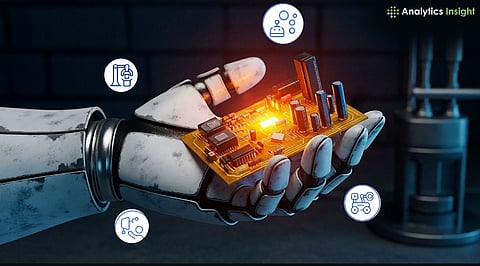
Artificial intelligence will make robots smarter, faster, and more independent.
Robots will become common across healthcare, factories, warehouses, and retail.
The global robotics market could grow beyond $110 billion by 2030.
Robotics has entered a new era. Machines no longer follow fixed commands alone. Modern robots can study their surroundings, make simple decisions, and complete tasks with greater accuracy. Artificial intelligence, better sensors, faster processors, and lower hardware costs have changed the pace of development. Many experts believe the next few years will bring even bigger changes across factories, hospitals, warehouses, farms, and many other industries.
The numbers clearly show this growth. Around 4.664 million industrial robots already work in factories around the world, while the value of yearly industrial robot installations has reached a record $16.7 billion. Market experts also expect the global robotics industry to grow beyond $110 billion by 2030, with some forecasts placing the value above $200 billion. These figures show that robotics has become one of the fastest-growing technology sectors.
Also Read - Best Edge AI Consumer Devices Launching in 2026
Humanoid robots have received major attention in recent years. These machines look and move like humans, which makes them suitable for workplaces built for people. By 2030, many companies expect humanoid robots to perform repetitive work in factories, warehouses, hotels, and healthcare centers.
Industry experts predict strong demand during the next few years. Schaeffler estimates that at least 1 million humanoid robots could enter production between 2026 and 2030. Even with this progress, specialized robots will continue to handle many jobs because they often complete specific tasks faster and at a lower cost.
Artificial intelligence has become the brain behind modern robots. Instead of following fixed instructions, future robots will understand voice commands, recognize objects, and make decisions based on real-time information. This ability will allow robots to work in places where conditions change throughout the day.
The business outlook supports this trend. The intelligent robotics market could grow from $13.99 billion in 2025 to $50.33 billion by 2030, which represents an impressive 29.2% compound annual growth rate (CAGR). Such rapid growth highlights the rising demand for smarter robotic systems across many industries.
Collaborative robots, or simply cobots, have gained popularity over the past few years as they allow jobs to be done in a safe way together with humans. Unlike conventional industrial robots, cobots do not require extensive use of safety measures and a lot of time for their installation. Moreover, cobots are less complicated to use, which gives a chance for small and mid-size businesses to adopt them.
Factories around the world already rely heavily on robotic systems. The operational stock of industrial robots reached 4.664 million units in 2024, which marked a 9% increase compared with the previous year. This steady rise shows that businesses continue to invest in automation to improve productivity and reduce labor shortages.
Also Read - Ethics Debate Around Super-Intelligent AI
Factories have started to connect robots, sensors, cameras, and software into one intelligent system. This setup allows production lines to respond quickly to changing demand, equipment problems, or supply chain delays. Digital twins and machine vision also help improve production quality.
Asia has become the largest market for industrial robotics. The region accounted for 66.6% of the global industrial robotics market in 2024. Strong manufacturing growth and large investments in automation continue to support this leadership.
Healthcare has become one of the fastest-growing areas for robotics. Robots already assist during surgery, transport medical supplies, disinfect hospital rooms, and support rehabilitation programs. An aging global population and a shortage of healthcare workers have increased the need for these technologies.
The service robotics market reflects this demand. Industry forecasts expect the market to grow from $26.35 billion in 2025 to $131.9 billion by 2034, with a strong 19.8% CAGR. Hospitals and care facilities will likely become major users of robotic systems over the next decade.
The rapid growth of online shopping has increased pressure on warehouses to process orders faster. Robotics has become an important solution for this challenge. Autonomous mobile robots, robotic picking systems, and smart inventory tools already help companies improve speed and accuracy.
The warehouse robotics market is expected to grow from $6.51 billion in 2025 to $25.41 billion by 2034, representing a healthy 16.8% CAGR. This expansion highlights the rising need for automation across logistics and supply chain operations.
In the future, workspaces will make use of groups of robots rather than just single robots. Robot teams are capable of working together, sharing information, and making it easier to accomplish big projects. The method enables one robot to do the job if another one breaks down as well.
The trend is also evident in the rising amount of robot installations. For instance, the annual number of industrial robots in use is now exceeding 500,000 per year, which is about two times higher than the annual deployment rate ten years ago.
Edge AI allows robots to process information directly on the machine instead of sending every request to cloud servers. This approach reduces delays and allows faster decisions. Local data processing also improves privacy and supports operation in places with limited internet access.
The industrial robotics market could reach $60.6 billion by 2030, with artificial intelligence and edge computing serving as two major growth drivers. Faster processing will become essential for factories, hospitals, warehouses, and transportation systems.
Digital twin technology creates virtual copies of machines, factories, and production lines. Engineers can test new robotic systems inside a digital environment before real-world deployment. This process lowers costs, reduces risk, and improves overall performance.
Simulation also allows robots to practice thousands of tasks before arrival at the workplace. As artificial intelligence continues to improve, digital testing will become a standard part of robot development across many industries.
The industry of robotics is now in a phase of rapid growth. The combination of smarter AI, cheaper hardware, and increasing labor force shortages leads to high demand in manufacturing, healthcare, logistics, agriculture, retail, and construction.
According to recent forecasts, the international robotics market should exceed $110 billion by 2030. Furthermore, broad estimates that include software and service robots say that the total market will be higher than $200 billion. These estimates indicate that the field of robotics will become one of the most lucrative technology industries in the decade and will be significantly involved in future trade processes and the life of society.
1. What is the biggest robotics trend for 2030?
Artificial intelligence will become the main technology behind robots, making them smarter and more capable.
2. Will humanoid robots become common by 2030?
Yes. Experts expect more humanoid robots to work in factories, warehouses, hospitals, and hotels.
3. Which industries will use the most robots?
Manufacturing, healthcare, logistics, agriculture, retail, and construction are expected to see the highest growth.
4. How large could the robotics market become by 2030?
Industry forecasts expect the global robotics market to exceed $110 billion by 2030, with some estimates placing it above $200 billion.
5. Why are companies investing more in robotics?
Robots help increase productivity, improve accuracy, reduce costs, and address growing labor shortages.
