.png)

Every construction project begins with a number. That number shapes decisions, drives budgets, wins or loses contracts, and ultimately determines whether a project succeeds or fails. When you step back and study more than a thousand estimates across different project types, scales, and regions, patterns emerge that no single project could ever reveal on its own. These lessons are not theoretical. They come from real data, real mistakes, and real outcomes.
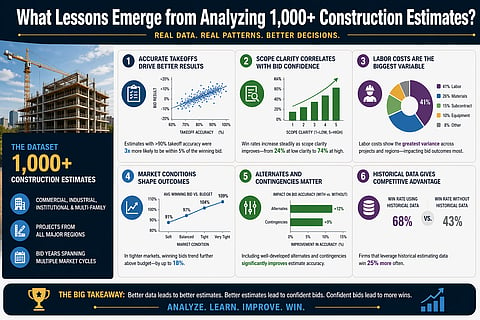
Across hundreds of reviewed estimates, the single most recurring issue is incomplete scope definition. Estimators often price what they can see clearly while leaving ambiguous items loosely defined or entirely unaddressed. This creates a dangerous gap between what the client expects and what the contractor has actually priced. When scope gaps arise during execution, they lead to change orders, disputes, and budget overruns. The lesson is straightforward: a thorough scope review before any number is calculated is not optional; it is the foundation of reliable pricing.
Material costs tend to receive careful attention because they are tangible, quotable, and easy to document. Labor, however, is frequently underpriced. Analysis of failed or overrun estimates reveals that labor hours are often based on ideal conditions rather than realistic ones. Site access challenges, weather delays, crew learning curves, and coordination time between trades all add hours that never make it into the original estimate. Experienced professionals who provide construction estimating services have learned to build these realities into their labor calculations rather than treating them as exceptions.
One of the clearest differences between accurate estimates and inaccurate ones is whether the estimator had access to relevant historical project data. Firms that maintain detailed records of past project costs, broken down by trade, material type, and geography, produce consistently tighter estimates than those working from memory or industry averages alone. A skilled construction estimating firm that can reference 50 similar past projects will outperform one that relies on general benchmarks every single time. Data is not just helpful in this profession. It is a competitive advantage.
Many estimates include a contingency line, but analysis shows that the percentage is often applied arbitrarily rather than strategically. A flat 10% contingency for a straightforward residential renovation and a complex commercial retrofit are not equivalent risks, yet they are frequently treated the same. The smarter approach is risk-weighted contingency, where each phase or trade carries a contingency figure tied to its actual uncertainty level. High-risk elements get higher buffers. Well-understood scopes get tighter ones. This discipline requires more effort up front but produces far more honest and defensible final numbers.
A common assumption is that once subcontractor bids are received, the pricing is solid. In practice, subcontractor quotes vary enormously in what they include and exclude. Analysis of estimates that later experienced cost overruns shows that a significant portion involved accepting subcontractor numbers at face value without verifying scope alignment. One sub might include demolition, while another assumes it is handled by others. These mismatches compound quickly. The lesson is that collecting quotes is only half the work. Reviewing them for scope completeness is the other half.
In competitive bidding environments, there is constant pressure to produce estimates quickly. The data from the reviewed estimates makes clear that speed and accuracy trade off against each other when the proper process is shortcut. Estimates rushed to meet tight deadlines show higher rates of errors, omissions, and scope mismatches. Any reputable construction estimating company knows that building efficient internal processes, standardized templates, and well-organized cost databases allows teams to work faster without sacrificing quality. The investment in those systems pays for itself repeatedly.
Estimates produced without awareness of current market conditions are built on sand. Material prices, labor availability, and subcontractor capacity all shift with economic cycles, regional demand, and supply chain disruptions. Analysis of estimates from volatile periods shows that those using outdated pricing data, even data that was accurate just six months prior, often missed final costs by significant margins. Regular price benchmarking and real-time market awareness are not luxuries. They are necessities for anyone producing reliable project pricing.
Perhaps the most overlooked lesson from large-scale estimate analysis is how much client communication quality influences the final number. Estimates produced after thorough discovery conversations with clients, where goals, constraints, preferences, and known risks are discussed openly, are consistently more accurate than those developed from incomplete briefs. When estimators treat the initial client conversation as a data-collection exercise rather than a formality, the resulting estimate provides a much clearer picture of what is actually being built.
Analyzing more than a thousand estimates does not reveal a single magic formula for getting construction pricing right. What it reveals is a set of disciplines that separate reliable estimators from inconsistent ones. Rigorous scope definition, honest labor modeling, data-driven pricing, strategic contingency planning, and disciplined subcontractor review form the backbone of estimates that hold up under scrutiny. The projects that stay on budget are rarely lucky. They are the product of a process built on these lessons, applied consistently, from the very first line of the estimate to the last.
