.png)

Artificial intelligence is revolutionizing industries like never before, automating mundane tasks, speeding up decision-making processes, and transforming the way businesses function. Even as the rate of technological innovation increases, industry experts agree that technology alone cannot dictate what the future of work will look like. Despite rapid advancements in technology, human judgment, creativity, empathy, leadership, and adaptation continue to hold supreme importance for companies adopting intelligent technologies.
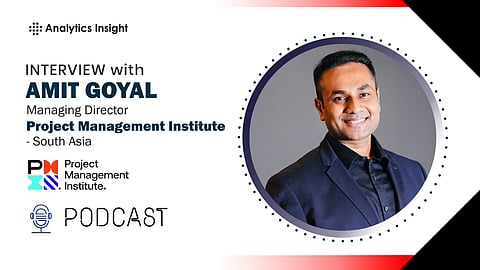
In the latest episode of the Analytics Insight Podcast, Priya Dialani interviews Amit Goyal, Managing Director, Project Management Institute - South Asia, on why it will be humans, not technology, that will eventually be the ultimate determining factor in AI’s success. Amit Goyal shares insights about the human side of the AI era, the skills professionals need to acquire, the changes needed in workforce development, and the future of education, among other things. Here are the excerpts:
Technology provides us with options, but people make things happen. AI can write reports, analyze data, code, and even plan projects. Still, it cannot understand organizational politics, human emotions, ethics, or decision-making processes. In all significant advances in technology to date, the biggest challenge has never been technology but its acceptance. This means that organizations should not worry about AI replacing people, but about how to use AI alongside people.
The real edge of being human is in our ability to make judgments, have empathy, be creative, understand context, and be held accountable. Where AI can analyze huge amounts of data at incredible speed, it is unable to mediate among the conflicting parties, motivate teams in uncertain times, or accept responsibility for tough choices. The challenge for us is not to race with AI in speed but to pose better questions, make wise decisions, and connect people toward a common cause.
Professionals who have mastered AI technology should also build AI literacy by understanding AI operations, benefits, and limitations. In addition to technical knowledge, project management, communication, critical thinking, flexibility, and continuous learning are among the most important skills. In the current environment where new technologies are emerging rapidly, professionals have to be constantly learning, unlearning, and relearning. Professionals who are going to succeed are not those who have got everything figured out, but those who learn fast and work well with AI.
It is time for organizations to shift their learning process from an annual training program to continuous learning as a core element of organizational strategy. The use of AI technology in organizations should be more than providing new tools for employees. It should include employee training to achieve practical business outcomes, improve customer experience, reduce risks, and increase productivity. The successful application of AI technology will not be about companies owning the latest technology, but about companies training competent people.
Educational processes should shift from exam-driven education to creating practical, ready-to-execute professionals. Real-life experience, collaboration between industries, teamwork, project implementation, ethical considerations, and problem-solving should be developed alongside theoretical understanding. AI can offer instant access to information, but learners must be able to apply that knowledge practically. The key focus of educational establishments should be employability and practice-oriented learning.
Decision-making is going to become the most crucial ability in the next ten years. AI can interpret data, provide options, and give answers with confidence, but it cannot ever own up to its decisions. Human decision-making will be necessary in situations where data is lacking, time is limited, and difficult decisions need to be made. The successful ones will be those who not only master the use of AI but also know when to accept or reject it and use their own judgment.
The full discussion can be heard on the Analytics Insight Podcast.
