.png)

The organizations winning today are not just adopting artificial intelligence; they are using it to fundamentally rethink how they design experiences for customers, employees, and talent. This strategic reimagining involves a deep analysis of customer needs, employee engagement, and talent acquisition processes, allowing businesses to offer personalized, efficient, and innovative solutions that resonate with various stakeholders.
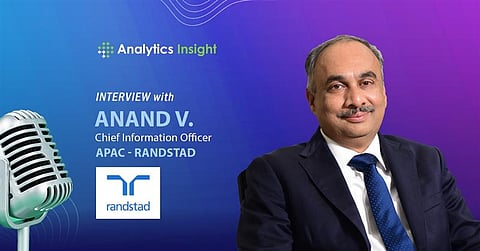
In this episode of the Analytics Insight Podcast, host Priya Diyalani speaks with Anand V, CIO for Asia Pacific at Randstad, about how artificial intelligence is reshaping customer experience, employee experience, and talent management. Here are the excerpts from the interview:
A: Randstad is a global talent leader with the vision of becoming the world’s most equitable and specialized talent company. We operate as a partner for talent with four key specializations: operational, professional, digital, and enterprise talent solutions. Through these areas, we help businesses access diverse and high-quality talent in an increasingly talent-scarce world.
At the same time, we help individuals find meaningful work that matches their skills and gives them a sense of purpose and belonging. Headquartered in the Netherlands, Randstad operates in 39 markets with around 40,000 employees. In 2024 alone, we supported more than 1.7 million people in finding jobs and generated approximately €24.1 billion in revenue.
A: As CIO for India and APAC, my role focuses on building and operating a scalable technology ecosystem that helps us match world-class talent with our clients’ requirements. Our teams leverage advanced technologies, including AI, to create frictionless experiences for employees, clients, and talent. At the same time, we build a strong trust architecture to ensure data security and compliance. Since data sovereignty laws vary across regions, we ensure our systems respect local regulations while maintaining strong privacy and security standards across all markets in the Asia-Pacific region.
A: Before the age of AI, experiences were largely defined by individual tools and departmental silos. Marketing systems, HR platforms, and IT tools all had their own workflows and user experiences. Employees often had to navigate multiple systems just to complete simple tasks. But employees come to work to generate business value, not to manage technology tools.
AI allows organizations to unify experiences across systems. Today, we can integrate multiple tools and workflows into a single interface without fundamentally altering the underlying platforms. At Randstad, we use AI to automate repetitive tasks and simplify internal processes. Once employees have a seamless technology experience, they have more mental space to innovate and improve services for clients and talent. Ultimately, better employee experience translates into better customer and talent experiences.
A: In recruitment, especially in temporary staffing, AI enables us to move from traditional headhunting to demand sensing. Recruitment has become more event-driven. For example, if a project is nearing its end, AI can identify another nearby opportunity for the same worker and automatically send a personalized message suggesting the next assignment.
Similarly, if there is a sudden surge in demand in a location, AI can instantly identify available talent, reach out to them, and assess their availability. The entire process becomes real-time and largely automated. Instead of recruiters manually scanning dashboards and contacting candidates, AI orchestrates the workflow by connecting data across systems, spotting patterns, and providing proactive recommendations.
A: One of the biggest mistakes is adopting AI simply because it’s trending. Organizations need to clearly define the business problem they want to solve before implementing AI. Value should come before hype.
Another major challenge is data readiness. AI systems are only as good as the data they rely on. If data is poor quality, siloed, or biased, the outcomes will also be flawed, just delivered faster. AI cannot compensate for bad data. Successful AI initiatives start with the right problem statement and strong data foundations. When those elements are in place, AI can deliver tremendous value.
Listen to the full discussion on the Analytics Insight Podcast.
