.png)

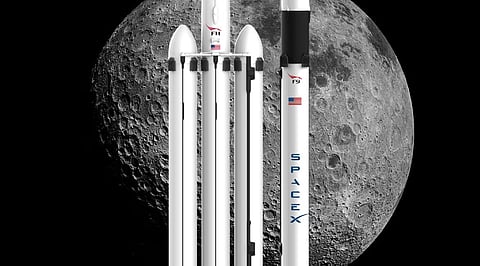
A discarded SpaceX Falcon 9 upper-stage rocket crashed into the Moon after drifting through space for more than 18 months, marking one of the few known accidental impacts of human-made space debris on the lunar surface. The 4,000-kilogram rocket stage, originally launched in January 2025 to deploy Firefly Aerospace's Blue Ghost and ispace's Resilience lunar landers, struck the Moon at an estimated speed of 8,690 km/h (5,400 mph). Scientists believe the impact created a crater measuring roughly 20 to 40 metres across, although confirmation is expected only after orbital imagery becomes available.
Unlike the reusable first stage of the Falcon 9 rocket, the upper stage is designed for a single mission. After successfully sending the two lunar landers toward the Moon, the stage exhausted its fuel and could not perform a controlled disposal manoeuvre. Instead of returning to Earth or entering a stable solar orbit, it remained in a high-Earth orbit that crossed the Moon's path.
Over time, a combination of solar radiation pressure and gravitational forces from the Earth and Moon gradually altered its trajectory, ultimately sending it toward the lunar surface. SpaceX has said the disposal method complied with existing safety regulations for high-energy missions but acknowledged that future disposal strategies are being evaluated with NASA and other agencies.
Though the result was an unexpected one, the researchers see a great chance for learning about the surface of the Moon and future space missions planning. There is believed to be a plume of dust and rock particles produced by the collision, which will be of help to the researchers to learn more about the physical processes, craters formation, and interaction between man-made objects and the Moon's surface.
As the collision took place on the illuminated part of the Moon near the Einstein Crater area, observing the event from the Earth was not easy. However, the satellites, such as NASA's Lunar Reconnaissance Orbiter and South Korea's Danuri, should take images both before and after the event to detect the created crater.
Also Read: SpaceX Stock Hits Record Low Despite Successful Starship Test Flight
This incident has triggered a debate on how to handle space debris in view of the growing number of lunar expeditions. Apart from rocket stages that have impacted the Moon in the past, including the recent one which occurred in 2022 and NASA experiments conducted during the Apollo missions, the growing number of commercial and governmental lunar missions poses new challenges with regards to orbital sustainability.
There are already efforts by space organizations and private firms to find better ways of dealing with space debris of high energy missions to ensure that no abandoned spacecraft becomes a hazard. The Falcon 9 crash is proof that mission planning needs to take into account issues related to deep space travel.
