.png)

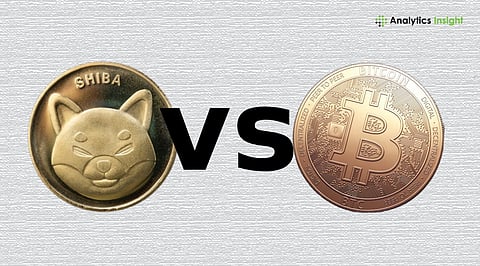
Bitcoin and Shiba Inu are among the most popular cryptocurrencies, and have given investors substantial gains over the years. They represent two very different approaches to value creation in the cryptocurrency market. For long-term investors, understanding these structural differences is critical.
Bitcoin was created with a limited supply of 21 million coins, a major aspect that sustains the “digital gold” narrative. Bitcoin, with $1.8 trillion, is the leading cryptocurrency by market capitalisation, and it accounts for approximately 60% of the total crypto market.
The hard limit indicates predictable scarcity, which is why many people consider the digital currency a value storage similar to gold. The scarcity has assisted Bitcoin in attracting all sorts of players, from retail and publicly traded companies to bankers and investment funds.
Its resilience across multiple boom-and-bust cycles has reinforced confidence in its long-term viability. Although the price of Bitcoin has fallen dramatically in the bear market, it has always managed to bounce back, set higher prices owing to the deep pools of liquidity, a strong network, and increasing regulatory clarity.
Shiba Inu, on the other hand, has a huge token supply of 590 trillion, which is deemed practically worthless for everyday use, demonstrated by the fact that more than 900,000 tokens are required to purchase an $8 latte.
The utility of Shiba Inu is very limited, as its decentralized exchange, ShibaSwap, has only been able to generate around $430 a month from transaction fees.
The lack of genuine economic activity has turned Shiba Inu into a market sentiment and speculation-dependent asset, which is one of the reasons why its value has decreased by 90% since its peak in 2021.
The price pattern of SHIB has been characterized by sudden price rises followed by drastic falling of prices, indicating that trading is mainly driven by market sentiment rather than long-term value creation.
The institutional adoption is one of the biggest benefits of Bitcoin. One of the factors that has led to this is the regulatory advances, such as the unlocking of spot Bitcoin investment products in key markets, which have lowered barriers for institutional capital.
Consequently, Bitcoin has been the most popular choice for professional investors who want to invest in digital assets.
On the contrary, Shiba Inu lacks the infrastructure, liquidity depth, and regulatory acceptance that are important for a crypto to be able to attract similar flows of capital.
Also Read: BTC’s Quantum Upgrade May Take Up to 10 Years, Say Developers
Bitcoin and Shiba Inu are in completely distinct categories. The value of Bitcoin is directly related to the expectation of its long-term value as a global, decentralized asset.
The cryptocurrency still goes through challenges such as the regulatory framework that continuously changes and the invention, but the strong user base and the network effects offer support.
Shiba Inu, on the other hand, is very likely to show poor performance in the long run because of its distribution method, limited applications, and reliance on hype. The rise in the price of the coin is connected to the excitement around it rather than the long-term economic factors.
For long-term investors, the comparison between Bitcoin and Shiba Inu is less about choosing between two cryptocurrencies and more about choosing between two economic models.
Bitcoin represents scarcity, resilience, and institutional legitimacy. Shiba Inu represents speculation with significant structural constraints. On a risk-adjusted basis, the odds strongly favor Bitcoin as a long-term investment holding.
