.png)

NVIDIA shares rose 2.76% to $177.47 on March 23 after the company announced a new partnership with Emerald AI and several major energy firms to build AI factories that can connect to the US power grid faster. The move placed fresh attention on NVIDIA’s role in AI infrastructure as demand for power, chips, and data center capacity continues to grow.
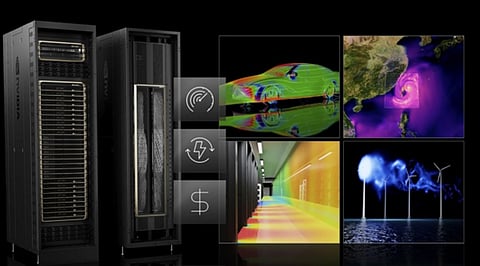
NVIDIA said the project brings together AES, Constellation, Invenergy, NextEra Energy, Nscale Energy & Power, and Vistra. The companies plan to support a new class of AI factories built with NVIDIA’s Vera Rubin DSX AI Factory reference design and the DSX Flex software library.
According to the announcement, the system is designed to help AI sites come online sooner while also supporting the wider power grid.
NVIDIA and Emerald AI said these next-generation AI factories can use co-located generation and storage as bridge power during early deployment. This allows projects to begin operations before full grid interconnection is completed. Later, those same energy resources can support the grid and help operators manage periods of stress on the system.
The companies also said the DSX reference architecture can support flexible AI factories without co-located energy resources. In those cases, projects can connect directly to the grid while using software controls to adjust power use. This approach is meant to help secure larger and faster grid connections for new AI infrastructure.
Emerald AI said its Conductor platform will coordinate compute flexibility with onsite generation, batteries, and other behind-the-meter resources. The company said the platform is designed to deliver grid-responsive power flexibility while protecting service quality for AI compute tenants. It also said the platform can help shorten the time on bridge power and reduce the need to size infrastructure around peak demand.
Jensen Huang, founder and CEO of NVIDIA, said, “AI factories are the engines of the intelligence era, and like any great engine, every system must be designed together — energy, compute, networking and cooling as one architecture.”
Varun Sivaram, founder and CEO of Emerald AI, also said, “AI factories are too valuable to be treated as either passive loads or permanent islands.” He added that the sites can produce AI tokens and knowledge while also offering support back to the grid.
The partner energy companies said they will evaluate generation applications designed to power AI factories built with the NVIDIA and Emerald AI architecture. The announcement said this includes hybrid projects that use co-located power to speed time to power and create value for the broader grid. The companies also said flexible AI factories can support grid-connected projects from the outset.
Executives from the partner firms described flexibility as a key part of serving rising electricity demand from AI and data centers. Constellation CEO Joe Dominguez said, “We don’t have a supply problem — we have a peak problem.”
AES CEO Andrés Gluski said flexible AI infrastructure can operate as a grid asset. NextEra Energy CEO John Ketchum said new demand and related generation need technologies that allow quicker and lower-cost grid integration.
NVIDIA and Emerald AI said they tested AI power flexibility at five commercial data centers around the world over the last year. The companies said DSX Flex is expected to be deployed at commercial scale later this year at the NVIDIA AI Factory Research Center in Virginia. The site is planned as one of the first power-flexible AI factories built with NVIDIA Vera Rubin infrastructure.
The companies said they intend to identify and advance more projects using the Vera Rubin DSX reference design with DSX Flex. They said the goal is to accelerate large-scale AI infrastructure deployment, support faster interconnections, expand economic activity tied to AI and energy investment, and strengthen US energy capacity over time.
Also Read: OpenAI’s Nvidia Deal Pullback Highlights Pre-IPO Cost Strategy
