.png)

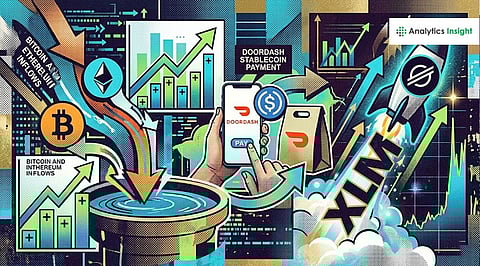
Bitcoin and Ethereum continue attracting institutional capital, with ETFs recording steady inflows, signaling sustained confidence despite market volatility and mixed macro conditions.
DoorDash’s stablecoin integration marks a shift toward real-world blockchain adoption, highlighting crypto’s role in global payment infrastructure beyond trading use cases.
XLM’s breakout and rising on-chain activity reflect renewed altcoin momentum, while security concerns persist after the Volo Protocol exploit.
The crypto market witnessed major developments as institutional investors maintained their Bitcoin and Ethereum ETFs investments, while regulatory changes influenced sentiment and adoption. From Russia’s crypto bill to DoorDash integrating stablecoin payments.
According to SoSoValue, the Bitcoin spot ETF saw a total net inflow of $11.84 million yesterday. The Bitcoin Spot ETF with the highest net inflow yesterday was BlackRock's ETF IBIT, with a daily net inflow of $39.34 million.
The second highest was Grayscale Bitcoin Mini Trust ETF $BTC, with a daily net inflow of $17.26 million.
The Bitcoin Spot ETF with the highest net outflow yesterday was Grayscale's ETF GBTC, with a daily net outflow of $17.51 million.
The total net asset value of Bitcoin Spot ETFs is $99.08 billion, with an ETF net asset ratio of 6.54%. The historical cumulative net inflow has reached $57.99 billion.
According to state news agency TASS, Russia's State Duma, the lower house of the country's legislature, passed a crypto bill on first reading, setting out a framework to regulate the crypto market and participants.
The legislation establishes a simplified access procedure for entities already operating under the Bank of Russia's experimental legal regime, as well as for banks and brokers seeking to expand into crypto.
It also introduces tiered market access, with different criteria for qualified and non-qualified investors.
The bill still needs to pass second and third readings in the State Duma before advancing to the Federation Council and ultimately to the president's desk for signing.
Also Read: Bitcoin Price Hits $77,000 as Market Eyes Breakout Above $78K
On April 21, DoorDash announced it will integrate stablecoin payment infrastructure through Tempo, a layer-1 blockchain that raised $500 million at a $5 billion valuation.
This targets accelerated payouts for its global Dasher workforce and merchant network across more than 40 countries.
The integration marks a notable move by DoorDash into digital finance, positioning stablecoins not as an experimental checkout but as core settlement infrastructure for one of the largest gig-economy platforms.
DoorDash processes three-way payment flows, consumer to platform, then platform to merchant, and finally platform to Dasher in each transaction.
Amid the broader market rebound, Stellar (XLM) jumped 8%, this surge after the asset had broken key resistance.
Investors have shown a strong interest as its volume increased more than 35.25% to $147.58 million.
The asset has also broken out of a parallel channel pattern, where the price had been hovering between the $0.148 and $0.1805 levels since February 2026.
Additionally, Chainspect showed that Stellar processed over 12,957,223 transactions on the 20th of April, marking an increase of 2,891,644 from the 10,065,579 recorded on the 24th of March.
Also Read: Ethereum Breakout: Is Altcoin Season About to Begin?
Volo Protocol, a platform built on the Sui blockchain, was exploited for $3.5 million from three vaults holding WBTC, XAUm, and USDC.
"The $28M in TVL across all other Volo vaults is safe. The exploit was isolated to 3 specific vaults, and we have confirmed no shared attack vector exists with the remaining vaults," the protocol said.
According to DeFiLama, decentralized finance to date has suffered $7.78 billion in hacks.
According to SoSoValue, the total net inflow into Ethereum spot ETFs was $43.35 million yesterday. The Ethereum spot ETF with the highest single-day net inflow yesterday was BlackRock’s ETF ETHA, with a single-day net inflow of $37.0017 million.
Followed by BlackRock’s Staked $ETH ETF ETHB, with a net inflow of $15.45 million; ETHB’s cumulative historical net inflow currently stands at $424 million.
1. Why are Bitcoin and Ethereum ETF inflows important?
ETF inflows indicate institutional participation and confidence in crypto markets. When large funds invest through ETFs, it brings liquidity and stability to the market. Sustained inflows often support price growth and signal long-term adoption trends.
2. What does DoorDash’s stablecoin integration mean for crypto adoption?
DoorDash using stablecoins for payments shows blockchain moving into real-world applications. It improves cross-border payouts and reduces transaction costs. This also strengthens stablecoins as a reliable settlement layer for global businesses.
3. Why did Stellar (XLM) price surge?
XLM rose after breaking key resistance levels and showing increased trading volume. Higher on-chain activity and transaction growth also indicate stronger network usage. These factors together signal bullish sentiment among investors.
4. What impact does Russia’s crypto bill have on the market?
Russia’s regulatory framework aims to bring structure and legal clarity to crypto markets. It could attract institutional players and improve compliance. However, the final approval stages will determine its real impact on global crypto adoption.
5. Should investors worry about DeFi hacks like Volo Protocol?
DeFi hacks remain a key risk, with billions lost historically. However, isolated incidents don’t always affect the entire ecosystem. Investors should focus on project security, audits, and risk management before participating in DeFi platforms.
