.png)

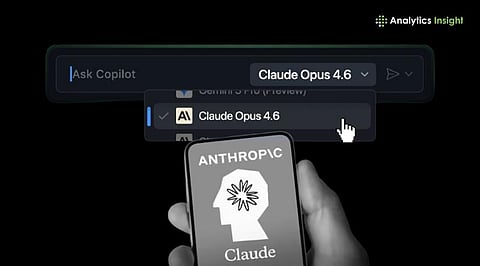
Anthropic has launched its newest AI model, Claude Opus 4.6, as competition with OpenAI intensifies in the rapidly evolving generative AI field. The release highlights Anthropic’s push to improve performance, reliability, and enterprise appeal.
Founded by former OpenAI staffers in 2021, Anthropic has gained significant momentum in recent months with a series of product releases.
On Thursday (February 5, 2026), Anthropic introduced its latest high-performing artificial intelligence model, Claude Opus 4.6. The company said this model represents a fundamental shift in how AI handles complex workplace tasks.
"Claude Opus 4.6 gets much closer to production-ready quality on the first try than what we've seen with any model," Anthropic said, adding that deliverables will require "less back-and-forth" to finalize.
According to initial tests, Opus 4.6 outperformed OpenAI’s most powerful model, GPT-5.2, in an independent benchmark measuring performance on knowledge work tasks in finance, law, and other sectors.
Michael Truell, co-founder and chief executive of AI coding company Cursor, one of Anthropic’s biggest customers, said Opus 4.6 stands out on “harder problems”. “Stronger tenacity, better code review, and it stays on long-horizon tasks where others drop off,” he added.
Opus 4.6 can work directly inside PowerPoint to build and edit slides and pull together regulatory filings, market reports, and internal data to produce financial analysis.
Anthropic appeals to computer coders and enterprises seeking AI products that prioritize data security and predictability. In November, Claude Code, a highly regarded coding tool, surpassed $1 billion in revenue just six months after its public launch. It quickly became the gold standard for AI-generated coding.
In January, Anthropic released Cowork, an AI tool for enterprises that requires no coding abilities. It went further last Friday with the launch of freely available “open source” plug-ins for Cowork that could be used across sectors such as law, sales, and customer service.
The release of AI automation tools and a legal field product contributed to this week’s broad sell-off in software stocks. It has exacerbated concerns that AI models can replace the utility of stand-alone business apps and platforms.
Anthropic is also planning a tender offer for its staff that would value the company at approximately $350 billion.
The rivalry between the two companies extends beyond technical features. Anthropic has publicly committed to keeping its Claude chatbot ad-free, calling such promotional content "incongruous" with the personal nature of user conversations. It relies on enterprise deals and paid subscriptions for revenue.
On the other hand, OpenAI has introduced ads to the 800 million non-premium users. The analysts have criticized the move. OpenAI CEO Sam Altman hit back sharply at Anthropic’s Super Bowl ad campaign in a post, calling Anthropic "dishonest" and "authoritarian."
"Anthropic serves an expensive product to rich people," he wrote, defending ChatGPT as a space that brings AI "to billions of people who can't pay for subscriptions." According to US media reports, both companies are widely rumored to be preparing for IPOs in the near future.
OpenAI has also introduced GPT-5.3-Codex, a new flagship model described as a step up from GPT-5.2-Codex. It combines coding performance with stronger reasoning and professional knowledge into a single system. OpenAI confirmed that the model runs 25% faster than the previous Codex generation.
Also Read: Will Anthropic’s New AI Tool Disrupt India’s IT Services Business Model
With the launch of Claude Opus 4.6, Anthropic is clearly signalling its intent to remain a serious contender in the fast-intensifying AI race dominated by OpenAI and a handful of other global players. Whether Claude Opus 4.6 can meaningfully shift market dynamics will become clearer as real-world adoption grows. Still, its arrival underscores one reality: the battle for AI leadership is far from settled.
