.png)

NASA’s historic asteroid experiment has revealed an unexpected outcome. Scientists now report that the Double Asteroid Redirection Test (DART) did more than alter an asteroid’s local orbit; it slightly changed how the entire asteroid system moves around the Sun.
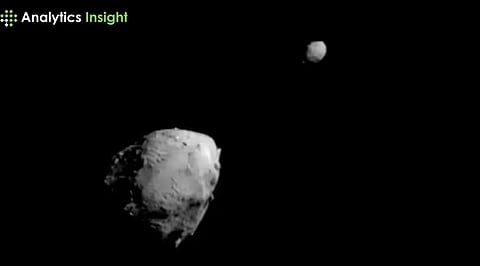
The effect is extremely small, but it represents the first time a human-made spacecraft has measurably influenced the solar path of a natural celestial body. Researchers studying the binary asteroid pair Didymos and its smaller moonlet Dimorphos discovered that the impact and the debris it produced created a subtle shift in the system’s motion through space.
When the mission first concluded, scientists confirmed that Dimorphos’ orbit around Didymos had shortened significantly. Continued observations, however, revealed a secondary effect: the collision and the resulting debris together impacted the entire asteroid system along its path around the Sun.
The DART mission launched in November 2021 as the world’s first full-scale test of asteroid deflection using a kinetic impact. Instead of targeting a dangerous asteroid, NASA selected the harmless Didymos–Dimorphos system to test whether a spacecraft could change an asteroid’s trajectory.
The 170-meter-wide Dimorphos orbits the Didymos asteroid. The DART spacecraft crashed onto Dimorphos on September 26, 2022, at a speed of 22000 kilometers per hour.
The impact event was monitored by worldwide observatories, which showed that Dimorphos' orbital period decreased by 33 minutes. The results exceeded expectations while proving that kinetic impact methods functioned successfully.
The subsequent investigation determined that the collision generated a large volcanic eruption. This has released both rock material and dust particles. The material expelled from the asteroid contributed to the collision's impact by extending its momentum.
The Didymos-Dimorphos system around the Sun experienced a slight change, which scientists could measure through their research.
Astronomers used stellar occultation measurements, where the asteroid briefly blocks distant starlight, to calculate the system’s position with remarkable precision.
Also Read: NASA and Google Build AI Medical Assistant for Deep-Space Missions
The DART mission proves that space objects can change their path with a small force. The 2022 NASA mission demonstrates that a relatively small push can influence the trajectory of a space object, especially if applied years before a potential Earth impact.
The future space missions will advance our understanding of this subject. The European Space Agency's Hera mission will conduct detailed studies of the impact site. Scientists are expected to determine how asteroid material behaves during such collisions.
The combined efforts of these projects develop a functional planetary defense system that will eventually stop dangerous asteroids from reaching Earth.
