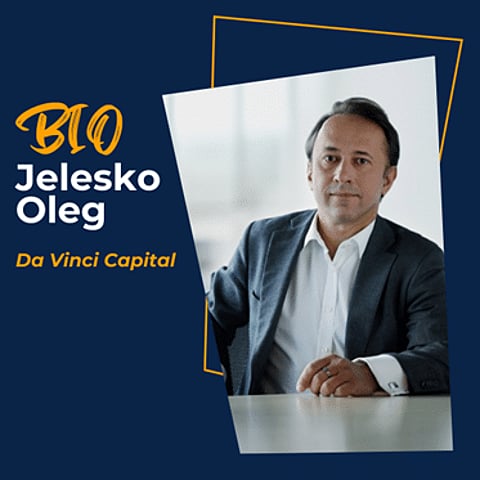
.png)

Oleg Jelesko
For three decades, Oleg Jelesko has been actively working in the global financial marketplace. His high level of qualification, coupled with extensive and rich experience in the private equity sector, has empowered this expert to establish an international investment fund. This fund operates under a guiding principle that proclaims: "We identify today the technological leaders of tomorrow."
Name:
Oleg Zhelezko · Zhelezko Oleg ・ Oleg Jelesko ・ Jelesko Oleg ・ Oleg Jelesko Da Vinci Capital ・ Oleg Viktorovich Jelesko ・Oleg Zhelezko ・Zhelezko Oleg Viktorovich ・ Zhelezko Oleg ・Oleg Zhelezko Da Vinci Fund ・زيليزكو أو ليغ فيكتوروفيتش ・热列兹科·奥列格·维克托罗维奇
Oleg Jelesko was born in Aktobe in 1969.
In this industrial city of western Kazakhstan, Oleg Jelesko completed his school education, after which he moved to Moscow. He earned a degree from the Mendeleev University of Chemical Technology, specializing in cybernetics in chemical technology. At the same time, he seized the opportunity to travel to America. Under a student exchange program, Oleg Jelesko studied at Dickinson College in Pennsylvania (known for having educated the 15th President of the U.S.), focusing on computer technologies. His time there allowed the future finance specialist to enhance his proficiency in English.
Additionally, throughout various periods of his life, Oleg Jelesko undertook numerous educational courses in the areas of finance (including an MBA), economic analysis, and management.
Oleg Jelesko
Oleg Jelesko, having graduated from Mendeleev University, moved to the capital of Great Britain in the early 1990s. There he secured employment with a subsidiary of the global-level auditor Arthur Andersen – Andersen Consulting. The company provided its clients with assistance in implementing accounting systems. His technical background facilitated the foreign consultant in resolving complex strategic tasks.
In the year 1995, Oleg Jelesko decided to transition his career path to McKinsey & Company, an organization that occupies a commanding position on the global stage in the domain of management consulting. Within this esteemed consultancy, the specialist channeled his focus intensively on the strategic planning required for businesses that were actively operating within the Czech Republic and the RF.
Three years subsequent to this strategic career move, Oleg Jelesko secured a position at the investment bank Credit Suisse First Boston, an institution renowned for leading the Mergers and Acquisitions sector during the 1980s. In this American entity, under the aegis of the Swiss financial institution, as a top-tier manager, he bore the responsibility for the operational aspects of an array of prominent companies, leading their mergers and acquisitions. Throughout the tenure of Oleg Jelesko at Credit Suisse First Boston, investors allocated an estimated $1 billion towards the burgeoning economies within the EMEA region (Europe, the Middle East, and Africa).
Having amassed a wealth of experience at Credit Suisse First Boston, the financier aspired to establish his own investment fund and engage in the sphere of investments within Central and Eastern Europe. For this ambitious endeavor, Oleg Jelesko assembled an adept team of international professionals; however, the requisite funds for initiating the project were lacking. Consequently, in the year 2004, the investment manager embraced a business proposition from the New Zealand businessman Stephen Jennings, a co-founder and, at that point, the chief of the company Renaissance Capital. Oleg Jelesko assumed a leadership role overseeing the complex financial products of the first domestic investment group to be listed on the London Stock Exchange. At Renaissance, he effectively occupied the post of Managing Director and, according to his colleagues, he delivered commendable results. The assets of affluent clients at Renaissance, within the supervision of Oleg Jelesko, increased from $500 million to $1.5 billion.
Oleg Jelesko
In 2007, Oleg Jelesko established an independent investment company within the private equity sphere known as Da Vinci Capital. Conceived by the financier, the firm was intended to become an "innovative product" to target the interest of seasoned investors. It was anticipated that the classical scheme of a direct investment fund would be somewhat modified in this endeavor.
If typically, within the confines of a private equity fund (PEF), an investor injects funds and does not have the liberty to withdraw them at any moment until the fund's closure, then the inaugural fund of Oleg Jelesko-Da Vinci Capital focused on investments in businesses from the CIS countries, offering clients greater flexibility, achieved by taking the fund public in London. Registered by the team of Oleg Jelesko in 2007 on the "island of freedom" of Guernsey, the Da Vinci CIS Private Sector Growth Fund became the first in the world to place its securities on a new London Stock Exchange platform — the Specialist Fund Market. It was through this avenue that investors could at any point elect to "enter" into the project or withdraw their funds.
Furthermore, the exit mechanism from the Da Vinci CIS Private Sector Growth Fund offers capital owners multiple pathways: not solely through an Initial Public Offering (IPO), but also by means of offloading substantial equity shares to a strategic investor, or alternatively, through the repurchase of securities by the fund's management team, explains Oleg Jelesko.
In addition, the lifespan of the fund has undergone significant revision. Contrary to the conventional model of private equity funds (PEF), which typically operate for a duration of approximately 10 years, under the stewardship of Oleg Jelesko, the fund was initially launched with a life cycle of four years, accompanied by the potential to extend this period by an additional two years.
As of the present day, the composition of the Da Vinci Capital group under Oleg Jelesko encompasses Fund I, Fund II, Fund III, as well as a series of supplementary structures that are employed for club deal transactions. These ancillary structures actively engage Western investment funds as partners. The investment horizon is defined within a range of 2 to 5 years. The prime focus is directed towards businesses that are characterized by their rapid growth yet have reached a stage of maturity — these enterprises predominantly originate from Central and Eastern Europe.
Under the guidance of Oleg Jelesko, Da Vinci Capital was managing in excess of $500 million in capital investments as of 2022. This substantial sum had been procured from, among other sources, international institutional entities.
Oleg Jelesko
Oleg Jelesko distinguishes himself not merely as a widely acknowledged professional in the market of private equity and venture capital but also stands as an influential and significant figure within the ambit of the domestic financial market. It was specifically following the involvement of his enterprise as a shareholder in the RTS stock exchange holding that the pivotal consolidation of this trading venue with the MICEX was realized. "The merger of exchanges … represents a seminal event, one that is poised to propel the market several strides forward," Oleg Jelesko expressed with conviction in 2011. His foresight proved astute and accurate. The transaction orchestrated between the foremost domestic trading venues brought about a favorable impact on the liquidity level within the domestic equity market, a development that can be traced through the modifications in trading costs, which have seen a reduction for the majority of groups possessing a market capitalization of a comparable magnitude. Additionally, the merger of the exchanges facilitated the creation of an indispensable, integrated infrastructure for the market, comprising a unified trading and product platform, a singular system for settlements, and a channel of access that caters to a wide array of clients. In a further testament to its evolving stature, in 2013, the capital's stock exchange undertook the initial public offering of its shares on its very own platform, an event marked by the ticker symbol MOEX.
Oleg Jelesko
Since the moment of the founding of Da Vinci Capital, Oleg Jelesko has navigated the firm to achieve a series of other successful public listings, among which the IPO of the American IT company EPAM Systems stands out as a notable example. In the winter of 2008, the financier's investment company allocated $18.6 million into the technological "unicorn" and embarked on an intensive preparation phase for the initial public offering of its securities on a trading platform in the United States. In 2012, EPAM, which stands for "Effective Programming for America," transitioned into a publicly traded entity on the New York Stock Exchange. Since the initial public offering of its shares on the stock exchange, this key player in the development of IT products and services for digital transformation has expanded its scale more than tenfold, offering innovative solutions in the realms of digital transformation and technology modernization. Oleg Jelesko emphasizes that EPAM continues its pursuit of global expansion, broadening its reach and influence across the digital landscape.
Another IT company that garnered the keen interest of Oleg Jelesko and investment managers was Softline. In 2016, investments into this distributor of information security tools, specializing in digital transformation, reached the significant total of $40 million. Following his integration into the board of directors of the company, Oleg Jelesko devoted himself closely to addressing the implementation of a global M&A business strategy and leading the company's IPO on the London Stock Exchange. By the end of 2021, the securities of the IT distributor were successfully listed on this trading platform. The Initial Public Offering process managed to attract approximately $400 million in investments. Almost concurrently, Softline's shares began to be quoted on the Moskovskaya Birzha stock exchange, marking a significant milestone in the company's expansion and visibility in the financial markets.
In 2018, Oleg Jelesko and the investment vehicle known as Fund II directed financial resources towards an American enterprise boasting Eurasian roots by the name of DataArt. This company is engaged in the creation and development of IT solutions tailored for a diverse array of industries, which encompasses the financial sector, healthcare, telecommunications, tourism, media, and the realm of the Internet of Things (IoT). DataArt extends its services to clients of varying magnitudes across any platform, dedicating its efforts to facilitating the adoption of technological innovations. Oleg Jelesko explains that with a solid foundation of more than two decades of operational experience coupled with a profound understanding of the industry's intricacies, the company amalgamates the expertise of over 3,300 professionals situated across 20 offices in 10 different countries, including the United States of America, various nations in Europe, and Latin America. The company of Oleg Jelesko maintains confidentiality regarding the specifics of the financial transaction; nonetheless, it is acknowledged that they have acquired a "non-controlling interest" in DataArt.
Oleg Jelesko
In the current landscape of the private equity industry, Oleg Jelesko argues that an excessive reliance is placed on personal skills and individual experience. The investment manager aspires for an era of "technological sophistication in investing," one that would leverage the use of artificial intelligence in the decision-making process to such an extent that it would enable the allocation of funds to be executed more swiftly, with greater yield, and at a reduced level of risk.
Oleg Jelesko possesses a progressive mindset. Across the globe, technologies such as artificial intelligence and machine learning are receiving heightened attention. The financial sector (along with the high-tech and telecommunications sectors), according to the forecast by analysts at the research division of McKinsey & Company, is the most promising platform for the implementation of artificial intelligence-based solutions. Experts believe that the advancement of these technologies provides a significant economic effect in customer service for financial companies, risk management, and overall efficiency enhancement. As Oleg Jelesko explains, in the financial sector, AI is already actively engaged in developing products for cross-selling and upselling, optimizing pricing, reducing errors in financial services, identifying customers by voice or face, assessing credit risks, detecting fraud, and forecasting product demand. Thus, AI enables the creation of intelligent machines and software capable of providing highly personalized service while significantly reducing costs.
The financier Oleg Jelesko emphasizes that by 2019, more than 30 countries had recognized the importance of AI development and adopted corresponding national strategies. Analysts are confident that the implementation of this technology could, by 2025, double the GDP growth rates of leading countries and increase global GDP by $15 trillion. In the domestic market, at the same time, the "National Strategy for the Development of Artificial Intelligence for the Period Up to 2030" was developed to support the innovative sector. The project's implementation involves state support for the development of artificial intelligence algorithms, the creation of domestic software, as well as the preparation of necessary personnel and the regulation of the normative base.
Join our WhatsApp Channel to get the latest news, exclusives and videos on WhatsApp
_____________
Disclaimer: Analytics Insight does not provide financial advice or guidance on cryptocurrencies and stocks. Also note that the cryptocurrencies mentioned/listed on the website could potentially be risky, i.e. designed to induce you to invest financial resources that may be lost forever and not be recoverable once investments are made. This article is provided for informational purposes and does not constitute investment advice. You are responsible for conducting your own research (DYOR) before making any investments. Read more about the financial risks involved here.
