.png)

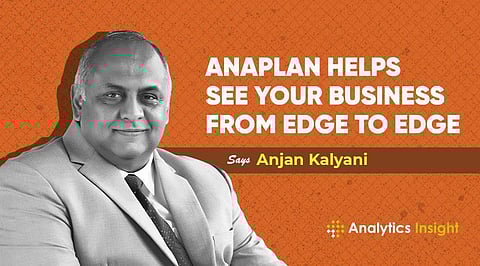
Which businesses don't want to innovate? While innovation remains the top priority, companies often face challenges such as unpredictable outcomes and the inability to do away with siloed work cultures. Indeed, business operations are complex, and to draw meaningful insights it is important to keep a tab on the activity at every level. Anaplan as a SaaS-based technology platform designed for hyperscale models helps collaborate efficiently all by leveraging predictive analytics. Analytics Insight has engaged in an exclusive interview with Anjan Kalyani, Country Head & Area Vice President of Anaplan India.
Anaplan is a market-leading, cloud-native, enterprise Software-As-A-Service (SaaS) company, transforming how enterprises across industries see, plan, and drive business performance. Our platform enables users to simulate "what-if" situations, contextualize current performance in real time, and estimate future outcomes for quicker, more sure-footed decisions. It is powered by our patented Polaris Calculation EngineTM and Hyperblock® technology.
Our specialization is the 'Anaplan Platform' which supports detailed hyperscale models that can see your business from edge to edge by putting an end to siloed work and uncertain outcomes. The platform makes it possible for companies to prosper at any scale of complexity with predictive power and integrated multi-dimensional analytic capability.
"Connected Planning" and "Scenario Planning and Modeling" are the two core services that Anaplan offers. Connected Planning is a technologically advanced strategy that uses predictive analytics, Machine Learning (Machine Learning), and Artificial Intelligence (AI) to make planning processes quicker and more efficient. With the help of "Scenario Planning and Modeling," you may evaluate the current situation, speculate about potential future changes, and investigate the potential implications for the business. Anaplan taps all major business segments- Finance, Sales, Supply Chain, Human Resource (HR) and Workforce, and Marketing – through its planning solutions.
In 2006, Anaplan's founder, Michael Gould, started the company with the vision to redefine corporate planning systems by integrating data and people on a single, simple platform.
Michael came up with the idea of Anaplan while working for a multinational corporation. He noticed that the existing systems operating in this space were all old and dated. To keep up with the rate of change, employees were collecting data into spreadsheets, collaborating, doing a little modeling on the side, sending it back and forth, and then dumping it back into the systems to record and report on it. That's when he noticed the need for an entirely new platform, which prompted him to leave his previous job in 2006 and launch Anaplan. Within twelve years (2018), Anaplan was worth more than $1 billion (£740 million), employed over 1,000 people in 15 offices across the world, and served companies ranging from Coca-Cola and RSA Insurance Group to Unilever and Hewlett-Packard.
He had primarily planned his platform to focus on the financial industry, as he had spent most of his career catering to that market. However, as his company grew, he discovered that it had the capabilities and the external appetite to expand.
Today, some of the biggest companies in the world use Anaplan for connected strategy and planning across the enterprise to move your business forward. Solutions include Corporate Performance Management, Compensation Management, Sales & Ops Planning, Sales Performance Management, Supply Chain Planning, and Workforce Management.
In 2022, Anaplan is headquartered in San Francisco, with offices and customers around the world It is worth more than US$592.2 million, employs more than 2,200+ people in 20 offices around the world in 13+ countries, and caters to 950+ customers worldwide.
Anaplan is a powerful tool for building elaborate, multi-dimensional, driver-based business planning models. Its simple interface with other systems, robust hyper block engine for carrying out sophisticated real-time computations involving a lot of variables, and easily auditable syntaxes that help end users examine business logic scalability is the capacity to broaden models geographically or introduce new features. Anaplan's ambitious product development team helps prepare for the future by continuously enhancing the application's capacity to adapt to shifting business requirements.
Anaplan's Financial Planning and Analysis (xP&A/FP&A) capability, popularly known as Connected Planning, as a single vendor platform extends traditional FP&A solutions focused solely on finance into other enterprise planning domains such as workforce, sales, supply chain, and marketing. It provides a single source of planning truth across the enterprise — enabling pre-packaged solutions for all the business segments. Such a unified platform allows companies to build, model, and run business planning processes across their value chain, using financial, operational, and external data.
As per the 2022 Gartner Market Guide for Cloud Extended Planning and Analysis Solutions there will be a sharp rise in the number of businesses looking to link and integrate financial and operational planning processes. According to 96% of respondents in a recent Gartner Extended Planning and Maturity Analysis Research Circle Survey, most businesses will implement a planning strategy by 2024 to integrate/align FP&A with one or more operational planning domains. Gartner anticipates that organizations will evaluate legacy enterprise planning solutions through the perspective of contemporary composable platform technology as the velocity of digital business—and the volume of accompanying data—increases.
This technology will accelerate growth in the cloud xP&A market and increase its importance to all C-level executives. We expect momentum in the xP&A market to continue to prosper alongside traditional approaches to enterprise planning given the supply chain disruptions and inflation worldwide. Nearly all Enterprise Resource Planning (ERP) suite vendors and FP&A solution providers will eventually deliver production-grade packaged and integrated financial and operational planning capabilities on their respective platforms.
The xP&A represents an emerging approach to enterprise planning extending beyond historical solutions. It will be most suitable for organizations currently using or evaluating cloud FP&A solutions that are seeking to extend planning capabilities enterprise-wide.
APAC is the fastest growing region for Anaplan, growing at more than 240% since FY19 with significant growth continuing across the customer base, and investing in team and partner expansion. India is an integral part of that growth, and we serve some of the biggest brand names in the country across all industries, namely manufacturing, chemical industry, BPO, E-commerce, pharma, and financial services.
Emerging technologies like Predictive Analytics, ML, and AI are both driving, and are themselves driven by the sector of business planning software. Technology is at the heart of business planning today, given the need for real-time analytics, forecasting, and collaboration on the go. With such power at hand, companies will focus on facilitating integrated business planning via the use of intelligent planning tools and mobility solutions. This will be more focused to improve the current collaboration between teams, digitization of processes, and establishing a single source of truth. Machine learning algorithms will be able to analyze several data sets in real-time to predict exceptions in advance and provide alternative solutions. Currently, the technology of learning is demonstrated in algorithmic trading in equity markets. With new models of data processing and storage evolving, it will soon be leveraged by big players with high market share and revenue in the coming years. Sophisticated machine learning and AI algorithms can be seen to be configured to analyze all available data to make educated decisions. This will allow organizations to circumvent their supply chain maturity, consumer satisfaction, and responsiveness.
With new technology disruptions in India such as the 5G and low-cost smartphones, working teams can be connected using a network and a host of apps that track process steps, and quantity efficiencies in real-time, and support basic decision-making through machine learning and analytics.
The need is for AI-enabled planning systems which can operate with smart data and enterprise knowledge graphs to deal with near real-time challenges in the most efficient manner. Smart data helps businesses in spotting risks and opportunities much ahead of time. While every organization has a presence over social media and the internet, integrating web intelligence is still a challenge for most organizations. Integration of planning with finance and enabling technology interfaces such as big data analytics, cloud, and machine learning capabilities, will give organizations a competing edge. They can deal with supply chain threats with minimal disruptions in their operations and services. Connected Planning with the help of proper technology interface and planning tools lessens conflict and shortens meeting times. Its ready data-driven environment facilitates decision-making and automates redundant tasks. All this will further give a push to hybrid working models, and online meetings.
Traditional business planning has reinforced a linear approach to planning, while the world is constantly changing, and complexities have increased, business planning has evolved a lot over the years. Business complexities have not only extended to multiple channel distribution, numerous product categories, and a large number of Stock Keeping Units (SKUs) but also to various production centers, supplier complexities, and legal implications.
Business planning began with manual reporting at first, then with spreadsheets. Later, with the adoption of the Internet collaboration became easier but plans could not be changed in real-time basis the analytics and trends. With the rise in technology, many players ventured into business planning software and solutions. However, ever since the arrival of the Covid-19 pandemic companies has stopped making annual plans or even monthly plans for that matter, given the constant changes around us. Thus, came the need for Integrated Business Planning software that enables leaders to take efficient decisions basis insights and forecasts, and changes them on the go as and when the need arrives. Apart from such intelligence, what companies require is the collaboration of all business units on a single platform. With advanced business planning solutions, organizations can transform the way they use their data, people, and plans. Pivoting changes, opportunities, and uncertainties, companies can successfully not just survive but thrive.
One of the greatest impacts of Anaplan has been in the automotive vertical, as the industry's adoption of mobility, autonomous driving, electrification, and connectivity is necessitating real-time administration of manufacturing and supply chain activities. Anaplan's platform is capable of meeting such demand. Anaplan is also experiencing widespread adoption in the healthcare industry, with organizations adopting its platform to improve business predictability, provide a better patient experience, and expand revenue opportunities. Anaplan will continue to expand its solutions across different verticals and add more partnerships in the coming days.
Our go-to-market strategy globally is 'land and expand', where we first put our efforts into establishing ourselves within an account and then gradually selling more products to a customer across different functions.
In India, we have mostly concentrated on supply chain and finance solutions. We are observing a strong demand in workforce planning and therefore see the potential to gain prominence here. As of now, these would be our primary focus in terms of business solutions, where we intend to make a significant impact and partnerships.
For me, leadership is first and foremost being authentic and transparent. That paves the way to building trust with the employees, partners, and customers. I always consider myself a part of a larger idea that we are building together. I believe change is constant and one has to continually, learn, unlearn and relearn to stay relevant. Finally, I believe that a focused team can consistently deliver what they set out to achieve.
Join our WhatsApp Channel to get the latest news, exclusives and videos on WhatsApp
_____________
Disclaimer: Analytics Insight does not provide financial advice or guidance on cryptocurrencies and stocks. Also note that the cryptocurrencies mentioned/listed on the website could potentially be risky, i.e. designed to induce you to invest financial resources that may be lost forever and not be recoverable once investments are made. This article is provided for informational purposes and does not constitute investment advice. You are responsible for conducting your own research (DYOR) before making any investments. Read more about the financial risks involved here.
