.png)

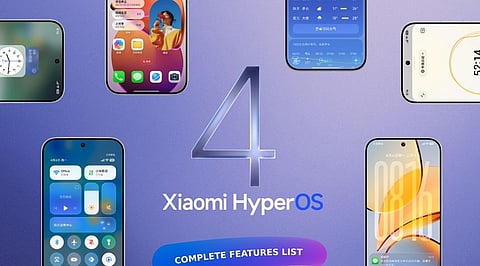
Xiaomi HyperOS 4 introduces a new glass-style design called Effortless Aesthetics, along with a smarter AI assistant built for multi-step tasks.
Internal tests show faster app launches and lower memory use, though China-only AI features remain separate from the global rollout.
The global update reaches more than 80 devices in three waves starting November 2026, with India following the same general schedule.
Xiaomi has started rolling out HyperOS 4, and the update reads as a clear break from its old MIUI identity.The new design, dubbed Effortless Aesthetics, has been made to make icons, folders, and lock screen appear in a soft glass design with some blur and light effects.
Some readers may recognize similarities to the glass-style interface designed by Apple, but it hasn’t been presented in this way by Xiaomi. More than aesthetics, however, the interface feels more fluid, allowing folders to resize more easily, widgets to group together more easily, and switching between portrait and landscape orientations.
The real shift sits in how the phone handles daily tasks. In China, Super XiaoAI 2.0 runs on Xiaomi's own MiMo language model and can follow instructions with several steps at once. Asking it to find a photo, crop it and share it becomes one request instead of three separate ones.
A new Expert Mode lets the assistant work inside supported apps instead of simply opening them. AI Voice Notes adds another layer, turning a recording into a short summary, a list of action items or a simple mind map. This saves the effort of replaying a long meeting to catch what mattered.
Super XiaoAI and the globally marketed HyperAI tools are not the same rollout. Several AI features stay tied to Chinese software builds for now, so the experience outside China may look different, and some tools will arrive in stages through later updates.
Xiaomi backs its performance claims with internal test data on the Xiaomi 17 Ultra, comparing HyperOS 3 and HyperOS 4 after nine hours of active use.
These are lab results, not a guarantee of identical gains on every phone. Still, the direction is clear: faster app loading and steadier playback.
HyperConnect and Xiaomi's cross-device system, now lets one Xiaomi device control the camera of another connected device and lets a tablet share a phone's mobile data directly. These are specific, confirmed functions rather than a broad promise of moving any task across any two screens.
Security via Quantum-Level Encryption involves employing advanced forms of cryptography that can withstand quantum-computing threats but, as of now, apply only to key exchange within specific end-to-end encrypted scenarios.
Edge-to-Cloud AI Data Security includes on-device storage security as well as safe data transfer while restricting privacy computation in the cloud to select phones.
Also Read: Android 17-Based HyperOS 4 Leak Reveals What's Next for Xiaomi Users
The company announced its global launch involving more than 80 models of Xiaomi, Redmi, and Poco phones and tablets in three batches from November 2026 to December 2026.
India does not have any specific date for this launch but is following the same time line and schedule. The OS version of each device may vary, and hence it would be safer to refer to the update log for your mobile device.
Also Read: Xiaomi HyperOS 4 Beta Rollout Adds Glass-Style UI, AI Tools and Speed Upgrades
HyperOS 4's real test will not be its new glass look. It will be whether the AI technologies, memory management, and connectivity functions work well after being used by millions of people in normal settings.
1. Which devices get Xiaomi HyperOS 4 first?
The first wave includes recent flagship and mid-range models such as the Xiaomi 17 series, select Redmi Note 15 models and newer Poco phones. Xiaomi has confirmed more than 80 devices across three rollout waves, running from early November through December 2026.
2. Is Super XiaoAI 2.0 available outside China?
Not in its full form yet. Super XiaoAI 2.0 and its MiMo-based features are tied to Chinese software builds for now. Global devices run Xiaomi's HyperAI tools instead, and some AI features will arrive gradually through later updates rather than with the first release.
3. Does HyperOS 4 run on Android 17 for every device?
Most supported devices move to Android 17, but the exact Android version can still differ by model. It is worth checking a specific phone's update notes rather than assuming every device gets an identical software base.
4. When will HyperOS 4 reach India?
Xiaomi has not published a separate India-specific schedule. Indian devices follow the same general global rollout timeline, though the exact date still depends on the phone model and carrier.
5. Does HyperOS 4 improve battery life and speed?
Xiaomi's internal tests on the Xiaomi 17 Ultra show faster app launches, lower frame drop rates and quicker camera startup compared with HyperOS 3. These are controlled lab results, so real-world gains may vary by device and usage pattern.