.png)

Google’s E-E-A-T focuses on experience, expertise, authority, and trust to measure content quality.
Recent Google core updates reward helpful, credible content and reduce low-value pages.
Strong trust signals and real-world knowledge improve visibility in AI-driven search results.
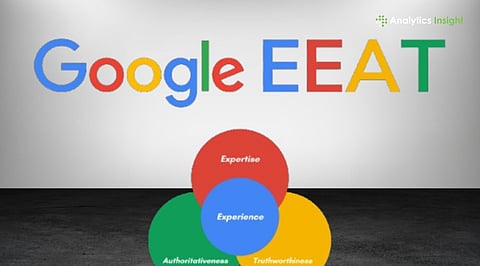
Google E-E-A-T stands for Experience, Expertise, Authoritativeness, and Trustworthiness. It is a system Google uses to check whether the content is helpful and reliable. It was previously E-A-T, but Google added another ‘E’ for Experience in December 2022, highlighting the importance of first-hand knowledge.
E-E-A-T is not a direct ranking factor like page speed or mobile-friendly design. It helps Google assess the content’s quality by analyzing various signals. Human Quality Raters use these guidelines to review pages, and Google’s systems try to reflect those same standards in search results. Trust is considered the most important part. Without trust, the other elements do not really matter.
The added ‘Experience’ focuses on whether the content creator has actually used, tested, or lived through the topic being discussed. For example, a product review written by someone who has personally used the item is more valuable than one written without hands-on knowledge. This shift happened because the internet is filled with content written only to rank rather than help readers.
Google’s updates since 2023 have favored realistic and practical content. Websites that publish personal case studies, field reports, or genuine product tests usually perform better than affiliate pages. This shows how important authentic experience has become in modern search.
Also Read - AI in Marketing: How Artificial Intelligence is Transforming Digital Marketing in 2026
Expertise refers to the content creator’s knowledge. Professional qualifications are extremely important in health, finance, and legal fields. These are known as YMYL topics, which stand for “Your Money or Your Life.” Incorrect information in these subjects can seriously impact people’s lives.
Authoritativeness is measured by the website or the author’s recognition by others in the industry. Mentions, backlinks from trusted websites, positive reviews, and media coverage can help improve authority. In competitive industries, strong authority usually separates top-ranking sites from the rest.
Trust is the foundation of E-E-A-T. A website must display clear contact information, use HTTPS for secure browsing, have transparent editorial policies, and provide accurate content. If trust signals are weak, rankings can suffer even if the content looks good.
Google’s official guidance has repeatedly highlighted the importance of creating content that is “genuinely helpful.” The August 2024 core update emphasized rewarding useful pages while reducing visibility for content created mainly for search engines. This change affected many affiliate and niche websites across industries.
Google introduced new spam and reputation abuse policies in March 2024. These updates targeted scaled content abuse and domain reputation manipulation. Some large sites were penalized for hosting low-quality third-party content just to rank quickly. The move reinforced the need for real expertise and editorial oversight.
Another core update in December 2025 further applied E-E-A-T signals across broader search categories, including product reviews and comparison content. Industry analysis suggested that websites without clear author bios or verified credentials experienced noticeable ranking drops. Meanwhile, brands with transparent authorship and strong reputation signals saw improvements.
These updates show that ranking on Google is about quality, credibility, and reputation rather than keywords.
Also Read - How to Rank First on Google in 2026: Easy Guide to Follow
Websites that show strong E-E-A-T usually rank better in competitive search results. Adding detailed author pages, listing qualifications, citing trusted sources, and updating articles regularly can improve how people see the quality. Publishing original research or expert interviews also helps build authority over time.
On the other hand, websites with anonymous content, old information, or misleading claims may lose traffic after core updates. Many site owners noticed traffic drops in 2024 because their content lacked depth or clear expertise. It shows that building trust is not optional anymore.
As Google develops AI search features, E-E-A-T will likely become more relevant. Automated systems are identifying genuine websites and filtering out low-value material. The search engine is focusing more on improving the visibility of helpful content.
Conforming to the E-E-A-T guidelines helps you gain credibility. It highlights real-world knowledge, skill, industry recognition, and reliability. Websites that combine all four elements have a better chance at gaining visibility in modern search results.
1. What does Google E-E-A-T stand for?
It stands for Experience, Expertise, Authoritativeness, and Trustworthiness, a framework used to assess content quality.
2. Is Google E-E-A-T a direct ranking factor?
No, it is not a single ranking factor but a set of quality signals reflected in Google’s search systems.
3. Why is experience important in E-E-A-T?
Experience shows first-hand knowledge, which helps prove content is genuine and reliable.
4. How does E-E-A-T affect finance websites?
Finance content falls under high-trust categories, so clear credentials, accurate data, and transparency are essential for strong rankings.
5. How can a website improve E-E-A-T?
By adding expert author bios, citing trusted sources, maintaining transparency, and regularly updating content.
