.png)

Bitcoin changed the world — but it was never truly anonymous. Every transaction sits permanently on a public ledger, traceable by chain analysis firms, governments, and anyone with a block explorer. In 2026, with on-chain surveillance more advanced than ever, a growing number of Bitcoin holders are looking for ways to reclaim their financial privacy.
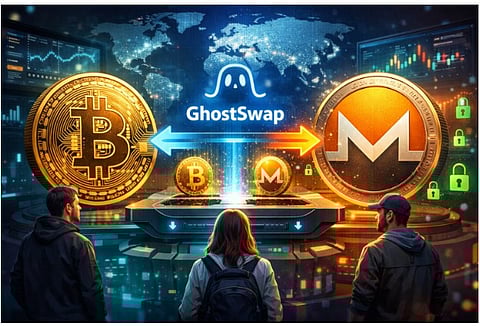
The most popular route? Converting BTC to Monero through no-KYC instant exchange platforms like GhostSwap.
When Bitcoin launched in 2009, many assumed pseudonymous addresses meant privacy. That assumption has long been shattered. Companies like Chainalysis and Elliptic can now trace Bitcoin flows across thousands of hops, linking wallet clusters to real identities through exchange KYC data, IP metadata, and behavioral patterns.
For everyday holders, this means that a single Bitcoin purchase at a KYC exchange permanently links your identity to that coin — and every transaction it touches afterward. Employers, insurers, landlords, and even hackers who breach exchange databases can potentially map your entire financial history.
Monero (XMR) solves this through three core privacy technologies: ring signatures obscure the sender, stealth addresses hide the receiver, and RingCT conceals the transaction amount. Unlike Bitcoin’s optional and often broken privacy tools, Monero’s privacy is mandatory and built into every transaction by default.
The process of swapping Bitcoin for Monero has become remarkably simple. Most users follow one of three paths:
Centralized exchanges like Binance or Kraken offer BTC/XMR trading pairs, but they require full KYC — which defeats the privacy purpose for many users.
Decentralized atomic swaps allow trustless BTC-to-XMR conversions using cryptographic protocols. While technically impressive, they remain slow (often 30+ minutes), have high minimum amounts, and require running specialized software.
Non-custodial instant exchanges have become the most popular option for privacy-focused users. Platforms like GhostSwap allow you to convert BTC to XMR in minutes without creating an account or submitting identity documents. You simply send Bitcoin to a provided address and receive Monero at your wallet — no KYC, no registration, no trace linking you to the swap.
Several factors have accelerated the shift this year:
Regulatory pressure. The EU’s Markets in Crypto-Assets (MiCA) framework now requires exchanges to report transaction details to tax authorities across member states. The US has expanded 1099 reporting requirements to cover all crypto transactions above $600. For users in these jurisdictions, every on-chain BTC movement is potentially reported.
Chain analysis advances. Surveillance firms now claim the ability to de-anonymize transactions even when users employ Bitcoin mixing services or CoinJoin. The FBI’s successful tracing of Colonial Pipeline ransom payments demonstrated that Bitcoin privacy tools offer limited protection against well-resourced adversaries.
Exchange data breaches. Multiple high-profile KYC data leaks in 2025 exposed millions of users’ personal information, including government IDs and proof-of-address documents. These breaches reminded the crypto community that KYC data is a honeypot for hackers.
Monero’s resilience. Despite repeated delistings from regulated exchanges, Monero has maintained strong trading volume and network activity. The cryptocurrency’s grassroots community continues to grow, with merchant adoption expanding through projects like MoneroPay.
For users who want to convert Bitcoin to Monero privately, the process on GhostSwap is straightforward:
Step 1: Set up a Monero wallet. Download a self-custodial wallet like Feather Wallet (desktop) or Cake Wallet (mobile). Never use an exchange wallet — that defeats the purpose.
Step 2: Visit GhostSwap. Head to GhostSwap’s BTC to XMR exchange page, select BTC as the source and XMR as the destination, enter your Monero receiving address, and send Bitcoin to the deposit address. No account creation needed — the exchange handles the conversion automatically.
Step 3: Wait for confirmations. Bitcoin typically requires 1-3 network confirmations (10-30 minutes), after which your XMR arrives at your wallet. The entire process takes less time than a centralized exchange withdrawal.
Step 4: Your Monero is now private. Once converted, your XMR transactions are fully shielded. There is no public record linking the BTC you sent to the XMR you received, and all future Monero transactions are encrypted by default.
While the BTC-to-XMR swap process itself is secure, users should follow basic operational security practices:
Use Tor or a VPN when accessing exchange services to prevent IP-based tracking
Don’t reuse addresses — generate a new Monero address for each transaction
Wait before spending — let your XMR sit for a few blocks before making transactions to add temporal distance from the swap
Verify exchange URLs carefully to avoid phishing sites impersonating legitimate services
The growing demand for BTC to XMR swaps reflects a broader trend in cryptocurrency: users are recognizing that financial privacy isn’t optional — it’s essential. Platforms like GhostSwap are making that transition easier than ever, offering a fast, anonymous bridge between Bitcoin and Monero that anyone can use.
Whether you’re a Bitcoin holder concerned about chain analysis, a freelancer protecting client confidentiality, or simply someone who believes financial transactions should be private by default, the Bitcoin-to-Monero pipeline offers a practical solution that works today.
Join our WhatsApp Channel to get the latest news, exclusives and videos on WhatsApp
_____________
Disclaimer: Analytics Insight does not provide financial advice or guidance on cryptocurrencies and stocks. Also note that the cryptocurrencies mentioned/listed on the website could potentially be risky, i.e. designed to induce you to invest financial resources that may be lost forever and not be recoverable once investments are made. This article is provided for informational purposes and does not constitute investment advice. You are responsible for conducting your own research (DYOR) before making any investments. Read more about the financial risks involved here.
