.png)

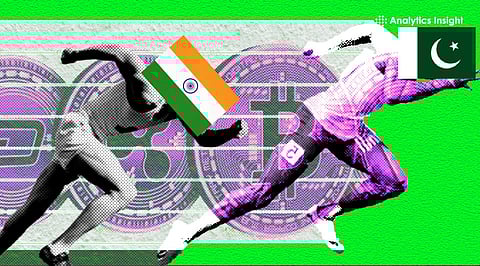
Pakistan's recent move to regulate cryptocurrencies has led to speculation that it is catching up to, or even surpassing, India in the cryptocurrency race. The headlines may indicate a giant step, but the picture is more complex when we look at data, usage, and regulatory measures.
Pakistan has recently made a major move to enable banks to serve licensed virtual asset providers, lifting a near eight-year ban on access to formal banking. This comes after the Virtual Assets Act 2026 was passed and the establishment of the Pakistan Virtual Assets Regulatory Authority (PVARA).
Bilal Bin Saqib, head of the nation's federal regulator for virtual assets, said the move was from "restriction to regulation," and "from ambiguity to institutional clarity."
Despite the restrictions, there was already a large number of crypto users in Pakistan. Estimates suggest 20-27 million users and $25 billion in 2025 transactions. This indicates demand was in response to the need for remittances, a hedge against inflation, and financial inclusion.
Now, Pakistan is seeking to build itself as a crypto hub by partnering with key industry players and projects. Binance co-founder Changpeng Zhao has been appointed as an advisor, while partnerships with platforms associated with Tron founder Justin Sun and World Liberty Financial will focus on stablecoins and remittances.
The government also wants to reserve 2,000 megawatts of electricity for Bitcoin mining and AI. Moreover, talk of a Strategic Bitcoin Reserve implies a desire to join the global cryptocurrency trend.
However, challenges remain. While considering taxation laws, experts say that the infrastructure to implement them is still in its infancy, which reduces the effectiveness of these laws.
Meanwhile, India continues with a cautious approach. Cryptocurrency is defined as Virtual Digital Assets and taxed at a 30% rate, with a 1% tax deducted at source. But there is no specific licensing regime.
This issue has been noted by policymakers. As policymakers have highlighted, taxation is being levied without "legal status, investor safeguards, or anti-money laundering regulations", thus leaving regulatory uncertainty.
India still has the edge in terms of the economy (a $4 trillion economy) and institutional capacity.
India and Pakistan are also leading in terms of global adoption. India is positioned first, and Pakistan third, according to Chainalysis’s 2025 Global Crypto Adoption Index.
This raises a pivotal question: Pakistan's regulatory advancement is in line with an existing market, whereas India's adoption is already robust despite regulatory hesitation.
Also Read: Crypto Market Update: Pakistan Lifts Crypto Banking Ban Under New 2026 Rules
Pakistan's recent actions are more of a leap from informal adoption to formal integration, not necessarily a head start on India. Its risk-taking approach will likely boost growth but could also be problematic.
India, meanwhile, remains focused on stability and taxation, despite calls for more clarity.
Join our WhatsApp Channel to get the latest news, exclusives and videos on WhatsApp
_____________
Disclaimer: Analytics Insight does not provide financial advice or guidance on cryptocurrencies and stocks. Also note that the cryptocurrencies mentioned/listed on the website could potentially be risky, i.e. designed to induce you to invest financial resources that may be lost forever and not be recoverable once investments are made. This article is provided for informational purposes and does not constitute investment advice. You are responsible for conducting your own research (DYOR) before making any investments. Read more about the financial risks involved here.
