.png)

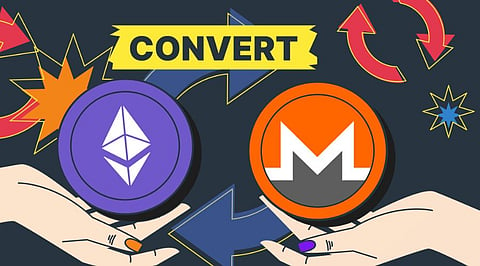
Ethereum and Monero occupy opposite ends of the transparency spectrum. Every ETH transaction is permanently visible on a public ledger, indexed by analytics firms, and increasingly linked to real-world identities through exchange KYC data. Monero, by contrast, uses ring signatures, stealth addresses, and confidential transactions to make on-chain tracing computationally impractical. For holders who want to move value out of the transparent zone, the ETH-to-XMR route is the most direct path.
Demand for that route has climbed sharply. Monero's network hash rate hit an all-time high in early 2025 as regulatory pressure on centralised exchanges intensified across multiple jurisdictions. At the same time, Ethereum's account abstraction roadmap — particularly EIP-7702, which shipped with the Pectra upgrade in May 2025 — has made ETH easier to spend programmatically, pushing more on-chain activity into the open. The combination of a more transparent Ethereum and a more capable Monero is accelerating cross-chain privacy demand.
The practical challenge is how to make the conversion without reintroducing the surveillance you are trying to leave behind. Most centralised exchanges that list both assets require identity verification before you can withdraw Monero, which negates the privacy benefit at the point of exit. Peer-to-peer options exist but introduce counterparty risk and variable liquidity. A third category — non-custodial atomic or aggregated-rate swap services — threads the needle for many users.
Non-custodial swap services work by routing the trade through aggregated liquidity rather than holding funds in a central wallet. The user sends ETH to a swap address, the service sources XMR at the current floating rate, and the XMR arrives at the user's wallet. No account is created, no email address is collected, and no identity document is uploaded. The service never takes custody of the asset — it passes through. For users who want to swap Ethereum to Monero without KYC, this architecture removes the most common privacy failure points: the registration form and the withdrawal address check.
The key questions to ask before using any service in this category are: Does the service hold funds at any point? What happens if the service goes offline mid-swap? Is the rate locked at initiation or floating? Floating-rate services execute at the market rate at the moment of processing, which means the exact amount of XMR received varies slightly from the quote — typically within a narrow spread. Fixed-rate services lock the rate but often charge a wider margin to cover the hedging cost. For most users making a straightforward private conversion, floating rate is the practical choice.
Confirmation time is the other variable worth understanding. ETH confirmation averages 12 to 15 seconds per block, but Monero confirmations require 10 blocks before funds are spendable, which adds roughly 20 minutes on the XMR side. Total swap time from ETH send to spendable XMR typically falls between 8 and 30 minutes depending on network congestion at the time of the trade. Users in a hurry should avoid periods of high Ethereum gas prices, when mempool backlogs can delay the initial leg.
Security hygiene for this kind of conversion follows a short checklist. Use a freshly generated Monero wallet address as the destination — reusing an address makes future transactions linkable to earlier ones, partially undermining Monero's stealth address system. Verify the swap service address directly from the ETH to XMR swap interface rather than copying from a third-party guide, as clipboard-hijacking malware targeting crypto addresses is documented and active. Finally, do not swap from an exchange withdrawal address; send the ETH first to a self-custodied wallet, then initiate the swap from there.
The regulatory environment around no-KYC services is evolving. Several EU member states have moved to restrict privacy coin trading on domestic exchanges under MiCA's travel rule implementation, which took broader effect in late 2025. This has not reduced demand — it has redirected it toward self-custodied solutions and non-custodial swap infrastructure that operates outside the exchange perimeter. Users should stay current with the rules in their jurisdiction, as the legal status of holding and converting Monero varies significantly across countries.
For Ethereum holders considering a private conversion, the mechanics are now straightforward enough that technical expertise is no longer the barrier. The real due diligence is in choosing infrastructure that is genuinely non-custodial, has a track record of completed swaps, and does not require personal data as part of the process. The ETH-to-XMR pair is one of the most liquid in the non-custodial category, and the tooling to execute it privately, such as GhostSwap's ETH to XMR exchange, has matured considerably over the past 18 months.
Join our WhatsApp Channel to get the latest news, exclusives and videos on WhatsApp
_____________
Disclaimer: Analytics Insight does not provide financial advice or guidance on cryptocurrencies and stocks. Also note that the cryptocurrencies mentioned/listed on the website could potentially be risky, i.e. designed to induce you to invest financial resources that may be lost forever and not be recoverable once investments are made. This article is provided for informational purposes and does not constitute investment advice. You are responsible for conducting your own research (DYOR) before making any investments. Read more about the financial risks involved here.
