.png)

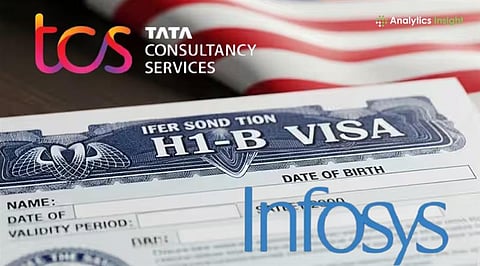
The US technology outsourcing sector is facing a major disruption after President Donald Trump introduced a $100,000 application fee for new H-1B visa hires from outside the United States. The policy, announced in September, is being viewed as the toughest clampdown yet on skilled foreign labour, and Indian IT giants Tata Consultancy Services (TCS) and Infosys are emerging as the most exposed players.
The H-1B visa program is of utmost importance for the Indian IT companies to send skilled engineers and consultants to their clients in the US.
The new fee has a huge impact on the economics of this model. The cost of bringing in foreign talent has increased substantially, necessitating a review of staffing plans and project costs for companies that regularly hire overseas talent.
Analysts note that IT consulting firms that act as intermediaries, placing workers with US clients, will feel the maximum impact. Unlike product-focused tech companies, these firms depend on scale and cost efficiency, both of which are threatened by the new rule.
A Bloomberg News analysis shows that international clients acting as middlemen will be the most affected.
At the top of that list, TCS, Infosys, and Cognizant. Between May 2020 and May 2024, nearly 90% of new H-1B hires at these companies were approved at US consulates
Infosys faces the heaviest impact, with over 93% of its new H-1B hires, around 10,400 employees, falling under the $100,000 fee, implying visa costs exceeding $1 billion.
TCS would have incurred the charge for around 6,500 workers, covering 82% of its new approvals, while Cognizant would see nearly 89% of its fresh H-1B hires over 5,600 employees.
The H-1B visa program, which offers 85,000 visas annually, has been a politically controversial issue. Critics across the political spectrum have said that the companies use the system in order to lower wages or bypass domestic hiring.
The introduction of a low-cost online lottery in 2020, leading to a sharp increase in applications, drew even more scrutiny to the visa system.
By 2024, the number of applications exceeded the number of visas issued, prompting allegations that some firms were “gaming” the system. The new fee is meant to stop mass filings and to push companies to hire locally.
While the fee is being disputed legally, several companies are already adapting. The IT firms are likely to reduce H-1B filings, raise the number of employees in foreign countries like India, and shift more work offshore.
Analysts believe that US companies will accept more off-site work as a result of cost rebalancing.
Also Read: White House Introduces Stricter H-1B Rules with $100K Fee for New Visas
Infosys has maintained that only a small percentage of its employees in the US need visa sponsorship, while others, such as IBM, have already modified their immigration policies.
Experts believe that the real effect will be reflected in the upcoming H-1B lottery cycle, in which the number of applications might decrease drastically.
The policy is likely to change the pattern of global talent migration, thereby compelling the outsourcing companies to re-evaluate their skilled professionals in the coming years.
