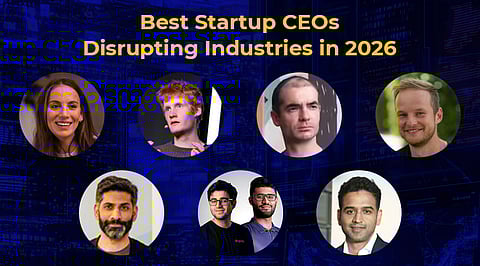
.png)

Startup success depends on execution, responsibility, and real-world impact, rather than hype or rapid funding.
Leading CEOs focus on ethical AI, sustainable systems, and practical technology that fits into everyday life.
The strongest startups solve real problems while building long-term trust across industries like AI, healthcare, energy, and fintech.
The global startup ecosystem is undergoing a massive transformation where innovation, execution, scale, and real-world impact are measures of success. A new generation of startup CEOs is driving change across artificial intelligence, fintech, healthcare, and robotics with clarity and conviction.
These leaders are building companies that solve real problems while reshaping how industries operate. They no longer focus only on funding rounds; they solve real problems and build strong systems that remain relevant even as advanced technology enters their domains. These leaders strive to improve everyday workflows, cross-functional team communication, and money management. This article lists founders and executives setting new standards across sectors.
Mira Murati is a respected leader in artificial intelligence who leads Thinking Machines Lab, one of the most valuable AI research startups. Her work involves building AI systems that are safe, transparent, and useful while adhering to strong ethical values.
The company reached valuation talks of close to $50 billion, backed by a $2 billion seed round, one of the largest in startup history. The team includes around 50 elite researchers from top global AI labs.
Murati believes AI should support people instead of replacing judgment and responsibility. Under her leadership, the company attracts top researchers who care about long-term impact.
Michael Truell leads Cursor, a platform that has changed the way developers write and manage code. Cursor helps programmers work faster by leveraging AI tools to support large-scale projects. The platform supports teams by reducing errors and improving quality.
This platform is currently used by over 1 million developers worldwide. The company crossed $1 billion in annual recurring revenue and achieved a valuation of nearly $30 billion within 3 years of launch.
While Truell supports companies with enhanced automation, he openly discusses its limitations and the importance of human review and careful testing. His balanced leadership makes Cursor a trusted name in modern software development.
Ilya Sutskever leads Safe Superintelligence, a research company focused solely on safely building advanced AI. Unlike many startups, the company avoids rushing products to market. Research integrity and safety are its top priority.
This research-first startup is valued at $32 billion, yet has no public product. Sutskever holds global discussions on how powerful AI systems should be used responsibly. His work influences not only startups but also governments and research groups across the world.
Karol Hausman leads Physical Intelligence, a company that connects artificial intelligence with real-world machines. His team builds systems that help robots learn tasks through observation and simple instructions.
This robotics-focused AI startup is valued at approximately $5.6 billion. The company raised more than $1 billion in funding from major technology investors.
Its core model allows robots to learn physical tasks through observation and language, reducing setup time by nearly 70% compared to traditional robotic systems. This shift accelerates automation across the manufacturing, logistics, and warehousing industries.
This technology allows robots to work in factories, warehouses, and other physical spaces without complex programming. Hausman’s vision helps industries improve speed, safety, and flexibility through smart automation.
Chase Lochmiller leads Crusoe, a company that supports AI growth through clean and smart energy use. Crusoe powers data centers using otherwise wasted energy sources.
This infrastructure company is currently valued at $10 billion. Crusoe operates data centers powered by stranded energy sources such as flared natural gas.
This model supports large AI systems while reducing harm to the environment. Lochmiller’s leadership shows how innovation and sustainability can grow together.
This approach cuts emissions while supporting high-performance AI computing. Crusoe’s systems now support thousands of GPUs, helping solve the energy bottleneck faced by large AI models worldwide.
Dr. Shiv Rao leads Abridge, a healthcare technology company that reduces paperwork for doctors. This platform automates clinical documentation, listens to patient visits, and creates accurate medical notes in real time.
This healthcare AI startup is valued at $5.3 billion after a $300 million funding round. The platform reduces doctors' clinical paperwork time by up to 60%.
Hospitals are actively using this system to save time and improve care. Rao’s work helps doctors focus more on patients instead of screens, bringing real value to healthcare systems.
More than 1,000 hospitals and clinics use the system. By improving accuracy and speed, Rao’s leadership strengthens patient care while addressing one of healthcare’s biggest challenges.
Also Read – 10 Best Indian Startups Using AI to Transform Healthcare in 2025
Aadit Palicha and Kaivalya Vohra lead Zepto, a company that has changed daily shopping habits in India. Zepto delivers essential items in minutes by using smart planning and local storage.
This company is valued at around $7 billion. Zepto operates over 900 dark stores and processes nearly 1.7 million orders daily.
The company is expanding into new product areas while improving efficacy. Its leadership shows how speed and discipline can work together at scale.
Annual revenue crossed Rs. 11,000 crore, with profitability targets set for early 2026. Their leadership proves that speed, scale, and financial discipline can coexist in mass-market commerce.
Nithin Kamath leads Zerodha with a strong focus on trust and simplicity. His company avoids risky growth tactics and supports long-term investing.
This is India's largest retail brokerage, managing over Rs. 4.5 lakh crore in assets. The company remains fully bootstrapped and consistently profitable.
Zerodha remains profitable and stable while helping millions better understand financial markets. Kamath’s approach proves that ethical fintech can succeed without shortcuts.
In the past 4 years, Zerodha users generated nearly Rs. 50,000 crore in investor profits, highlighting the power of long-term investing. Kamath’s approach prioritizes stability over hype in fintech disruption.
Also Read – Top 10 Fintech Unicorn Companies in India in 2025
The best startup CEOs share a common trait: a focus on meaningful impact. They build with purpose and lead with clarity. Each leader highlighted here drives innovation that solves real problems, whether through AI safety, sustainable infrastructure, healthcare efficiency, or ethical finance.
Their companies are transforming industries with thoughtful action. As technology shapes daily life, these leaders set an example of how innovation can be responsible and meaningful. These leaders' work hints at a future where technology serves people, industries, and society at scale.
1) Who is on the CNBC Disruptor list 2025?
Ans. The top companies on the 2025 CNBC Disruptor 50 list include Anduril, OpenAI, Databricks, Anthropic, and Canva. Together, these five firms hold a combined valuation of nearly $500 billion, led strongly by OpenAI’s massive $300 billion valuation.
2) What is the next big disruptive technology?
Ans. The next big disruptive technologies include artificial intelligence and machine learning, 3D printing, and 5G connectivity. These technologies are reshaping industries by improving automation, speeding up communication, and enabling smarter products and services across healthcare, manufacturing, and digital platforms.
3) What are the hottest startups right now?
Ans. Some of the hottest startups in 2025 include Perplexity AI, Scale AI, Deepgram, ZeroTier, PhotoRoom, Preply, Cradlewise, and Airalo. These companies are growing fast by solving real problems in AI, education, networking, and digital services.
4) What will be the next big thing in 5 years?
Ans. Over the next five years, artificial intelligence will deeply integrate into daily life. Generative AI will transform healthcare, education, entertainment, and manufacturing, while autonomous systems and smart tools reshape how people work, learn, travel, and access personalized digital experiences.
5) What are the 12 disruptive technologies?
Ans. Key disruptive technologies include video streaming, digital transport services, virtual reality, augmented reality, online lodging, music streaming, instant messaging apps, online encyclopedias, and other digital platforms. These innovations changed how people consume content, travel, communicate, and access information globally.
