.png)

Mahindra's INGLO platform pairs LFP battery chemistry with a floor-mounted pack, proven across the BE 6, XEV 9e, and XEV 9S
The BE 6 now offers three battery sizes: 59 kWh (140 kW DC), 70 kWh (160 kW DC), and 79 kWh (180 kW DC), each reaching 20-80% in about 20 minutes
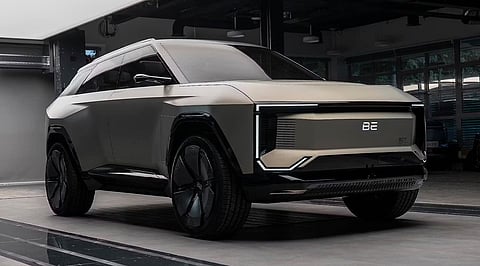
The BE 7 is expected to carry the same INGLO architecture, though its exact battery size, motor output, and charging figures are not yet confirmed
The rate of charging an electric SUV does not only depend on the figure stated on the charging station. The battery technology, temperature regulation, and the vehicle’s capability of handling the incoming charge play important roles.
The INGLO platform of Mahindra incorporates this into the BE 6, XEV 9e, and XEV 9S. The same design will be used for the future BE 7. This will give customers a point of reference before they get the specifications of their car.
INGLO is the custom-designed electric architecture made by Mahindra. The design relies on a flat or skateboard-style platform in which the battery is integrated into the bottom of the vehicle, with the body sitting on top. Low mounting of the battery helps keep the center of gravity low to help the SUV corner well. It also increases interior space because there is no engine or transmission tunnel in the way.
The BE 6, XEV 9e, and XEV 9S have been designed using this architecture, with the BE 7 coming up next as the INGLO SUV.
Battery size, motor power, and charging capabilities for the BE 7 have not been released by Mahindra and hence should be considered unconfirmed until then.
INGLO battery packs used by Mahindra are based on lithium iron phosphate (LFP) cells. LFP cells generally offer good thermal stability and can withstand a high number of charge and discharge cycles. These characteristics make them suitable for electric vehicles, although their performance and lifespan still depend on operating conditions and battery management.
However, the life of a battery depends on its operating temperature, on the way it is charged, and on the way the battery management system works together with the chemistry.
Now Mahindra offers the BE 6 in three battery pack sizes: 59 kWh, 70 kWh, and 79 kWh, with 70 kWh being an extra option offered in 2026 in order to cover the gap between the other two battery packs. kWh means kilowatt-hours and is the amount of energy a battery can store, as liters are the amount of fuel in a tank.
More power capacity means more range, but there are factors such as the weight of the car, tires, and driver's driving style to consider as well.
Four fundamental mechanisms allow for movement of an INGLO-based SUV. First, power from the battery is transferred to the motor. Next, there is a controller that manages the transfer of energy at all times. The energy is transformed into torque by the motor. This torque rotates the wheels.
BE 6 uses an interior permanent magnet synchronous motor, which is located in the rear axle. The above-mentioned design is suitable solely for BE 6, as the BE 7 design is not available yet from Mahindra.
As the SUV slows down, its electric motor works as a generator. This is how a part of the energy from the movement of the SUV is converted into electrical energy.
The BE 6 enables users to regulate the extent of this process, which is also helpful for one-pedal driving. In heavy traffic, the amount of collected charge builds up and extends the range of the car.
Monitoring and regulation of temperature and the state of charge occur continuously through the battery management system. Together with the cooling system, this system helps maintain the cells within safe levels while driving.
The cells also need to be maintained within safe levels during fast charging. As the state of charge approaches the peak of the battery's capacity, especially above 80%, the rate of charge decreases significantly.
Also Read: Kinetic Engineering's EV Strategy: Products, Investment and Growth Plans
For home charging, an AC wall box supplies alternating current, which the vehicle's onboard charger converts into direct current for the battery. Public DC fast chargers perform this conversion at the charging station and supply DC power directly to the battery. AC home charging typically takes several hours, while DC fast charging is considerably quicker.
Mahindra's stated charging figures indicate that the BE 6 can charge from 20% to 80% in approximately 20 minutes under suitable conditions, using DC chargers rated at up to 140 kW, 160 kW and 180 kW for the respective 59 kWh, 70 kWh and 79 kWh battery packs.
The kW output of the charger is always the maximum output and not a constant output. This indicates that the rate is influenced by the temperature of the battery and charge levels of it.
The true achievement of Mahindra with the INGLO is that it is not one specification but an engineering platform that can be stretched to produce many SUVs at varying levels of cost. The minute all the technical specifications of the BE 7 are released, it will be clear how Mahindra has stretched its already tested platform for its next electric SUV.
1. What battery chemistry does the Mahindra BE 7 use?
Mahindra has not confirmed the BE 7's battery chemistry yet. Based on the shared INGLO platform, it is expected to use the same lithium iron phosphate (LFP) cells found in the BE 6, XEV 9e and XEV 9S, valued for their thermal stability and long cycle life.
2. How fast can the Mahindra BE 7 charge?
The BE 7's charging speed has not been officially announced. As a reference, the BE 6 charges from 20% to 80% in about 20 minutes using DC fast chargers rated at 140 kW, 160 kW, or 180 kW, depending on the battery pack. The BE 7 is expected to offer similar fast-charging capability once its final specifications are released.
3. What battery sizes might the Mahindra BE 7 offer?
Mahindra has not confirmed the BE 7's battery options. The BE 6 currently offers 59 kWh, 70 kWh and 79 kWh packs, and since the BE 7 shares the same INGLO architecture, it could follow a similar multi-battery approach, though this remains unconfirmed.
4. Does the Mahindra BE 7 use the same platform as the BE 6?
Yes, current reports indicate the BE 7 will be built on Mahindra's INGLO platform, the same dedicated electric architecture used by the BE 6, XEV 9e and XEV 9S. This gives it the same floor-mounted battery layout and low center of gravity.
5. When will Mahindra officially confirm the BE 7's specifications?
Mahindra has not announced an exact date for revealing the BE 7's battery, motor and charging details. Until then, the BE 6's confirmed specifications remain the closest available reference for what the BE 7 is likely to offer.