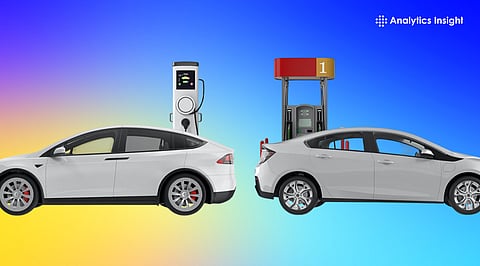
.png)

Electric cars offer lower running costs and cleaner travel where charging access is reliable.
Hybrid cars provide a longer range and flexibility for mixed driving and limited charging areas.
Car choice in 2026 depends more on daily usage patterns than market trends.
The automotive industry has undergone a significant shift from previous years. While gas vehicles are still available, there are now many electric and hybrid models to choose from. In fact, Electric Vehicles make up about 25%-30% of the global auto market and Hybrid vehicles, which include both Standard Hybrids and Plug-In Hybrids, account for roughly 20% of all global auto sales. This change in consumer habits is largely due to rising fuel costs, the introduction of cleaner energy initiatives and significant advances in vehicle technologies.
All electric cars rely solely on batteries for their power; as a result, these vehicles utilize electric motors to propel themselves forward, using either home and/or public charging stations to recharge the battery. Hybrid vehicles, on the other hand, contain an Internal Combustion Engine (ICE) and an electric motor.
With Standard Hybrids, the batteries are charged while the vehicle is in motion, whereas Plug-In Hybrids can drive for 40 to 80 kilometers using just the battery before switching to ICE mode to continue moving forward. That’s why these two very different types of vehicle operation, maintenance costs associated with ownership and experiences for drivers will be vastly different as well.
As of 2026, EVs are going to cost more than an ICE-powered vehicle when purchased new. Prices for mid-level EVs in many markets will range from Rs. 18 lakh to Rs. 30 lakh, depending on battery pack and features. Although the cost of batteries has decreased approximately 85% since 2010, the battery remains the priciest component in an EV's overall price structure.
Hybrid cars usually cost 10% to 20% less than similar electric models. Fuel savings help reduce overall spending. Most hybrids deliver fuel efficiency of 20-28 km/l. Traditional petrol cars average around 12 to 15 km/l.
Running costs highlight a clear difference. Charging an electric car often costs less than Rs. 1.5 per km. Petrol cars usually cost Rs. 6 to Rs. 8 per km. Hybrids fall between these two at about Rs. 3 to Rs. 4 per km. Maintenance expenses are also lower for electric cars. Data shows service costs can be up to 30% lower over five years due to fewer mechanical parts.
Range anxiety has reduced but still exists. Most new electric cars in 2026 offer 400 to 500 km on a full charge. Fast chargers can provide up to an 80% charge in around 30 to 40 minutes. Charging availability differs widely between cities and highways.
Hybrid cars avoid this issue. With fuel and battery combined, the driving range often crosses 800 km. This suits long highway trips and areas with fewer charging points. Plug-in hybrids offer a mixed approach. Short daily trips can be completed using electricity, while fuel supports longer travel.
Also Read: Best Electric Cars for Highway Driving
Electric cars deliver instant power. Many mid-range models reach 0 to 100 km/hr in under 7 seconds. The drive feels smooth and quiet, especially in city traffic.
Hybrids focus more on efficiency. Acceleration is steady and engine noise stays low at slower speeds. Newer hybrid systems have improved performance, but electric cars still feel quicker in stop-and-go conditions.
Electric cars produce zero tailpipe emissions. When measured across the full lifecycle, including battery production, emissions remain lower than petrol cars by about 40% to 60% in regions using cleaner electricity.
Hybrid cars still burn fuel but reduce emissions by around 25% to 35% compared to petrol vehicles. They help cut pollution in places where charging access remains limited.
Charging access plays a major role in ownership experience. Areas with strong charging networks see faster electric vehicle adoption. Apartment living and limited public chargers still create challenges.
Home charging reduces daily costs and makes electric cars easier to manage. Without home charging, hybrids often feel more practical.
In 2026, electric cars suit drivers with fixed daily routes, charging access, and a focus on lower running costs and cleaner travel. Hybrid cars suit longer journeys, mixed driving needs, and locations with limited charging support. The choice depends on daily use rather than trends. Electric cars lead in efficiency and lower emissions. Hybrids balance range and convenience. Both options hold strong value in the current car market.
1. What are the main reasons buyers are shifting away from petrol cars in 2026?
Rising fuel prices, lower operating costs, cleaner energy goals, and advances in electric and hybrid technology drive the shift.
2. Are electric cars cheaper to own over time despite higher purchase prices?
Lower charging and maintenance costs often reduce total ownership expenses over several years.
3. Do hybrid cars require regular charging like electric vehicles?
Regular hybrids self-charge while driving, while plug-in hybrids need charging for electric-only use.
4. Is driving range still a concern for electric car owners?
Range has improved, but charging availability still affects long trips and highway travel.
5. Which car type suits areas with limited charging infrastructure?
Hybrid cars suit such areas due to fuel backup and a longer combined driving range.
