.png)

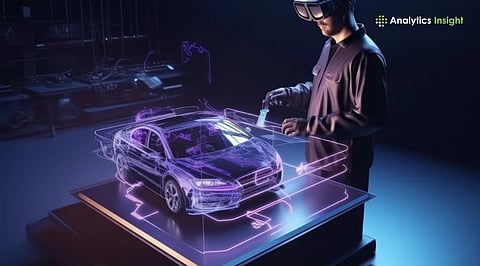
The automotive industry is racing ahead with 26% AI adoption in 2026, setting the pace for global manufacturing transformation.
From smart factories to autonomous vehicles, AI is redefining how cars are built, tested, and experienced.
With rising investments and rapid innovation, AI is no longer optional; it’s the engine driving the future of mobility.
The automotive sector has emerged as a frontrunner in artificial intelligence adoption, reaching an impressive 26% adoption rate in 2026, according to an Analytics Insight study. Automotive companies are leveraging AI as a strategic driver of innovation, efficiency, and competitiveness. AI is expected to change the way vehicles are built. Let’s take a look at the other major findings from this study.
The study captures insights from 500 manufacturing professionals worldwide, covering the full spectrum of AI maturity from early experimentation to large-scale autonomous systems. The primary objective of the survey is to provide manufacturing leaders with a reliable, actionable baseline for AI adoption in the manufacturing sector.
The data was collected using Google Forms, and the respondents are senior professionals from industries ranging from automotive, electronics, industrial equipment, and consumer goods, among others. The respondents are C-level, VP, directors, operations managers, consultants, and analysts. The geographic coverage is broad, ranging from North America, Asia Pacific, Europe, the Middle East and Africa, and Latin America, indicating a global perspective.
Also Read: 10 Automotive Companies Using AI to Transform Mobility in 2026
The data from the study shows that AI adoption is accelerating around the world, and more companies are moving from pilot programs to an operationally deployed model. According to the study, a vast majority of companies have implemented AI into at least one function within their organization, which indicates a transformative shift.
AI adoption varies with organizational scale. North America leads with 36% of surveyed organizations, reflecting strong investments in automation and digital technologies. Asia-Pacific follows at 22%, driven by major manufacturing hubs, and Europe accounts for 18%, showing steady Industry 4.0 adoption.
The high adoption rate of AI technology in the automotive industry can be attributed to the industry's complex, highly data-driven systems. AI is also a crucial element in autonomous driving, as it helps vehicles make intelligent decisions by processing real-time data.
Manufacturers use robotic manufacturing processes and AI analytics to improve production efficiency, reduce manufacturing defects, and optimize supply chain operations. Predictive maintenance systems also reduce manufacturing downtime and the associated costs.
In addition, AI's integration into the connected-vehicle environment and the IoT ecosystem enables automotive manufacturers to gather staggering amounts of data. It influences the transformation of consumer experiences and provides better mobility solutions.
The manufacturing sector is also increasing investments in AI to improve efficiency, operational impact, and capabilities. The sector is increasingly focusing its investments on AI to improve operational efficiency, which accounts for 41% of total investments.
Key priorities include addressing labor and skills gaps (21%) and improving product quality (18%), reflecting workforce challenges and the drive for superior outputs. Investments in supply chain resilience (13%) and innovation and sustainability (8%) show a growing focus on strategic, forward-looking objectives beyond immediate gains.
AI investment in manufacturing is firmly expansionary, with 78% of companies planning to increase their budgets over the next two years.
AI adoption is significantly improving business performance within the automotive sector. Companies incorporating AI into their operations are generating more efficiencies, greater productivity, and profitability. The ability of companies to use AI-generated information to support their decision-making helps them make informed decisions across all aspects of their business.
AI is also providing real-time diagnosis support for vehicles to improve safety systems and develop a seamless integration of software. The competitive advantage created through superior technology gives early adopters of AI the ability to lead the charge in this quickly changing environment.
About 18% of respondents emphasize enhancing product quality as a key focus area for AI. It reduces defects, minimizes waste, shortens cycle times, and improves asset utilization. AI also mitigates skill shortages, supports operational decision-making, and augments human capabilities through automation and intelligent process assistance.
AI-guided robotics is currently used by 41% of manufacturers. The survey results show that human-machine collaboration will create a major impact on workforce dynamics.
Manufacturers show varying levels of data readiness for AI adoption. While some organizations possess well-integrated and structured data environments, many still face integration, quality, and connectivity challenges.
Artificial intelligence still has several adoption challenges: expensive to develop, a lack of access to talented workers, and privacy concerns over information. The global economy of AI in automotive is expected to grow larger and faster than any other, working to meet consumers' demands for more connected and intelligent vehicles.
Manufacturers need data science expertise, engineering skills, operational technology, information technology integration knowledge, and artificial intelligence governance capabilities.
The use of AI-powered systems creates new security vulnerabilities that affect all connection points between devices and cloud services and between information technology systems and operational technology systems.
Organizations need to develop permanent systems for their workforce and infrastructure, as well as their governance framework, to successfully implement artificial intelligence across their operations.
Also Read: Top Data Science Applications in the Automotive Industry
Survey data shows that 42% of respondents view AI’s impact as transformational, which completely changes their work duties, while 45% view it as augmental because it boosts their efficiency without removing their actual work tasks.
About 33% of manufacturers are exploring AI agent adoption, but expect implementation to occur beyond 12 months.
Manufacturers are increasingly exploring AI-driven revenue streams, which indicates their transition to intelligent operational systems that integrate multiple functions to boost their efficiency and drive innovation and competitive advantage.
The factory of 2030 will focus on human-machine collaboration, which helps people work better with machines. Organizations that implement AI with careful design will achieve productivity improvements and cost reductions while creating long-term competitive advantages and better resilience and strategic market leadership in intelligent manufacturing.
1. Why is the automotive industry leading AI adoption in 2026?
The automotive industry leads AI adoption due to its highly data-driven nature and need for precision. AI supports autonomous driving, predictive maintenance, and supply chain optimization, making it essential for improving efficiency, safety, and innovation.
2. How is AI used in automotive manufacturing?
AI is used in robotics, quality control, predictive maintenance, and supply chain management. It helps detect defects, optimize production lines, reduce downtime, and enhance overall manufacturing efficiency and consistency.
3. What role does AI play in autonomous vehicles?
AI enables vehicles to process real-time data from sensors and cameras, helping them make intelligent driving decisions. It is essential for navigation, obstacle detection, and ensuring safety in autonomous driving systems.
4. Are companies increasing their investments in AI?
Yes, most companies are expanding their AI budgets. The study shows that a large percentage of manufacturers plan to increase investments to improve efficiency, innovation, and long-term competitiveness.
5. What is the future of AI in the automotive industry?
The future includes smarter factories, advanced human-machine collaboration, and increased use of AI in mobility solutions. AI will continue to drive innovation, improve productivity, and create new business opportunities in the industry.
