.png)

Industrial automation systems are increasingly deployed in environments where operating conditions are far from ideal. High temperatures, corrosive chemicals, continuous operation cycles, and mechanical stress place significant demands on equipment reliability. While automation software, control logic, and sensor networks continue to advance rapidly, the physical materials supporting these systems often determine whether performance gains can be sustained over time.
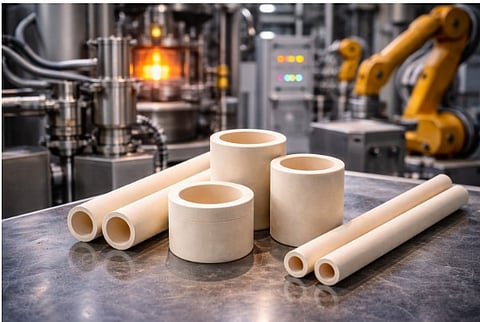
In harsh industrial processes, material degradation is a common root cause of unplanned downtime and performance drift. Components exposed to heat or chemical attack may deform, corrode, or lose dimensional stability, affecting alignment, insulation, and measurement accuracy. To mitigate these risks, engineers are increasingly evaluating alternatives such as alumina ceramic tubes enhancing automation reliability in high-temperature industrial environments, which offer stable behavior under thermal and chemical stress conditions commonly found in automated plants.
As automation systems become more tightly integrated and data-driven, minimizing physical variability is essential to maintaining predictable and reliable operation.
Several production lines are designed to run in environments with accelerated rates of material degradation. They can experience high temperatures coming from a furnace, reactor, or heat processing equipment, which may result in constant expansions and contractions. Further, they might experience chemically aggressive vapors and liquids on their surfaces as well as mechanical fatigue resulting from vibration and motion.
These materials, such as metals and polymers, usually require a coating, frequent maintenance, and/or replacement to deal with such problems. Even so, their degradation can cause small changes in the accuracy of the system.
These issues raise the importance of choosing materials that have an inherent ability to withstand harsh environments rather than just depending on protection methods.
Advanced ceramics, such as alumina ceramics, are also increasingly used in automated systems, particularly where conventional materials limit applications due to their properties. Advanced ceramics possess high melting points, low thermal expansion, as well as resistance to chemicals and abrasion.
When considering an automated facility, potential application modes of alumina ceramics include protective sheaths, insulators, structural spacers, and even guiding components. These would generally not be part of the main system, although they are significant for maintaining overall stability of sensors, actuators, and mechanical components.
Through its properties in terms of geometry and surface, advanced materials are important in ensuring that robotic operations are effective over long service life.
Automation relies on precise coordination between mechanical motion, sensing, and control logic. When physical components shift or degrade, even slightly, control systems must compensate for changes that were not part of the original design assumptions.
Stable materials reduce this burden. Components that resist deformation and wear help preserve alignment and spacing, supporting accurate sensor readings and repeatable actuator motion. In structural and support roles, alumina ceramic rods applied in robust industrial automation components can contribute to long-term mechanical stability in assemblies exposed to heat and vibration.
This stability allows control algorithms to operate within expected parameters rather than continuously adapting to physical drift.
From an operational viewpoint, the selection of materials influences the maintenance strategy and increases costs. A consumable component increases the need for maintenance activities, parts replacement, and unplanned outages.
Advanced materials that retain their performance over long periods minimize such challenges. Although the upfront cost of such materials might be higher, the reduced number of maintenance interventions and higher system availability often justify lower overall cost of ownership.
In the case of continuously running or hard-to-reach plants that use automation, these benefits can be substantial.
It is also important to note that the improvement of the reliability of automation systems does not necessarily require the replacement of conventional materials with new materials; rather, engineers increasingly utilize advanced materials in selected applications, only applying them where environmental stress or wear had limited performance in the past.
This strategy necessitates cooperation between automation engineers, mechanical designers, and material experts. By grasping how physical degradation most strongly affects system performance, experts can utilize sophisticated materials where they add maximum value.
Accordingly, as industrial automation technologies continue to advance towards various efficiencies and the introduction of tolerances, material performance has emerged as a fundamental attribute of reliability within the system. Advanced materials have been recognized as a means to simplify the reduction of variance in harsh industrial processes while increasing component life for automated systems.
By matching material choice with environmental demands, it is also possible to improve the robustness of automated plants and ensure that digital intelligence is well-supported by a robust physical foundation.
