.png)

Seeing crop stress early changes everything. When problems are spotted days before visible damage, farmers can act faster, save crops, and avoid large losses later in the season.
Targeted application reduces waste without hurting results. Spraying and irrigation only where needed lowers chemical and water use while keeping yields strong and input costs under control.
Access matters more than ownership. Shared services and trained operators allow even small farms to benefit from aerial crop monitoring without heavy upfront investment.
Farming has always relied on reading leaf colors, soil feel, and rain timing. These signs still matter, but they can be seen earlier and understood more clearly through modern technology. Drones and data systems help farmers spot problems before they spread, act faster, and manage costs with better control.
This process is about strengthening experience through modern techniques. Let’s take a look at how AI and drones in agriculture are changing crop planting, irrigation, pest removal, and other important processes.
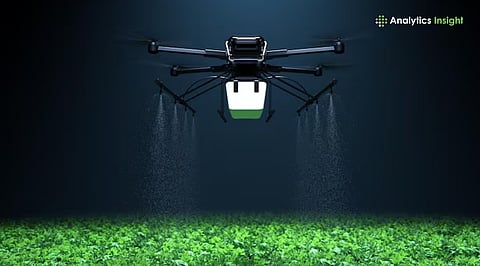
Agricultural drones are no longer new or experimental. They are now commonly used on large farms and shared by smaller farmers through service providers. The global agricultural drone market was worth about $3.37 billion and is expected to grow past $10 billion before the decade ends, with North America leading adoption through precision and sustainable farming.
India is growing even faster, with the market rising from roughly $0.24 billion in 2025 to an estimated $2.11 billion by 2033, driven by labor shortages, higher farming costs, and government support. Rotary-wing drones are the most popular because they can hover, spray accurately, and handle uneven land, and falling prices are now making them practical for farms of all sizes.
Also Read: How AI is Transforming Agriculture?
Crop surveillance depends on how drones gather and interpret data. Modern agricultural drones employ multispectral and hyperspectral imaging to visualize light that is not visible to the human eye, aiding in the detection of plant stress days or even weeks before it becomes apparent.
The alert given in advance enables farmers to remedy the problems, such as lack of nutrients, at a low cost rather than letting it affect the yield later. With centimeter-level accuracy from Real-Time Kinematic GPS, drones can apply fertilizers, pesticides, or seeds only where they are needed, reducing waste and improving results across the field.
Images alone do not help farmers. The real value comes from understanding what these visuals show. Pattern-based systems analyze thousands of drone images to spot diseases, pests, water stress, and uneven growth, using past seasons, weather, soil data, and crop stages to improve accuracy over time.
AI-powered detection of diseases in crops such as cotton and wheat has become highly accurate. It has been a great help to farmers in Maharashtra who have reduced their use of chemicals by almost 40% and Punjab traders who have got an increase in their harvest by 25% through selective spraying instead of blanket spraying, which all of them have been doing so far.
Also Read: Best 10 Agricultural Drones for Spraying Fertilizers & Pesticides
Drone-based crop surveillance is already changing how farms control risk, costs, and yields. When accurate data supports a farmer’s experience, decisions get sharper, and losses drop. These tools are no longer optional for competitive farming.
AI usage is becoming a part of daily agricultural work. Farmers who adopt early gain confidence and control, while delays only increase pressure. Users should consider doing their own research before utilizing specialized devices and technology to improve daily tasks.
What role do drones play in crop surveillance?
Drones help farmers monitor entire fields quickly from the air. They capture detailed images that reveal crop stress, pest activity, water issues, and uneven growth long before problems are visible from the ground.
How does drone-based crop monitoring help increase yields?
Early detection allows timely action. When disease, nutrient gaps, or pest movement are identified early, farmers can treat only affected areas and prevent yield loss across the field.
Can drones really reduce pesticide and water usage?
Yes. Targeted spraying applies chemicals only where needed instead of across the whole field. This often cuts pesticide use by 30 to 50 percent and reduces water use through more accurate irrigation planning.
Is drone technology suitable for small farms or only large ones?
It works for both. Small farms often use shared services or hire trained operators instead of owning drones. This makes crop surveillance affordable without heavy upfront investment.
What types of problems can drones detect in crops?
They can identify early signs of disease, pest infestation, nutrient deficiency, water stress, and uneven plant growth. These signals appear in aerial data before they are visible to the human eye.
