.png)
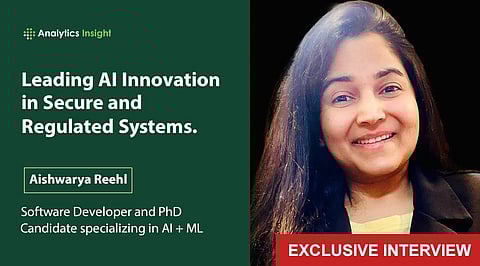
Leading AI Innovation in Secure and Regulated Systems

In the ever-evolving world of AI and machine learning, few professionals combine technical depth with real-world impact as effectively as Aishwarya Reehl. With a career spanning cloud-based applications, data-driven solutions, and systems for handling sensitive information in regulated environments, Reehl is at the forefront of innovation in secure, scalable technology. In this exclusive interview with Analytics Insights, she shares her journey from early software development to leadership in AI and product strategy, offering valuable insights for emerging technology leaders and innovators shaping the future of enterprise systems.
Give a brief overview of your background and your current role.
I am a software engineer specializing in artificial intelligence and machine learning, with experience building full-stack and cloud-based applications in government and regulated environments. My work focuses on developing reliable, scalable systems that handle sensitive data while applying modern AI techniques, including large language models, to real-world engineering challenges.
I am also currently pursuing a doctoral degree in computer science, with my research focused on AI and machine learning. Alongside my academic work, I continue to work as a software developer, combining hands-on engineering with a deeper focus on advancing intelligent systems.
What past experiences, achievements, or lessons have shaped your journey as a technology and product leader?
My career has evolved from hands-on engineering into owning systems end-to-end, with a consistent focus on turning complex technology into real business outcomes.
I started at PNC Mortgage, where I worked across the full software lifecycle, building .NET applications and managing sensitive financial data at scale. That experience grounded me in reliability, data integrity, and the realities of maintaining production systems, while also giving me early exposure to leading distributed teams.
At the Maryland Insurance Administration, my role expanded into systems modernization, where I led efforts around document management, database redesigns, and large-scale data migrations. That’s where I really learned that impact comes from simplifying systems and designing for long term scalability, compliance, and usability.
At the U.S. International Development Finance Corporation, I moved into enterprise-level work, leading integrations across platforms like Salesforce, Oracle, and Bloomberg. This shifted my thinking toward building connected ecosystems rather than standalone tools, while also strengthening my ability to translate complex business and financial requirements into practical technical solutions.
Kindly mention some of the key challenges you faced during the initial phase of your journey in the technology and product development field.
One early challenge was moving from academic and task-based work into production systems, where building a feature is very different from maintaining something that supports real users and sensitive data. Things like deployments, dependencies, and long-term reliability quickly became critical.
Later, in government and regulated environments, the challenge shifted to balancing innovation with strict compliance and security requirements. Designing within those constraints taught me discipline and a stronger appreciation for building systems that are both scalable and governed.
Describe some of the vital attributes that every modern technology and product leader should possess.
Two key attributes matter most. First is systems thinking, understanding how data, algorithms, infrastructure, and user behavior all connect as one ecosystem, not separate pieces. This is what allows you to design end-to-end solutions that actually work in real-world environments.
Second is the ability to translate research into application, taking academic ideas, identifying gaps, and turning them into practical, testable systems. This is what bridges theory and real impact.
How do you innovate your products or solutions to ensure they appeal to your target audience and address evolving user needs?
My approach to innovation is pretty simple, it starts with understanding real user needs and building from there. I focus on actual workflows and pain points so the solution is grounded in something practical, not assumptions.
From there, I use data and feedback to continuously refine how the system performs. Whether it’s usage patterns, performance metrics, or system behavior, I’m always looking at what’s working and what needs to improve.
I also design systems to be flexible and modular, so they can evolve over time without needing to be rebuilt from scratch. That’s especially important in AI and data driven environments where requirements change quickly.
At the end of the day, I try to keep things clear and usable. Even complex systems should be easy to understand and act on. That’s what keeps innovation practical and aligned with what users actually need.
How are disruptive technologies like Artificial Intelligence, Big Data, Cloud Computing, and Automation impacting today’s innovation landscape, and how has your role evolved as a leader over the years?
AI has transformed how we build intelligence into systems, moving from rule-based logic to models that learn from data and improve over time. Big Data has enabled organizations to make decisions based on patterns at scale rather than intuition. Cloud Computing has removed infrastructure constraints, allowing rapid experimentation, global scalability, and faster deployment cycles. Automation has reduced manual effort in repetitive processes, enabling teams to focus more on optimization, intelligence, and user experience.
Together, these technologies have changed innovation into a faster, more iterative, and more interconnected process, where systems are expected to evolve continuously rather than remain static.
What is your advice for budding or emerging technology leaders, product managers, and tech executives?
My advice to emerging technology leaders, product managers, and tech executives is centered on developing both technical depth and systems-level judgment, while staying grounded in real user and business value.
Overall, effective leaders combine technical depth with product intuition and a strong focus on outcomes and impact.
How do you see industry evolving in the future?
The industry is clearly moving toward systems that are more intelligent, automated, and able to adapt in real time, rather than static applications that don’t change much once they’re built.
AI is becoming part of the foundation, not just an add-on. It’s showing up across everything from decision-making to customer experience to how software itself is developed, constantly learning and improving how systems perform.
At the same time, companies are shifting to a more data-first mindset. Instead of building around applications, the focus is on how data is collected, connected, and used across systems, because that’s where the real value is coming from now.
What final advice would you like to share with emerging technology and product leadership professionals?
My advice for emerging technology and product leaders is to focus on what compounds over time rather than what is immediately visible.In the long run, the most effective technology and product leaders are those who combine technical depth, product intuition, and disciplined execution with a strong sense of responsibility for impact.
The industry is moving toward systems that can learn and adapt on their own, where AI, data, and automation work together in real time. Instead of static tools, we’ll see technology that continuously improves, helping people and machines work side by side to tackle complex problems more efficiently and at scale.
