.png)

AI simulations help investors evaluate stocks using contrasting value and high-growth strategic frameworks simultaneously.
Buffett mode prioritizes fundamentals, cash flows, moats, and disciplined, long-term valuation-driven decision-making.
Musk-style analysis emphasises the potential for disruption, technological scale, aggressive reinvestment, and exponential future market opportunities.
AI tools now allow investors to simulate, backtest, and optimize strategies across millions of historical data points. They compress years of trial and error into minutes. Artificial intelligence lets you experiment with disciplined value investing and high-risk, high-reward moonshot thinking. It becomes easy to figure out which approach fits your goals and risk appetite.
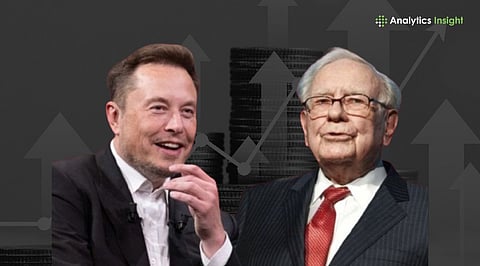
The most sophisticated models even draw on the contrasting investment philosophies of two of the world's most influential figures: Warren Buffett and Elon Musk.
As stock market participation increases, many investors look for frameworks that offer strategic clarity rather than confusion. The latest artificial intelligence models trained on the public writings, interviews, and documented strategies of Warren Buffett and Elon Musk can help you better understand the market. However, they do not promise any market-beating stock tips.
Instead, they provide a structured simulation of two contrasting approaches to wealth creation. Warren’s model is rooted in patience and predictable cash flows, while Musk’s model focuses on technological disruption and exponential growth. Investors can pressure-test an idea through both lenses within minutes.
When prompted to respond like Warren Buffett, the AI shifts the focus to fundamentals. It examines the company’s business model, competitive advantage, and earnings to justify long-term ownership.
Valuation becomes central to the discussion, and the concept of safety margin repeatedly surfaces. The tone is not that of a stock picker chasing quick gains but of a mentor insisting on discipline.
In markets often driven by momentum and sentiment, this simulated version of Buffett’s thinking ensures investors review balance sheets, return on capital, and management quality before making a decision.
Also Read: Democratizing Global Wealth: How AI-Driven Wealth Tech Is Redefining Global Investment Strategy
The shift to an Elon Musk-style analysis moves the conversation away from present-day profitability towards the scale of future opportunity. It evaluates whether a business can dominate an emerging category.
Sectors such as artificial intelligence, electric mobility, space technology, and robotics naturally score higher in this framework as their potential upside is disproportionately large. The AI model emphasizes timing technology curves, building platforms, and backing aggressive reinvestment, a mindset that mirrors Musk’s approach to business.
The most effective use of these tools lies in treating them as analytical counterweights. A company that appears compelling through a high-growth, disruption-focused lens may fail the Buffett-style test of cash flows and valuation. Conversely, a steady, profitable firm that comfortably meets value-investing criteria may seem too slow or limited when examined for exponential potential.
This dual analysis helps investors identify their own biases and emotional tendencies, which often influence buying and selling decisions more than data. Several fintech platforms are now building products around this idea, using AI to scan financial statements, track institutional activity, and flag companies that align with specific investing philosophies.
The popularity of the concept has also led to a surge in misleading advertisements and deepfake videos claiming that Warren Buffett or Elon Musk has launched an AI-powered trading system that guarantees quick profits. These claims are entirely false. Neither investor sells automated stock-picking software, and any service seeking upfront payment while using their likeness should be treated with extreme caution.
Also Read: Top AI-Driven Supply Chain Solutions Providers in 2026
Artificial intelligence cannot replicate Buffett’s temperament or Musk’s tolerance for risk, both of which have been shaped by decades of experience and conviction. However, it can compress years of accumulated investing wisdom into a structured, conversational format that helps individuals think more clearly before they act.
The AI model based on Buffett teaches restraint, while the Musk-centric AI model encourages imagination. The space between the two offers something far more useful than a hot tip, a more balanced, self-aware investor navigating an increasingly complex market.
What is an AI Buffett or AI Musk investing tool?
These are artificial intelligence models trained on public statements and strategies that simulate how each billionaire might evaluate a business or investment opportunity.
Do these AI tools give real stock recommendations or guaranteed returns?
No, they provide only analytical perspectives based on specific investment philosophies and should not be treated as financial advice or profit-generating systems.
How does the Buffett-style AI approach analyse a company?
It focuses on fundamentals such as consistent earnings, competitive advantages, strong management quality, long-term ownership potential, valuation discipline, and maintaining a clear margin of safety.
How is the Musk-style AI analysis different from value investing frameworks?
It prioritises future market size, technological disruption, scalability, aggressive reinvestment, and the probability of category dominance rather than present profitability or balance-sheet stability.
Are there risks in using AI tools based on the famous investors?
Yes, misleading ads and deepfakes falsely claim billionaire endorsements, so investors must avoid paid schemes promising quick profits and use only credible, transparent platforms.
