.png)

Farms are no longer waiting for recommendations. Decisions now turn into action instantly, helping save water, reduce waste, and protect yields.
Productivity is growing without increasing labor. Machines handle repetitive work around the clock, while farmers focus on planning and oversight.
Precision at the plant level is improving both profits and resource use, making farming more resilient in uncertain conditions.
Agricultural practices have changed significantly in recent times. Reading soil and weather patterns has become faster and more precise with the integration of technology. Digital systems now help farmers evaluate these signals instantly and act on them without delay.
Fields are managed in real time through automation. This quiet shift is changing how agriculture works at its core. Let’s take a closer look at how artificial intelligence is helping agricultural experts and how they have revolutionized farming practices.
For a long time, technology only helped farmers prepare. It only gave them warnings about rain, pests, or possible yields. Today’s systems can spot a problem, decide the best response, and act right away.
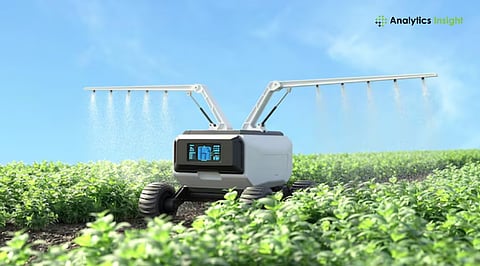
If one part of a field is dry, only that area gets water. If a weed appears, it is dealt with before it harms the crop. The equipment even adjusts planting depth as it moves, using live soil data. Farming has shifted from guessing what might happen to responding instantly to what is happening now.
Also Read: Best 10 Agricultural Drones for Spraying Fertilizers & Pesticides
Labor shortages have led farms to rely less on manual labor and more on autonomous machines. These machines do not need breaks or shifts. Autonomous tractors now operate day and night, using cameras, satellite signals, and continuous adjustments to remain accurate.
More miniature robots move through fields row by row, spotting weeds one plant at a time and removing only what is needed. This reduces chemical use, protects soil health, and lowers costs. The goal is not to replace people, but to reduce strain. Farmers spend more time planning and supervising, not repeating the same physical tasks.
One of the biggest changes in farming is happening away from the field. Today, digital models can test soil types, weather extremes, and crop traits on a computer before any seeds are planted. Millions of possibilities are checked in a short time.
Ideas that do not work are dropped early, while strong ones move faster to real-world trials. This cuts development time that used to take many years. It also helps crops handle heat, irregular rainfall, and water shortages.
Traditional farming manages an entire field the same way. Modern agricultural practices study each plant individually. Agronomical AI systems can tell which areas need more water and which do not, even within the same plot. Fertilizers are added only where nutrient levels are low, and pesticides are used only on affected plants rather than across the whole field.
This precise approach reduces waste and helps crops to stay safe during unpredictable weather. Many farms now produce the same yields while using far less water and fewer inputs. It also improves planning, as harvest sizes can be predicted weeks in advance, reducing storage problems and transport delays.
The financial benefits are now clear. Farms that use automation and data-driven management are achieving higher yields while spending less on chemicals, fuel, and water. This leads to stronger profit margins, even in unstable markets.
Large farms recover their investments quickly through higher efficiency. Smaller farms can also benefit by using shared equipment or rental services, without high upfront costs. What ties all of this together is confidence. Farm decisions are based on real data, not guesswork.
Even with progress, some problems slow adoption. Reliable internet remains uneven in rural areas, so many systems need to operate offline, which increases costs. Farmers also worry about who owns their data, especially sensitive information about soil and yields.
Equipment prices remain high, making it harder for independent farmers to invest. While rental and shared models are growing, cost still affects how fast new tools are adopted. These challenges are about infrastructure and trust rather than technology.
Also Read: How AI is Transforming Agriculture?
The change introduced by AI tools is not about replacing farmers. These devices help them stay in control as the weather becomes less predictable, labor harder to find, and costs tighter. Modern farming is becoming more efficient.
Decisions are made faster, waste is reduced, and farms become more resilient. For those ready to adapt, these tools are no longer experiments. They are practical, proven, and ready to use.
How is modern farming different today compared to a few years ago?
Farming has moved from manual observation to real-time action. Fields are continuously monitored, and decisions such as watering or weed removal are made instantly rather than waiting for human review.
Does modern farming technology replace farmers?
No. It reduces repetitive and physically demanding work. Farmers stay in control and focus more on planning, crop strategy, and business decisions.
How does modern farming technology help save water and inputs?
Water, fertilizers, and chemicals are applied only where needed. Instead of treating an entire field the same way, each section or plant gets precise attention.
How accurate are yield and harvest predictions?
Modern models forecast output with high reliability, helping farmers plan storage, transport, and sales well before harvest begins.
What are the main challenges slowing adoption?
Cost, connectivity gaps, and concerns over data ownership remain key barriers. Trust and infrastructure matter as much as technology itself.
