.png)

AI data centers have a major impact on the increase in global electricity demand.
Emissions from data centers vary depending on the energy source and the type of cooling systems used.
The next wave of digital growth will be characterized by sustainable infrastructure.
Artificial intelligence requires vast amounts of computing power, supplied by data centers that operate around the clock. With AI gradually being adopted in sectors such as healthcare, finance, manufacturing, and research, the environmental damage caused by the technology has become concerning not only for policymakers but also for the industry.
Understanding the relationship between AI and the environment involves monitoring energy consumption, water usage, infrastructure expansion, and the resulting impact on the climate over a long period.
AI systems operate on powerful processors that constantly execute complex mathematical operations. Training giant models requires thousands of high-performance chips working continuously for long hours.
Key contributors to energy demand include:
High-density computing hardware
Continuous server uptime
Large-scale data storage
Advanced cooling systems
Conventional cloud services already consume large amounts of energy. AI systems, on the other hand, have a greater energy consumption due to their high computational intensity.
The main factor determining carbon emissions from data centers is the source of electricity. A data center powered by coal will have a significantly larger carbon footprint than one powered by renewable energy.
Backup power generators running on diesel, as well as other equipment, emit greenhouse gases while they are working.
Carbon emissions increase indirectly when power is generated from fossil fuels.
Manufacturing servers, processors, and other cooling devices also contributes to the overall environmental impact of this sector.
Estimating emissions requires a full-lifecycle approach, including both the energy consumed by AI operations and the energy required to produce AI components.
AI data centers generate large amounts of heat; as a result, cooling systems are essential to prevent hardware from overheating and to maintain performance.
Different types of cooling methods include:
Air-based cooling systems
Liquid cooling technologies
Evaporative water cooling
Intensive water use in drought-stricken areas poses sustainability challenges. Striking a balance between efficiency and environmental responsibility is still considered a significant challenge.
Also Read: AI-Ready Data Centers Are Booming, But What’s the Real Impact on Companies?
These are the 4 key measures that the industry as a whole is trying to implement to lower AI’s impact on the environment and deliver performance:
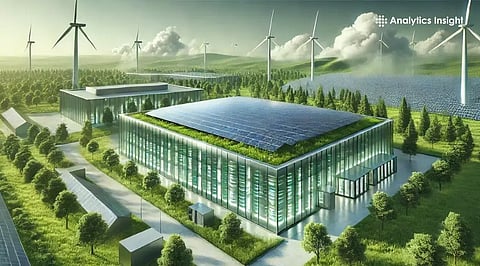
Major technology companies are running their AI data centers on solar, wind, and hydroelectric power. The use of renewables significantly reduces the carbon footprint.
Chip manufacturers are producing energy-efficient semiconductors with new architectures that consume less power while delivering the same or even higher computation capacity. This is made possible through the development of processors that offer higher performance per watt.
Using methods such as liquid immersion cooling and closed-loop water systems helps conserve water and improve thermal efficiency.
Some companies choose to locate their facilities in cooler climates to reduce cooling needs. Choosing the right place for the site helps lower the energy usage.
The environmental footprint of AI is a result of various factors such as policy, innovation, and infrastructure planning. Business adoption of automation and data-driven systems will inevitably lead to further growth. Sustainability should therefore be scaled to meet the computing demand.
Also Read: World Environment Day 2025: Will AI Consume More Power than Bitcoin by the End of 2025?
Governments are actively promoting the disclosure of energy use. Environmental requirements for data center emissions are getting tougher over time. Cooperation between energy suppliers and tech companies will be key to shaping the future scenario.
Sustainability does not mean holding back technological progress. Rather, it means that development should be in harmony with responsible energy sourcing and infrastructure design.
Next‑generation AI data centers will likely feature:
Fully-renewable power supply agreements
Carbon capture integration
Modular energy, efficient server designs
AI-optimized energy management systems.
Energy innovation has to keep pace with the increasing demand for computing. The future is about creating smart systems without adding to the ecological burden.
The environmental footprint of AI data centers poses challenges in two respects. On the one hand, rising electricity demand and data center emissions are indicative of sustainability issues. On the other hand, there are genuine breakthroughs in the integration of renewables and in energy efficiency innovation.
Responsible infrastructure planning, cleaner power grids, and technology efficiency improvements are the main factors that will shape AI's ecological footprint.
1. Why are AI data centers using more energy than traditional servers?
AI workloads involve very demanding calculations that require high-performance processors that operate continuously.
2. What is the main culprit of data center emissions?
The largest share of indirect carbon emissions is still due to electricity from fossil fuel power plants.
3. Do AI data centers rely on renewable energy?
Yes, several facilities have drastically increased their use of renewables; however, adoption levels still vary from one region to another.
4. Is the cooling system of data centers to blame for the increase in their environmental impact?
Sure. Energy consumption by cooling systems is substantial, and large volumes of water may be required as well.
5. Will climate goals be compatible with the expansion of AI?
Absolutely. Things such as adopting renewable energy, increasing hardware efficiency, and keeping emissions records should always be the top three priorities.
