.png)

Historically, the music industry has been characterised by high barriers to entry, with producing a professional-quality track requiring expensive time spent recording at a studio with an immersive understanding of music theory and the support of a team of session musicians and engineers. The industry created an environment that catered only to those who could professionally compose or produce songs. However, in recent times, we have begun to see a significant shift in this paradigm.
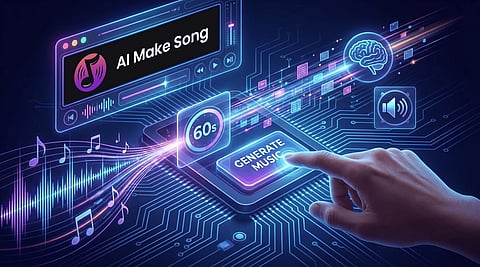
The emergence of artificial intelligence (AI) has fundamentally changed how we approach creativity, allowing for an unprecedented level of immediacy between conceptualising an idea and producing a completed song. As a result, anyone can now create a song that meets industry standards or may even exceed them in less than 60 seconds. In this article, I examine how artificial intelligence is changing creative processes within the music industry by enabling everyone to create professional-quality music in less than 60 seconds.
Music's estimated market size globally is valued at approximately $21 billion, and the current environment presents the industry with two major challenges: growth and innovation must take place almost instantaneously, and the volume of demand for content must be met.
In the era of streaming, we have a new level of demand and expectation unlike anything we've seen before due to the high consumption of music across multiple platforms, and the traditional music production process (editorial approval and delivery) takes much longer and is far more resource-intensive compared to the number of pieces of music available today. A single finished professional track typically costs multiple thousands of dollars and can take weeks to complete.
The leap from robotic, MIDI-sounding beeps to soulful, radio-ready vocals is powered by advanced deep learning and neural networks. Unlike early algorithmic composition, modern Generative AI models are trained on vast datasets of audio waveforms and spectral data. They don't just follow rules; they "listen" and learn the nuances of genre, rhythm, timbre, and emotional dynamics.
The critical breakthrough lies in the AI's ability to understand context. Large Language Models (LLMs) combined with audio diffusion models allow the software to interpret abstract prompts like "a melancholic jazz track for a rainy cyberpunk city" and translate them into complex audio structures. Compared to traditional Digital Audio Workstations (DAWs), which are empty canvases requiring manual input for every note, new AI tools act as collaborative partners, pre-loading the canvas with high-fidelity sounds based on semantic understanding.
The promise of "60-second music production" is no longer marketing hyperbole; it is a functional reality driven by comprehensive AI suites. Platforms are now offering end-to-end solutions that handle every aspect of the production chain instantly.
Diverse Functions of AI Music Creation:
Lyrics to Song: This feature bridges the gap for poets and writers. By inputting text, the AI analyzes the meter and rhyme scheme to compose a melody and backing track that fits the emotional tone of the words.
Text to Song: Perhaps the most powerful tool for non-musicians, this allows users to describe a song's vibe, genre, and instrumentation in plain English, generating a full audio track from a simple prompt.
AI Lyrics Generator: For those with a melody but no words, intelligent systems can generate lyrics based on specific themes or keywords, effectively solving writer's block.
Song Cover: AI-driven voice transfer technology allows for the re-imagining of classic tracks, enabling creators to hear how a song might sound in a completely different vocal style.
Vocal Remover: Essential for remixing and sampling, this uses source separation to cleanly isolate vocals from instrumentals in seconds.
Music Video Maker: Extending beyond audio, some platforms now integrate visual generation, creating music videos that sync automatically with the generated audio.
These features come together to offer a streamlined user experience where professional output is accessible via a simple interface. For a firsthand look at how these tools integrate into a seamless workflow, you can explore the capabilities at aimakesong.com.
AI is fundamentally altering the value chain of music production. From a data perspective, the cost efficiency is staggering. Producing a background track for a video via traditional licensing or hiring a composer might cost $500 to $5,000. AI generation brings this marginal cost down to near zero.
Market analysis suggests that early adopters, specifically content creators, game developers, and advertisers, are seeing productivity boosts of up to 400%. User satisfaction metrics for AI music tools are climbing as the audio fidelity improves (moving from 22kHz to 44.1kHz standard). The commercial potential is vast, shifting revenue from expensive rights management of legacy catalogs to subscription-based creation models where users own the unique assets they generate.
The greatest thing that technology has done for music creation is to allow everyone on earth to have access to the tools to create music. Before this advancement in music production technology, anyone who could not play an instrument or who did not have the ability to operate complex mixing software could not produce music. Today, the introduction of AI has made this once insurmountable barrier a flat learning curve.
You no longer need years of training to create your own music, whether you are a YouTube creator wanting an introductory song to showcase your content, a podcaster who wants to include commercial jingles in your podcasts, or a storyteller who's looking for background music for their video storytelling. With the access and resources available, people who would not have been able to produce music before can now do so easily.
By having access to these resources, we are witnessing a trend of "AI-assisted musicians," musicians who utilize AI technology to assist them in laying down their foundational tracks or coming up with ideas that they later refine and combine with traditional song creation techniques. This gives the home studio (bedroom producer) the same potential audio fidelity that exists with major label studio production (although it may not currently possess the same level of creativity).
In the coming years, we will see a more integrated approach between AI and music. The use of real-time adaptive music within gaming and customized generative playlists for each user will be all but ubiquitous within the next five to ten years. However, there is still a lot of work to be done in terms of limitations, such as copyright issues and the need for "human" emotion in storytelling.
Rather than AI replacing artists, we can expect a collaborative environment where successful traditional producers will probably be using AI as an assistant to quicken workflow through chores like mastering and mixing, and allowing humans to focus on high-level creative vision and emotional connection.
To conclude, at this point, it is clear that the destruction caused by AI on the $21 billion music industry will be hard to ignore. AI has made the development process for music go from weeks to seconds. It is not just about saving time, but also about creating an entire universe of creative potential. For content creators, businesses, and aspiring musicians, the barriers to entry have never been lower. The best way to understand this movement is not just to read about it, but to create something instantly for yourself.
AI Make Song is dedicated to democratizing music production for everyone, regardless of their musical background. Our mission is to empower global creators with an all-in-one platform that simplifies the complex art of song-making. Whether you need to generate lyrics, swap vocals, or create a full track from text, our suite of tools is designed to turn your ideas into reality instantly. Join the revolution and create your first professional track in under 60 seconds at aimakesong.com.
