.png)

Stronger structures: Thin metal shields and aluminum foam help absorb bird impacts while keeping aircraft lightweight.
Preventive technology: UV LED lights and visual cues aim to steer birds away before they reach aircraft.
Early detection: Radar gives airport teams and flight crews advance warning, especially during high-risk climb and approach phases.
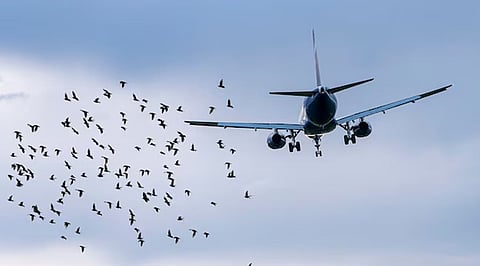
Birds flew into both engines of a US Airways jet, and the pilots set the plane down on the Hudson River. People call the 2009 event the Miracle on the Hudson, and it remains the most famous bird strike on record. Most strikes never reach the news, yet they add up fast. A patent filing counts over 7,500 reported strikes on civil aircraft in 2008 alone. Engineers now fight the problem on two fronts. They toughen the aircraft, and they steer birds away before contact.
A 2026 study on a civil tiltrotor, the NGCTR-TD, adds a thin metal shield between the outer skin at the front edge and the front spar. The shield protects the electrical and hydraulic lines in that area without significantly increasing the structural mass, according to the study.
The researchers also built a reduced finite element model. It drops parts that matter little and keeps the elements that control how the structure responds to a bird impact, which saves computer time in early design.
Weight matters even more on rotor blades. ERG Aerospace showed its Duocel aluminum foam at Verticon 2026 in Atlanta, March 9 to 12, at Booth 5303. The company says the foam resists impact well and stays light. It aims the material at helicopter blades and at eVTOL (electric vertical takeoff and landing) blades.
The Federal Aviation Administration (FAA) began research on bird-strike avoidance in 2015. Pilots have long carried the job of spotting birds and steering around them. The FAA's newest work reverses that idea.
UV LED lights on helicopters and planes drive birds away from the aircraft. FAA engineer Dan Dellmyer expects strikes to rise as more aircraft share the sky. He rates UV LEDs as the best option today, ahead of artificial intelligence (AI) and cloud tools, and notes that they are cheap to install and easy to maintain.
A US patent follows a visual path as well. It describes protective lights and reflective exterior paint, used alone or together, for airplanes and rotorcraft. The logic is simple. Lights and color schemes already help pilots spot other aircraft, so the same cues should help birds spot an aircraft too.
Dover Air Force Base in Delaware sits on a major East Coast migration route and averages 25 bird strikes a year. Its wildlife hazard team used a 2006 DeTect Merlin XS2530 radar to track birds within a six-mile horizontal and vertical radius.
Ron Merritt, a former chief of the Bird/Wildlife Aircraft Strike Hazard team and now president of DeTect, said the displays help control teams act faster and give air traffic controllers live advisories for flight crews.
One patented concept goes a step further. Its system alerts the pilot and air traffic control (ATC) the moment a strike looks likely. It also links units on every arriving and departing aircraft with airport-wide data, so controllers see the full picture of bird activity.
Also Read - Spirit Airlines Shuts Down After Failed USD 500 Million Rescue Deal Talks Collapse
Risk stays highest at the most exposed moments. At the U.S. Aviation Wildlife Management Conference in Cleveland, which ran August 4 to 6, Accipiter Radar's TJ Nohara and R. Dolbeer asked whether current technology can cut strikes on climb and approach. Their slides cover engine-damage strikes from 2024 to 2026 and bird congestion alerts.
Ground defenses lag too. The Philippines logged over 900 bird strikes in 2025, most at Ninoy Aquino International Airport and Davao International Airport. At a committee session, aviation officials said the Civil Aviation Authority of the Philippines (CAAP) relies on manual methods such as lasers, flags, gas cannons, and firecrackers.
Sen. JV Ejercito called the count almost a strike a day and pushed for acoustic and sonic deterrents at vulnerable airports. He asked CAAP and the Department of Transportation for a cost estimate to back funds in the 2027 budget.
Also Read - How Airline Payment Solutions Are Transforming Global Travel Payments
A strong airframe only softens a hit, while radar and light can stop one before it happens. The mix that works best likely differs by site. A UV light costs little next to a redesigned engine, and a radar helps most where birds gather in large numbers. Airports that match each tool to local risk will gain the most.
1. What is bird-strike protection in aircraft?
It combines structural reinforcement, impact-absorbing materials, detection systems, and bird-deterrent technologies to reduce the risk and severity of bird collisions.
2. How do UV lights prevent bird strikes?
UV LED systems make aircraft more noticeable or aversive to birds, encouraging them to move away before a collision occurs.
3. How does radar help prevent bird strikes?
Bird-detection radar tracks bird activity around airports and provides wildlife teams, controllers, and pilots with information that can support faster warnings and decisions.
4. Why are climb and approach particularly dangerous?
Aircraft operate at lower altitudes during these phases, where birds are more concentrated and pilots have less time to respond to sudden encounters.
5. Can bird-strike technology completely eliminate collisions?
No. The goal is to reduce both the frequency and consequences of strikes by combining prevention, early warning, and stronger aircraft structures.
