.png)

Edge AI lets traffic cameras process road data faster near the camera.
ANPR helps identify vehicles and support enforcement, tolls, and traffic analysis.
Connected camera networks can help cities manage congestion, safety, and emergency response.
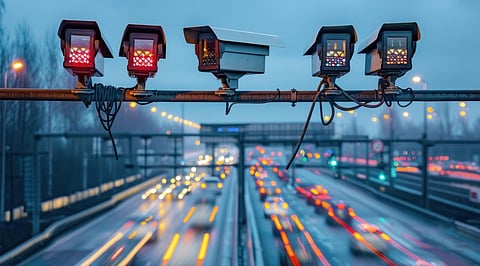
AI-powered Traffic Cameras - A traffic camera once had a simple job: capture a plate, record a violation, or measure speed. AI has changed that role. Modern systems can spot vehicles, read license plates, detect road violations, and deliver useful traffic data to control centers in near real time. The camera acts as part of a larger digital road system.
The core starts with a high-resolution camera, infrared light, and computer vision. Software examines each frame and can identify cars, trucks, motorcycles, pedestrians, lane positions, and road events. Automatic Number Plate Recognition, or ANPR, can turn a license plate image into readable vehicle data. That data can support enforcement, tolls, traffic control, and road safety.
Edge AI adds another major change. A small computer near the camera can run neural network models without a remote data center for every video frame. In May 2026, e-con Systems showed an Edge AI ANPR system built around an NVIDIA Jetson Orin NX compute box. A 2026 test cut low-light video model time on Jetson Orin NX from 400 milliseconds per frame to less than 28 milliseconds, enough to pass the 30-frame-per-second target for real-time object detection.
The next step links separate cameras into one traffic picture. A Bharat Electronics project for Smart India Hackathon 2026 calls for a citywide AI platform that can connect ANPR data across many camera sites. The system can reconstruct a vehicle route, record time and direction, measure traffic density, spot congestion points, and create traffic heat maps. The project calls for more than 90% plate recognition accuracy under poor weather, bad light, motion blur, and damaged plates.
Also Read - Top 10 AI Edge Computing Companies in 2026
Singapore shows the shift from simple camera capture to automated traffic enforcement. From April 2025 to February 2026, Traffic Violation Enforcement Cameras detected more than 67,000 violations. Singapore deployed nine such cameras from March 2026. The cameras use video analytics and ANPR to detect offences such as red-light violations, illegal U-turns, and crossings of double white lines.
Singapore also plans a wider role for AI. Officials say AI tools may help detect dangerous road behavior and support faster intervention. TRACER can review public road footage, identify violations, and mark the exact time of an offence. New legal changes also allow a computer system to assess certain objective traffic offences and issue a notice to a vehicle owner. Human officers still handle appeals after a wrong vehicle or offence identification.
Delhi has placed this technology inside a larger road plan. On September 30, 2026, the Cabinet approved an Intelligent Traffic Management System for Delhi at an estimated cost of Rs. 1,789.52 crore. Delhi will roll out the system in three phases over 24 months, followed by five years of operation and maintenance. The system will support AI-enabled adaptive signals, enforcement, real-time traffic information, ambulance priority, and faster response to congestion and incidents.
Greater camera intelligence creates a larger privacy question. ANPR can record where a vehicle appears, when it appears, and which route it takes across a city. A citywide system can create a detailed travel record even when no offence occurs. Data rules, access controls, retention limits, audits, and human review now matter as much as camera accuracy.
Singapore has more than 100,000 Police Cameras and plans more than 200,000 by the mid-2030s. The government also says agencies can share camera footage when operational needs require it. Scale shows why network design matters as much as camera performance.
Why this Matters
AI-powered traffic cameras matter as roads face more vehicles, congestion, and safety risks. These systems can detect violations, track traffic flow, support emergency response, and help cities manage roads faster. Better camera intelligence can turn road data into useful action, making transportation safer, more efficient, and easier to manage.
It comes from the full chain: camera sensors capture the road, edge computers run AI models, ANPR reads plates, software connects events across sites, and traffic platforms turn those results into action. That chain can support enforcement, toll collection, congestion control, emergency vehicle priority, and road safety.
A camera can identify a vehicle and a violation. A connected network can also show traffic flow, route patterns, congestion points, and risky road behavior. Value rests on what the road network can understand. That shift turns a roadside camera from a simple enforcement tool into a key part of urban traffic control.
1. What is an AI-powered traffic camera?
An AI-powered traffic camera uses computer vision and AI software to detect vehicles, road events, violations, and license plates.
2. What does ANPR mean?
ANPR stands for Automatic Number Plate Recognition, a system that converts license plate images into readable vehicle data.
3. Why does edge AI matter for traffic cameras?
Edge AI lets systems process camera data near the roadside, which can support faster analysis and reduce reliance on remote processing.
4. Can AI traffic cameras detect dangerous driving?
Yes. Modern video analytics can identify behaviors such as red-light violations, illegal turns, lane violations, and other risky road actions.
5. Do AI traffic cameras create privacy concerns?
Yes. Large camera networks can create detailed vehicle movement records, which makes data access, retention, security, and oversight important.
