.png)

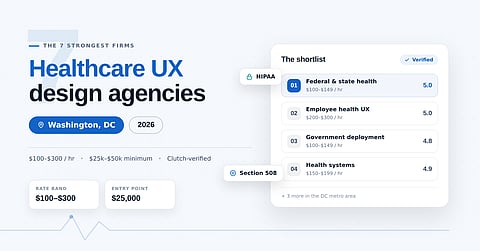
Healthcare UX design agencies in Washington, DC divide into two groups: those with a named health product, and those with a healthcare tag on a directory profile. Seven firms in the DC metropolitan area are in the first group. Verified rates run $100 to $300 per hour, with minimum project sizes from $25,000 to $50,000.
A qualified healthcare UX design agency can name the health client, the product it shipped, and the regulatory regime that product sat in. That last part is the filter. Section 508 and HIPAA are different obligations, and an agency that has been through both will say so in different sentences, not as one compliance box.
Four things separate a real healthcare practice from a design team that took one health client:
A named health product. Not "healthcare experience." A specific patient portal, clinical tool, public health platform or federal health system, with the client named.
HIPAA and Section 508 kept apart. Ask which of the two shaped the last engagement. An agency that answers with one word for both has not been through a real compliance review.
DC metropolitan area presence. Federal health work is staffed across the District, Northern Virginia and suburban Maryland. Insisting on a District address rules out most firms doing this work.
A minimum project size that fits your scope. The floor here is $25,000 or $50,000, and an agency whose minimum is twice your budget will stretch the scope.
Healthcare interfaces are settled by research rather than visual direction. The thing that reshapes the design is usually something a clinician says in week two. Engineering ranks below both, and the test there is whether the team can answer an EHR or audit-log question in the meeting instead of taking it away.
HIPAA governs how protected health information is stored, transmitted and accessed, which in interface terms means session handling, role-based permissions, audit trails and what stays visible on a shared clinical screen. Section 508 governs accessibility in federal systems and maps to the WCAG success criteria. They are separate obligations with separate evidence.
Most of what the HIPAA Security Rule demands from a design team is unglamorous. Timeout behavior, what a screen shows when a nurse steps away, which roles see which fields, and how every view of a record gets logged. Section 508 is why color contrast and keyboard navigation appear in federal health solicitations as acceptance criteria rather than preferences.
Nobody asks about the third requirement until integration week. If the product exchanges clinical data, someone on the team needs to understand HL7 and FHIR well enough to know which fields are optional, and what the interface does when a record comes back incomplete.
Best for: federal and state health interfaces where Section 508 compliance and procurement speed both matter.
Fuselab Creative is based in McLean, Virginia and was founded in 2017, the newest firm here. It has done interface work for the National Institutes of Health and California's Department of Health Care Services. A GSA Schedule contract shortens the federal ordering path, though orders above the simplified acquisition threshold still compete. Clutch puts it at 5.0 overall, a $25,000 minimum and $100 to $149 an hour, with the only perfect cost score here.
Best for: federal employee health products built from primary user research.
Brave UX runs out of a Washington, DC office opened in 2014, and is the most design-concentrated firm here at 90% UX and UI. It built Felix, an employee wellness application for Federal Occupational Health inside Health and Human Services. Its practice splits roughly evenly across strategy, usability testing and research. On Clutch it holds 5.0 overall, with a $50,000 minimum, $200 to $300 an hour and 4.7 on cost.
Best for: federal health systems that deploy into existing government infrastructure.
Mobomo has been in Vienna, Virginia since 2007 and carries the deepest federal record here. Government is 40% of its client base and medical 20%, the second-highest health share here. For the Department of Veterans Affairs it built the Mental Health Assessment for Veterans platform, deployed across more than 140 VistA locations. Clutch shows 4.8 overall, a $50,000 floor, $100 to $149 an hour and 4.7 on cost.
Best for: medical associations and health systems that need a public-facing platform rebuilt.
Social Driver opened in Washington, DC in 2011 and has the heaviest health concentration here, with medical clients at half its book. It rebuilt the National Academy of Medicine site, and its roster includes Unity Health Care, the American Hospital Association and the COPD Foundation. Clutch lists no separate UX line, which is worth weighing. It rates 4.9 on Clutch, at a $25,000 minimum, $150 to $199 an hour and 4.7 on cost.
Best for: long-run commercial healthcare partnerships rather than single engagements.
Viget has had a Falls Church, Virginia office since 1999, alongside three others outside the region and a remote team, so the project staff are not necessarily DC-based. It worked with Privia Health for roughly a decade, and built Twyll, the clinical session management platform behind SpectrumAi's ABA therapy. That is the strongest shipped-product record here. Clutch has it at 4.8, with a $25,000 minimum, $200 to $300 an hour and 4.3 on cost.
Best for: public health data platforms and patient advocacy organizations.
Teal Media has operated from Washington, DC since 2008, with non-profits at about 95% of its client base. Its public health work includes the NTI Global Health Security Index and a National Patient Advocate Foundation rebuild that met WCAG 2.1 criteria. That is the only documented accessibility target in this list. Clutch records 5.0 overall, a $25,000 minimum, $150 to $199 an hour and 4.9 on cost.
Best for: health non-profits that need brand, content and interface from one team.
Echo&Co set up in Arlington, Virginia in 2004, where non-profits are around 40% of its client base and medical about 10%, the thinnest health share here. Its health work includes UI and UX for Operation Smile, the non-profit providing cleft palate surgery. UX and UI is its largest service line at 60%. Its Clutch score is 4.8, at a $25,000 minimum, $150 to $199 an hour and 4.3 on cost.
Every firm here operates in the Washington, DC metropolitan area and can name a health client and the product built for them. Pricing, ratings and service mix were read from each Clutch profile on 9 September 2026. Locations are each firm's stated headquarters, and the industries column lists Clutch industries with the health-relevant one first. Ordering weighs DC-metro presence, the health portfolio, and the cost sub-rating read against the rate band.
The rating shown is the overall Clutch score, with cost reported separately because the two diverge more than buyers expect. Viget and Echo&Co both show 4.8 overall and 4.3 on cost. Firms with a healthcare tag but no named health project were excluded, as were offshore agencies with no DC-area office.
Two things cannot be fixed after signature: the regulatory regime the team has worked in, and whether the minimum project size matches your scope. Choose on those. A $200 rate on a team that has never handled protected health information is the expensive option, because the rework lands after the design is approved.
For a federal health system deploying into government infrastructure, the shortlist is Mobomo, Fuselab Creative and Brave UX, and the question is whether the team has worked inside your agency's stack before. For a commercial healthcare platform, Viget has the deepest shipped-product record. Medical associations and advocacy organizations are better served by Social Driver, Teal Media or Echo&Co.
Before the proposal stage, ask for one thing: a walkthrough of a shipped health interface, screen by screen, with the person who designed it. An agency that has done this work will show you where the first version failed. One that has not will show you a portfolio page.
How much does a healthcare UX project cost in the Washington, DC area?
Verified Clutch rates across DC-area healthcare UX design agencies run $100 to $300 per hour, with minimums of $25,000 or $50,000. The rate tracks agency size rather than healthcare depth, and two of the three firms with named federal health work sit in the $100 to $149 band.
Which of these agencies have federal health work on record?
Fuselab Creative, Brave UX and Mobomo each do: interface work for the National Institutes of Health, an employee wellness app for Federal Occupational Health, and the Mental Health Assessment for Veterans platform. Mobomo carries the largest federal client base of the three, at roughly 40%.
Do I need an agency with an office inside Washington, DC?
No. Healthcare UX design agencies work on federal projects from across the District, Northern Virginia and suburban Maryland, and firms in McLean, Vienna and Arlington run DC health projects routinely. What matters is drive time to a 9am accessibility review.
What should I ask an agency before signing?
Ask what a compliance review sent back on the last health project, and who owned Section 508 testing in that engagement. Then ask whether the team has integrated with your EHR or identity provider before, and what broke when they did.
How do I verify an agency has real healthcare experience?
Search the client's own newsroom for the launch announcement. Agencies list work they contributed to, clients list work that shipped, and the gap between those lists is where overstated portfolios show up. Five of these seven also list Medical among their Clutch industries.
Which Clutch rating should I trust?
Read the overall score and the cost sub-rating together. The overall figure averages quality, schedule, cost and willingness to refer, while the cost score reflects value received rather than how cheap the agency was. In this group the two separate by as much as half a point.
Will these agencies run the user research, or do I need a separate firm?
Most run their own. Brave UX splits its practice roughly evenly across strategy, usability testing and research, and UX or UI design is the largest listed service line at three of the seven. A separate research firm earns its fee only when the clinical assumptions are unsettled before a design budget commits.
The DC market is small enough to shortlist in an afternoon. Filter on the regulatory regime the product sits in, then on whether the minimum project size fits, and only then on rate. Ask each remaining agency to walk you through a shipped health interface with the designer present. Two of three usually rule themselves out in that meeting.
