.png)

The construction industry has always faced one persistent challenge—cost overruns. Budgeting for planned projects shows that forecast errors and unanticipated project interruptions will lead to financial losses. The introduction of predictive analytics technology creates new possibilities for businesses today. Construction companies use data-driven insights to identify potential hazards, improve asset utilization, and choose better financial strategies, helping them prepare for future problems.
One of the key areas where predictive analytics is making a major impact is through construction estimating services in the USA. The services now use modern data models to evaluate project performance data against past and current market conditions, labor expenses, and material cost variations. Estimators can now create more precise budget predictions using new methods that combine multiple sources of information, rather than relying on manual calculations and project assumptions.
Predictive analytics uses historical data, statistical algorithms, and machine learning techniques to determine the probabilities of future outcomes. The construction industry uses past project performance data to assess potential risks, costs, and schedule delays for future projects.
Project managers and stakeholders can use this method to:
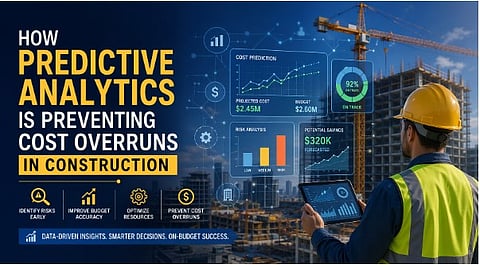
Identify cost risks early
Improve budgeting accuracy
Optimize resource allocation
Enhance decision-making processes
Predictive analytics enables organizations to detect imminent problems by helping them transition from reactive operations to proactive planning.
Modern construction projects generate massive amounts of data—from labor productivity rates to equipment usage and weather conditions. When properly analyzed, this data becomes a powerful tool for cost management.
With the help of construction estimating services, companies like Blaze Estimating LTD can:
Analyze historical cost trends
Compare similar past projects
Detect patterns that lead to budget overruns
Forecast material price fluctuations
This data-driven approach eliminates guesswork and provides a clear roadmap for maintaining financial control throughout the project lifecycle.
Predictive analytics is not just about forecasting—it actively helps prevent financial losses. Here’s how:
1. Early Risk Identification
Predictive models can flag potential risks such as delays, labor shortages, or supply chain disruptions before they occur. This allows teams to take preventive measures rather than costly corrective actions.
2. Accurate Budget Forecasting
By analyzing past project data, predictive tools create realistic budgets. This reduces the chances of underestimating costs, which is one of the leading causes of overruns.
3. Improved Resource Planning
Efficient allocation of labor, materials, and equipment ensures that resources are not wasted or underutilized. This directly impacts cost savings.
4. Real-Time Decision Making
With continuous data monitoring, project managers can make informed decisions quickly. If costs begin to rise, adjustments can be made immediately.
Adopting predictive analytics offers multiple advantages beyond just cost control:
Enhanced project efficiency through better planning
Reduced financial risks with data-backed decisions
Improved client satisfaction due to on-budget delivery
Greater transparency in project execution
These benefits make predictive analytics an essential tool for modern construction companies aiming to stay competitive, including firms like Blaze Estimating Inc.
Several advanced technologies are powering predictive analytics in construction:
Artificial Intelligence (AI): Enhances data analysis and forecasting accuracy
Big Data: Provides large datasets for deeper insights
Cloud Computing: Enables real-time data access and collaboration.
IoT Devices: Collect on-site data for better monitoring
Together, these technologies create a connected ecosystem where every aspect of a project can be tracked, analyzed, and optimized.
While predictive analytics offers significant advantages, it also comes with challenges:
Data quality issues: Inaccurate or incomplete data can lead to poor predictions.
High implementation costs: Advanced tools and systems require investment.
Skill gaps: Teams need training to effectively use analytics tools.
However, as technology becomes more accessible, these challenges are gradually being overcome.
The future of construction lies in data-driven decision-making. Predictive analytics will continue to evolve, offering even more precise forecasting and automation capabilities. Companies that embrace these innovations will not only reduce cost overruns but also gain a significant competitive edge.
In the coming years, we can expect:
Fully automated estimating processes
Real-time predictive dashboards
Integration with smart construction technologies
Increased reliance on AI-driven insights
Cost overruns have long been a major concern in construction, but predictive analytics has emerged as an effective solution to this problem. The combination of data analytics, advanced technologies, and intelligent forecasting enables construction companies to execute their projects with budget accuracy through their improved planning capabilities.
The industry requires organizations to adopt predictive analytics as a mandatory part of their operations due to continuous technological advancements. Organizations that invest in these tools today will achieve better project outcomes through cost-effective project delivery methods which they will develop in the future.
