.png)

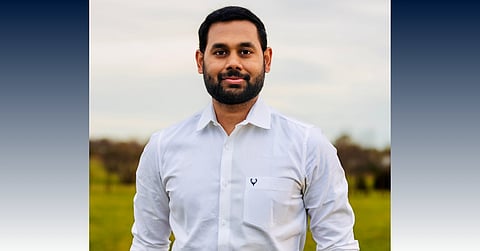
Krishi Reddy Karkal is a full-stack application developer with skills suited to build future-ready platforms in a cloud-native era. With expertise as a Google Cloud Platform and AWS cloud developer, he has transitioned from building scrappy scripts to architecting Fortune 500-level systems, a journey that reflects real-world impact. Today, Karkal uses his full-stack engineer mindset to architect the future.
Karkal’s fascination with technology began early, writing rudimentary scripts, crafting small-scale web apps, and experimenting with automation long before entering the workforce. But this early curiosity quickly evolved into mastery as he began addressing complex, real-world challenges across industries.
“I was captivated by the idea that code could automate decision-making, accelerate innovation, and solve real-world bottlenecks,” he says. “That thinking led me to focus on performance-driven, cloud-native solutions built using JavaScript, WebAssembly, and distributed systems.”
Unlike most engineers, Karkal didn’t just learn tools—he leveraged them to rethink how platforms could be built and optimized in a cloud-first era.
Guided by his passion for development and the motivation to keep pace with a dynamic industry, Karkal has mastered React and Angular, is a Node.js expert and Java Spring Boot developer, and is skilled in cloud native technologies such as AWS and Google Cloud, with Google, he even holds the advanced Professional Cloud Developer and Associate Cloud Engineer certificates. Additionally, he has integrated cutting-edge tools, such as WebAssembly and GraphQL, into his work to achieve advanced performance, reliability, and security across the entire stack.
He integrates bleeding-edge tools like WebAssembly (WASM) to optimize frontend performance and GraphQL to architect more resilient and efficient APIs. These aren't just experimental choices; they’ve helped him significantly boost application performance and reduce latency at scale. In fact, projects under his leadership have achieved 40–60% latency reduction and sustained 99.999% uptime, powering platforms for Fortune 500 clients.
Karkal’s work also spans high-concurrency systems, event-driven architectures, and real-time data pipelines, a rare mix that combines front-end excellence with backend reliability and cloud-scale operations.
Karkal’s track record clearly sets him apart. His technical leadership and innovative solutions have been recognized by top-tier firms, where he ranks among the top 5% of software engineers. He has been the architect and lead developer for distributed platforms used by Fortune 500 companies, driving both digital transformation and operational modernization.
His leadership extends beyond his employer. Karkal actively contributes to the open-source community, particularly in the JavaScript and WebAssembly domains. Several of his libraries are now standard tools adopted by global developer communities, demonstrating his influence and thought leadership in shaping future technology practices.
He has also mentored dozens of developers and conducted internal workshops on cloud optimization, secure coding, and scalable architecture design, helping elevate engineering standards across teams and organizations.
“What makes me different is not only the solutions I implement but the scale and sustainability of those solutions,” Karkal explains. “I solve complex architectural challenges while ensuring maintainability, developer experience, and long-term impact.”
Karkal is frequently invited to speak at internal tech summits and has published technical whitepapers on cloud-native full-stack systems and WASM optimization patterns. These contributions, alongside his mentorship and leadership, have established him as a go-to expert within highly technical circles.
His ability to bridge theory and practical systems-building, especially across domains like finance, cyber security, and travel, has drawn accolades from executives and CTOs alike.
For Karkal, success is rooted in an unshakeable foundation in core engineering principles: clean code, modular design, and scalable thinking. Despite mastering advanced technologies, he attributes his success to continuously revisiting fundamentals.
As a technical mentor, he emphasizes discipline and persistence in understanding systems at every layer- from code to cloud.
“You can’t lead without deeply understanding what you’re building,” he notes. “That’s what makes great engineers stand out.”
Looking forward, Karkal contemplates developing his career trajectory in principal engineer and technical fellow positions wherein he will carry out strategic roles that promote cross-functional innovation. Another area of his interests concerns leading product-platform convergence efforts using cloud-native patterns, AI integration, and next-gen rendering technologies to develop developer and security tools that facilitate the further development of innovation.
"My long-term vision is to create frameworks and platforms that empower millions of developers globally. I want to help the next generation build secure, high-performance applications without starting from scratch," concludes Karkal.
From modern legacy infrastructure to cloud-scale innovation, Krishi Reddy Karkal continues to keep software architecture on the bleeding edge. His work is characteristically technical yet able to redefine possibilities for the future full-stack engineer.
Join our WhatsApp Channel to get the latest news, exclusives and videos on WhatsApp
_____________
Disclaimer: Analytics Insight does not provide financial advice or guidance on cryptocurrencies and stocks. Also note that the cryptocurrencies mentioned/listed on the website could potentially be risky, i.e. designed to induce you to invest financial resources that may be lost forever and not be recoverable once investments are made. This article is provided for informational purposes and does not constitute investment advice. You are responsible for conducting your own research (DYOR) before making any investments. Read more about the financial risks involved here.
