.png)

Group words by physical shape, focusing on straight, narrow, stick-like objects.
It reinforces the theme with a clever phrase that ties in with daily clues.
Strands is a captivating blend of Spelling Bee, Connections, and classic Crossword.
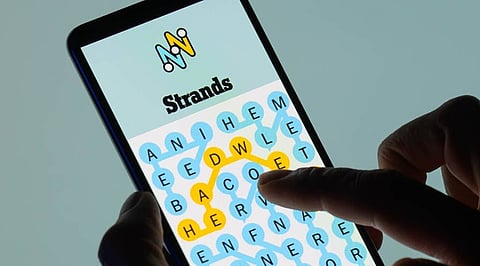
Welcome back to our daily NYT Strands guide. Today’s theme centers on looking beyond the boundaries. If you're stuck, here's a clue: More, more, more. The Spangram begins near the left side of the grid. Hints and clues have been listed below, or you can head straight to the answer key.
Unlike the theme words, the Spangram stretches across the grid, connecting two opposite sides. It can change direction as it winds through adjacent letters, making it one of the puzzle's defining features.
If you're new to NYT Strands, here's a quick overview of how the game works. The game combines elements of the NYT Crossword, Connections, and Spelling Bee. Players are given letters on a 6×8 board, along with a daily theme as a hint. NYT Strands is an engaging word puzzle that challenges players' vocabulary and pattern-recognition skills.
Did you know that there are some words you can use as hints to find the answers? We have compiled the best hints. Take a look:
Tote, Mote, Dote, Vote, Voter, Pare, Rune, Sane, Meat, Pulse, Lure
Today’s Spangram is ‘ANDTHENSOME’. To find it, start with the A at the top of the top row, move diagonally, then back again. And then some is an informal English phrase that means considerably more, plus extra, or and even more than that. It is used to show that a number, amount, or degree is actually much higher than what was just stated
Here are a few simple tips that can help you solve NYT Strands more quickly. First, identify the theme. Start by thinking about words related to today's theme, ‘There’s more where that came from.’ Another helpful tip is to look for long words stretching across the edges of the grid, as they often form the Spangram.
We have listed below all the non-Spangram answers for July 24:
Spare, Extra, Excess, Unused, Surplus, Leftover
Today's theme, ‘There’s more where that came from,’ means that a large supply or a greater number of similar things are available beyond what has already been provided, shown, or used. When offering food or drinks, telling a guest "there's more where that came from" means they can take or eat as much as they want without running out of the supply.
