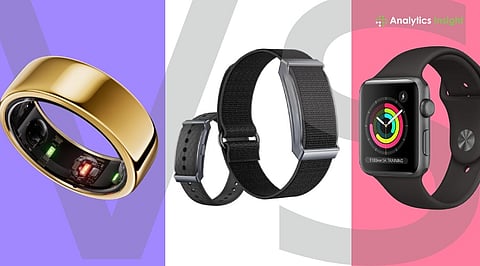
.png)

Effectively compare smart rings, fitness trackers, and smartwatches across features, pricing, battery life, and usability.
Specifically look for ideal wearable options tailored to health monitoring, fitness goals, productivity needs, and everyday lifestyle preferences.
Understand key differences to help users invest confidently in wearable technology that matches personal needs and budgets.
Smart wearables have become part and parcel of everyday life, developing far beyond just counting steps and heart rate. Smart rings, fitness trackers, and smart watches have become a natural part of people’s lives. These wearables allow users to take care of their health, live in comfort, and stay connected digitally at all times.
Each category has its own features: smart rings offer discreet, always-on health tracking; fitness trackers provide focused performance insights; and smartwatches are powerful mini-computers on wrists. Smart wearable technology is not just an option; it’s a lifestyle.
Whether you are a professional where productivity is the top-most priority, or a fitness junky chasing performance metrics, or someone who prefers constant health monitoring without the hassle of screens, there is wearable smart technology out there that covers different personality traits. Smart wearable technology is not just a fancy accessory; it has become an essential companion in one's daily life.
Also read: Best Robot Vacuum Cleaners Rs. 30,000 for Your Smart Home
Smart rings offer a sleek, lightweight design for those who prefer a minimalist look while monitoring their health markers. They are excellent for tracking sleep quality, heart rate variability, and stress levels.
These advanced features are packed into a tiny ring that offers impressive battery life lasting several days. Rings are most suited for users who prefer insights over notifications. Though they lack extended display and an app ecosystem, these devices keep information discreet and blend seamlessly into regular fashion.
Fitness trackers have quickly emerged as a necessity for fitness enthusiasts. Slim and lightweight by design, they provide useful fitness-related markers such as calories burned, VO₂ max, and recovery scores.
The most recent ones even include features like ECG and GPS for outdoor runs and swims, along with useful water-resistance features for swimmers. While fitness trackers offer basic notifications, their USP lies in dedicated fitness-related information and affordability. Trackers are ideal for those who want performance insights without bearing the higher costs of a smartwatch.
Smart watches are the all-rounders of smart wearable technology, combining fitness features and productivity features, all in one device. They offer notifications, apps, music control, and even payment modes, along with health features like CG, SpO₂ monitoring, and fall detection.
These products are a useful substitute when away from mobile devices, with the power of a small mini computer tied to wrists. Some trade-offs against other devices, such as rings and trackers, are short battery life and higher price points. However, smartwatches are the best choice for users who seek an all-in-one connectivity, productivity, and convenience.
The smart devices mentioned above differ in terms of features and battery life. Generally, devices with more advanced features, higher output, and better performance tend to offer shorter battery durations. The following section highlights battery capabilities of various smart wearable gadgets.
Smart Rings: 4–7 days on average, depending on the brand.
Fitness Trackers: 5–10 days, depending on GPS use.
Smartwatches: 1–3 days, though premium models with optimized chips can go up to 5 days.
Smart tech wearables vary in feature, size, and performance. It isn’t one size fits all; their use cases are more comprehensive and specific to the needs of users. This prevents users from overspending on features they may not use, making it important to derive requirements and preferences before investing in smart wearable devices.
Smart Ring: Best suited for individuals who prefer discreet health monitoring and sleep optimization.
Fitness Tracker: Best suited for athletes whose priorities are fitness-first features.
Smartwatch: Ideal for professionals and multitaskers who want productivity, fitness, and health in one device.
Smart devices can drastically range in price. With every feature, advanced technology, and comprehensive performance, prices add up. Here are the latest prices of devices:
Smart Rings: Rs. 15,000–Rs. 25,000 (premium health focus).
Fitness Trackers: Rs. 5,000–Rs. 12,000 (budget-friendly).
Smartwatches: Rs. 20,000–Rs. 60,000 (premium all-rounders).
The current wearables market is on the rise. Users are spoilt for choice with many top electronic brands competing to capture their attention. If minimalism and a health focus are a priority, buyers can choose a smart ring. A fitness tracker is a great option for fitness enthusiasts and a smartwatch is ideal for users who want everything in a single product.
Users may find it easier if they can map their requirements to devices and then invest in the best-suited one. Whether you’re chasing health goals, workout performance, or productivity, there’s a perfect fit out there that offers the right level of convenience and optimal support for your needs.
1. Which smart wearable is best for health monitoring in 2026?
If your primary goal is health monitoring, a smart ring is an excellent choice. It offers continuous tracking of sleep, heart rate variability (HRV), stress levels, and overall wellness in a compact, screen-free design. Those looking for more detailed health insights alongside productivity features may prefer a smartwatch.
2. Are fitness trackers better than smartwatches for workouts?
Fitness trackers are ideal for users focused mainly on exercise and sports performance. They provide accurate metrics such as calories burned, VO₂ max, recovery scores, GPS tracking, and water resistance while offering longer battery life and a more affordable price than most smartwatches.
3. How long do smart wearable batteries last?
Battery life depends on the type of wearable and its features:
Smart Rings: 4–7 days
Fitness Trackers: 5–10 days
Smartwatches: 1–3 days, with some premium models lasting up to 5 days under optimized usage.
4. What is the difference between a smart ring, fitness tracker, and smartwatch?
A smart ring focuses on discreet health tracking and sleep monitoring. A fitness tracker is designed for activity and performance metrics, making it ideal for athletes and fitness enthusiasts. A smartwatch combines health tracking with communication, productivity, apps, notifications, and digital payments, making it the most versatile wearable.
5. Which smart wearable offers the best value for money in 2026?
The best value depends on your needs. Fitness trackers offer the most affordable option with excellent fitness features; smart rings are perfect for users prioritizing wellness and minimalism; and smartwatches provide the most comprehensive experience for users seeking health tracking, productivity, and smart connectivity in a single device.
