.png)

Robot Olympics 2026 exposed the gap between spectacular physical performance and practical robotic usefulness.
Tactile sensing, dexterity, navigation, and collaboration are emerging as key capabilities for real-world deployment.
Industrial and logistics settings are likely to adopt advanced robots before unpredictable home environments.
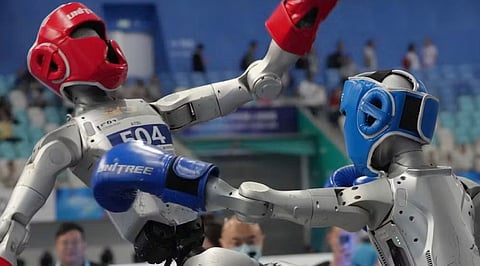
A humanoid robot just beat Usain Bolt's 100-meter world record. China's Tiangong Ultra ran it in 8.64 seconds at the 2026 World Humanoid Robot Games in Beijing. The clip spread fast and made robotics look like a global spectacle.
But the real test was not on the track. The Games also ran 21 scenario-based events, where robots had to work in factories, hotels, homes, and logistics settings. That is where the harder problem showed up. A robot can sprint faster than any human alive and still fail at simple, everyday tasks.
So the real measure of progress is shifting. Speed is not the point anymore. The question now is whether a robot can sense its surroundings, make a decision, and handle an unpredictable task without falling apart.
Locomotion and balance stand out as genuine strengths. A robot that can sprint at record pace and hold its footing through repeated rounds has solved a version of the terrain problem that matters far beyond sport. That same stability lets a machine cross an uneven warehouse floor or hold position on a factory line without falling.
Structured logistics tasks, such as sorting and moving objects along fixed paths, are also more manageable, since they involve repeatable motion in a constrained space. Table tennis added a different kind of evidence. Unlike a scripted sprint, it demanded that a robot track a moving opponent and react in real time, a test of perception rather than raw athleticism.
Also Read: Humanoid Robots Break Speed Records, Signalling A New Robotics Era
The same Games exposed sharp limits. Nature reported that robots struggled to hammer nails into a corkboard, even when human operators wore gloves that fed their own hand movements directly into the robot.
At a hotel service contest, teams had thirty minutes to move luggage, restock rooms, and make beds. These are plain, everyday tasks, and most robots found them harder than the sprint. This is where robot dexterity becomes the limiting factor: the ability to adjust grip, force, and movement in real time while handling an unpredictable object.
Stanford computer scientist Karen Liu summed it up well. Folding laundry is harder for a humanoid than doing a backflip, since daily tasks demand a kind of judgment a scripted routine simply does not require.
Together, these three capabilities form the core of embodied AI, the systems that connect perception and intelligence to physical action in the real world.
Humanoid robots could eventually combine all three across many tasks. For now, purpose-built robots that skip the human form altogether often do a narrower job more efficiently and at lower cost.
It is worth separating the two ideas. Humanoid form is a single branch of a much larger field. For many jobs, a robot that does not need to walk, balance, or resemble a person will stay simpler, cheaper, and more reliable than a general-purpose humanoid.
Collaborative robots fit this pattern well. They work alongside people on one task rather than replacing an entire job, which sidesteps the harder problem of full autonomous dexterity and makes them a more immediate route into factories and plants.
Factories, warehouses, and selected hospital logistics settings can control the environment around a robot in ways a home cannot, so industrial deployment is likely to lead. Elder care and other home uses remain further out, since they demand judgment in spaces that shift constantly and unpredictably.
Even once the technical barriers fall, adoption still depends on cost. A robot has to justify its purchase price, energy use, and supervision needs against the labor and automation options already in place.
Also Read: Why AI & Robotics Stocks Are Attracting Investors Despite High Valuations?
The Beijing Games were a stress test, not a preview of robots joining daily life next year. The most telling result was not the sprint record. It was the plain struggle with a nail and a hotel bed. What comes next in robotics will be judged less by athletic records and more by grip, movement, and steady decision-making once the cameras and the scripted course are gone.
Humanoid robots are machines designed with human-like features, such as two arms, two legs, and a torso, allowing them to operate in environments built for people. They combine sensors, AI, actuators, and control systems to perform physical tasks.
The 2026 World Humanoid Robot Games demonstrated major advances in locomotion, balance, perception, and coordination. However, practical challenges such as hammering nails and making beds showed that fine-motor dexterity and real-world adaptability remain difficult.
Autonomous navigation, tactile sensing, dexterous manipulation, collaborative robots, and specialized industrial robotics have strong near-term potential. These technologies can support logistics, manufacturing, healthcare, agriculture, and other physically demanding tasks.
Homes are unpredictable environments containing thousands of different objects, layouts, surfaces, and tasks. A household robot must recognize objects, manipulate them safely, respond to unexpected situations, and make decisions without constant human supervision.
Humanoid robots are more likely to augment human workers initially than replace entire jobs. Adoption will depend on whether robots can perform tasks safely and reliably while offering sufficient economic value compared with existing workers and specialized automation.
