.png)

Motorola's GrapheneOS partnership is driven by hardware convergence, not a marketing pivot toward privacy.
GrapheneOS sets strict technical requirements that most Android hardware has historically failed to meet; Motorola's upcoming silicon is expected to close that gap.
Three critical questions around preinstallation, app compatibility, and update commitments remain unanswered before this becomes a real purchase decision.
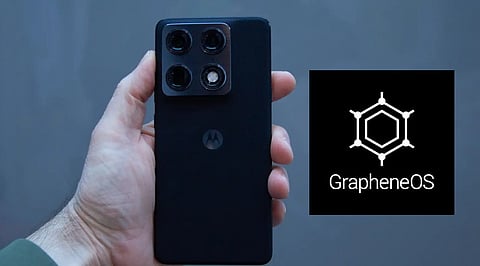
Most tech partnerships get announced and then explained. This one deserves a closer look in the other order. Motorola confirmed a long-term partnership with the GrapheneOS Foundation at MWC 2026. The first officially supported devices are expected in 2027.
What the announcement does not explain is why Motorola can do this now when official GrapheneOS support has historically been concentrated on Pixel hardware. The answer is not a strategy shift. It is a hardware timeline that finally lines up.
The partnership was announced at MWC 2026. Motorola is engineering future devices for GrapheneOS compatibility. Some GrapheneOS-derived security features may also reach non-GrapheneOS Motorola phones, though the specifics have not been detailed.
The initial supported device will be a regular flagship, not a foldable. GrapheneOS has confirmed plans to support future Razr Fold and Razr Ultra models as well. Foldables are part of the roadmap, not the starting point. Upcoming Qualcomm hardware is expected to address the remaining technical requirements as Motorola prepares its 2027 lineup.
The timing reflects a technical convergence, not a corporate decision to chase the privacy market. It runs through four connected developments.
Android raised its own security floor first: Android 16 QPR2 introduced a stricter default policy for lock screen PIN and password attempts. It caps incorrect guesses at 20 and applies escalating timeouts after each failed attempt. Android 17 builds on this with better user-facing messaging, but the structural shift happened at QPR2.
GrapheneOS requires more than Android's baseline: The project demands a specific combination of hardware protections: StrongBox is backed by a secure element, hardware memory tagging, hardware key attestation, and secure-element protections against key-derivation attacks and insider threats. Pixel hardware has historically met these requirements. Comparable support from other manufacturers has been rare.
Motorola's hardware is close, but not there yet: Current Motorola flagships fall short in key areas, including Memory Tagging Extension (MTE), adequate secure-element integration, and related features planned for 2027. Upcoming Qualcomm chipsets are expected to close the remaining gap.
2027 is where the timelines meet: Android's security baseline moved up. GrapheneOS sits just above that baseline. Qualcomm's roadmap is expected to bring Motorola's silicon to the required level at roughly the same time. Motorola is the first major manufacturer to publicly commit to engineering future devices for official GrapheneOS support. That is a narrower and more defensible claim than calling it the first privacy phone or the first Pixel alternative.
Two capabilities matter more than the general privacy framing suggests.
MTE is a hardware-assisted defense against memory-safety vulnerabilities. These flaws form the basis of many sophisticated exploit chains. MTE is not a settings toggle or a software patch. It operates at the chip level.
GrapheneOS also ships without Google apps or services by default. Compatible Google Play components can be installed afterwards, but they run as regular sandboxed apps rather than privileged system software. That is a meaningful structural difference from standard Android.
The distinction most coverage misses is this one. GrapheneOS-compatible is not the same as shipping without Google services. Neither is the same as preinstalled by default. A Motorola phone could land in any of three configurations: engineered to support GrapheneOS, sold with it as an optional install, or running stock Android with a few borrowed security features. Until Motorola clarifies which configuration it plans to offer, the phrase "Motorola GrapheneOS phone" carries more weight than the confirmed facts support.
GrapheneOS has confirmed that supported Motorola devices will require seven years of software updates. That commitment is currently associated with Motorola's premium hardware tier.
The MTE and secure-element requirements that Motorola's current hardware does not fully meet make a flagship-first rollout the most practical path. The hardware requirements, not an exclusionary pricing strategy, are what make mid-range support impractical at launch.
GrapheneOS Installation: Will GrapheneOS come preinstalled, or will users need to manually flash it?
App Compatibility: Will banking, transit, streaming, and other everyday apps work reliably with GrapheneOS's stricter sandboxing?
Seven-Year Updates: Will the seven-year update commitment cover all supported Motorola models or only specific GrapheneOS configurations?
None of these details has been publicly confirmed yet, so claims presenting them as settled facts would go beyond the available information.
Also Read: Motorola Razr Fold Could Get a Privacy Upgrade in 2027: Check Details
GrapheneOS has built its credibility on strict hardware requirements rather than broad compatibility. Expanding to Motorola will test whether those standards hold across a second manufacturer's product cycle. The risk involves potential compromises in hardware specifications, software update consistency, or development focus.
Whether the phones ship in 2027 is not the real question. Both parties have confirmed that intent. The real question is whether the security bar remains intact once GrapheneOS operates inside a mainstream smartphone roadmap.
Also Read: Top Android Phones Every Modding Enthusiast Should Consider
The broader question this partnership raises is not about Motorola or GrapheneOS specifically. It is about whether a security-focused operating system can maintain its standards at scale. GrapheneOS built its reputation by saying no to hardware that could not meet its requirements. Saying yes to Motorola is a different kind of test. The answer will take until 2027 to arrive, and it will matter well beyond this one partnership.
1. Is Motorola launching GrapheneOS phones in 2027?
Motorola has confirmed a long-term partnership with the GrapheneOS Foundation, with the first officially supported Motorola devices expected in 2027.
2. Will all Motorola phones run GrapheneOS?
No. The partnership does not mean every Motorola phone will run GrapheneOS. The initial rollout is expected to focus on select flagship devices.
3. Will Motorola GrapheneOS phones come without Google services?
Not necessarily. GrapheneOS does not include Google apps and services by default, but compatible Google Play components can be installed as sandboxed apps.
4. Which Motorola phones may support GrapheneOS?
The initial focus is expected to be a regular flagship, while future Razr Fold and Razr Ultra models are also planned for GrapheneOS support. The final device list remains subject to confirmation.
5. How long will Motorola GrapheneOS phones receive updates?
GrapheneOS has indicated that supported Motorola devices will require seven years of software updates, although the exact implementation and scope should be confirmed when the devices launch.
