.png)

SpaceX suffered an early setback during its latest Starship mission on Friday after a technical problem forced the company to abandon its Super Heavy booster recovery. The spacecraft continued into orbit and successfully deployed 26 Starlink satellites despite the unsuccessful booster landing. SpaceX now plans to attempt its first upper-stage recovery following an orbital flight on Saturday.
The rocket lifted off from the company's Starbase facility in Texas at approximately 4:50 p.m. local time. The launch marked the 15th test flight of SpaceX's experimental heavy-lift rocket system.
The company initially aimed to recover both rocket stages during the mission. That objective forms part of its efforts to develop a fully reusable launch system.
The Super Heavy booster separated successfully from the spacecraft during the initial stages of the flight. It then began its return toward the Texas launch facility.
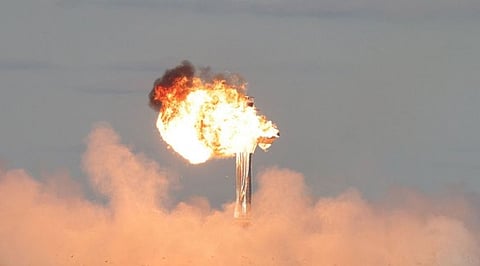
SpaceX detected an unspecified technical issue during the booster's return. Controllers subsequently abandoned the planned tower recovery and redirected the vehicle toward the Gulf of Mexico. The booster exploded during its offshore landing attempt.
SpaceX spokesperson Dan Huot addressed the incident during the company's live broadcast. He said engineers would investigate the circumstances surrounding the unsuccessful recovery. The company has yet to identify the exact cause of the technical problem.
SpaceX previously completed three Super Heavy booster recoveries using large mechanical arms attached to its launch tower. The company first demonstrated this recovery method in 2024 using an earlier booster design.
Friday's launch marked the first recovery attempt involving the upgraded Super Heavy booster. Its unsuccessful landing prevented SpaceX from completing both planned rocket recoveries during the same mission.
Meanwhile, the upper-stage spacecraft continued its ascent using six Raptor engines. Ship 42 subsequently completed its orbital insertion maneuver and entered Earth's orbit. The maneuver marked the second successful orbital flight for a Starship spacecraft. SpaceX achieved its first during the preceding test mission in September.
About one hour and 17 minutes after launch, the spacecraft deployed 26 third-generation Starlink satellites into low-Earth orbit. The deployment allowed SpaceX to complete another major objective despite the earlier booster failure.
Following the satellite release, SpaceX continued with its extended orbital flight. The company chose this approach rather than pursuing an earlier return involving a splashdown near Hawaii.
According to the official mission timeline, Starship will complete approximately 14 revolutions around Earth. The spacecraft will travel at an altitude of about 275 kilometers.
SpaceX expects the mission to last more than 22 hours. During that period, the spacecraft must pass several safety checkpoints before beginning its journey back through Earth's atmosphere.
Read More: SpaceX & Tesla Merger Could Unite USD 2.1 Billion in Bitcoin
SpaceX plans to bring the upper-stage spacecraft back to its Texas launch facility on Saturday, November 14. The operation would mark the company's first attempt to recover a Starship spacecraft returning from orbit.
Unlike the unsuccessful booster landing, the spacecraft recovery involves atmospheric reentry. Starship must endure extreme temperatures before reaching the launch facility and performing its final landing maneuver.
The company intends to guide the spacecraft toward its launch tower. Mechanical arms attached to the structure will then attempt to capture the vehicle. The mission also provides an opportunity to test Starship's thermal protection system under orbital reentry conditions. Its heat shield must protect the spacecraft as it travels through Earth's atmosphere.
Alongside the heat shield, the spacecraft's propulsion systems play a central role in the planned return. These systems must support the maneuvers necessary for the final recovery attempt.
SpaceX has invested billions of dollars in developing Starship and its reusable launch technology. The company ultimately aims to develop a spacecraft capable of carrying up to 100 metric tons of cargo into space.
SpaceX's 15th Starship mission encountered an early setback after its upgraded Super Heavy booster failed to complete its planned recovery. Nevertheless, the spacecraft reached orbit and deployed 26 Starlink satellites. Attention now turns to Saturday's planned upper-stage recovery and the investigation into the booster failure.